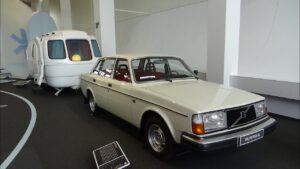
1953 Volvo PV444 – Auto Show Veterama Hockenheim 2015
The 1953 Volvo PV444 arrived at a time when Europe was rebuilding and private car ownership was becoming increasingly attainable. While its shape looked distinctly American-inspired, beneath the rounded bodywork was a compact and economical Swedish car designed for everyday realities. By 1953, the Volvo PV444 had already evolved from an ambitious post-war project into Volvo’s most important model, helping transform the company from a small manufacturer into a serious international automotive brand.
Technical Details
The 1953 Volvo PV444 was powered by Volvo’s B4B inline four-cylinder engine with a displacement of 1,414 cc. Depending on specification, output was approximately 44 horsepower, providing sufficient performance for both urban driving and longer journeys. The engine was mounted at the front and transmitted power to the rear wheels through a three-speed manual gearbox. The mechanical layout was conventional but carefully engineered for reliability and ease of maintenance.
One of the Volvo PV444’s most significant technical features was its unitary body construction. At a time when many competitors still relied on separate chassis designs, Volvo adopted a self-supporting steel body, improving rigidity while reducing weight. The front suspension used independent wishbones with coil springs, while the rear employed a live axle supported by leaf springs. Hydraulic drum brakes were fitted at all four corners.
The car’s engineering reflected Volvo’s growing focus on durability. Roads in Scandinavia could be challenging, especially during winter, and the Volvo PV444 was designed to withstand harsh conditions. The result was a vehicle that earned a reputation for robustness long before Volvo became internationally associated with reliability.
- Manufacturer: Volvo
- Model name: Volvo PV444
- Year of manufacturing: 1953
Design
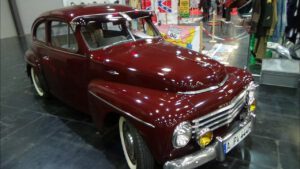
The design of the 1953 Volvo PV444 reflected the influence of American automotive styling trends of the late 1930s and early 1940s. Rounded fenders were integrated into the body, creating a smooth, streamlined appearance that contrasted sharply with the more upright shapes common before the war. The sloping roofline, prominent front grille, and curved rear section gave the car a modern appearance despite its relatively compact dimensions.
From the front, the Volvo PV444 presented a confident face, with a vertical grille flanked by integrated headlights. Chrome trim was used sparingly but effectively, adding visual interest without overwhelming the design. The car’s proportions balanced practicality with style, creating a shape that remained recognizable throughout the model’s long production life.
Inside, the cabin was straightforward and functional. Large windows provided good visibility, while the dashboard featured simple instrumentation arranged for easy reading. Seating was designed for comfort during long journeys, reflecting the fact that the Volvo PV444 was intended to serve as a genuine family car rather than merely a city runabout. The overall impression was one of practicality combined with a surprising degree of sophistication for its market segment.
Historical Significance
The Volvo PV444 occupies a central place in Volvo’s history because it was the model that established the company as a major automobile manufacturer. First presented in 1944, the car generated enormous interest despite the difficult circumstances of wartime Europe. Deliveries began after the war, and demand quickly exceeded Volvo’s production capacity.
By 1953, the model had become a cornerstone of the company’s success. The Volvo PV444 appealed to buyers who wanted a modern, reliable, and affordable car capable of handling Scandinavian conditions. Its self-supporting body construction and durable mechanical components distinguished it from many competitors in its class.
The model also played a key role in Volvo’s export ambitions. During the 1950s, Volvo increasingly targeted international markets, particularly the United States. The Volvo PV444 became one of the first Swedish cars to achieve meaningful export success abroad. Its reputation for durability and quality helped establish Volvo’s image internationally and laid the foundation for later export successes.
The Volvo PV444’s commercial success provided Volvo with the financial stability necessary to develop future models. Without the Volvo PV444, the company’s later achievements—including the Amazon, the 140 series, and the famous estate cars that followed—would have been far more difficult to achieve.
Quirks and Pop Culture
The Volvo PV444 was often nicknamed the “humpback Volvo” because of its distinctive rounded rear profile. This nickname remains widely used among enthusiasts today and immediately identifies the car within Volvo’s history.
Another interesting aspect of the Volvo PV444 was the contrast between its appearance and its origins. Many observers assumed the car was larger than it actually was because its styling echoed contemporary American automobiles. In reality, it was a compact European family car designed with economy and practicality in mind.
The model also became an important fixture in Swedish daily life during the 1950s. It appeared everywhere from city streets to remote rural communities, helping motorize a growing middle class. As a result, it occupies a nostalgic place in Swedish automotive culture and is frequently featured at historic vehicle events throughout Scandinavia.
Among collectors, the 1953 Volvo PV444 is particularly appreciated because it belongs to the model’s early development period, before many later refinements altered the character of the original design. It offers a glimpse into the moment when Volvo was defining the values that would shape the company for decades.
Display and preservation
We filmed this car at the Veterama Hockenheim 2015, held from March 20 to 22 at the legendary Hockenheimring. The circuit hosted Europe’s largest marketplace for classic car enthusiasts. Known as a “screwdrivers’ paradise,” the event ranged from rare treasures to forgotten relics, with vast areas filled with parts, tools, literature, and complete vehicles. Special highlights included a historic wall of death show and anniversary displays such as 40 years of the BMW 3 Series.
Conclusion
The 1953 Volvo PV444 was far more than a practical family car. Its durable engineering, modern unitary construction, and distinctive styling helped establish Volvo’s reputation both at home and abroad. By combining reliability, affordability, and everyday usability, the Volvo PV444 became the model that launched Volvo’s international success. More than seventy years later, it remains one of the most important vehicles in the company’s history and a lasting symbol of post-war Scandinavian automotive design.