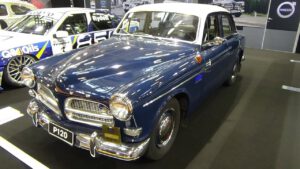
1958 Volvo Amazon P120 – Bologna Motor Show 2017
In 1958, the Volvo Amazon was still a relatively new model, yet it already signalled a major change in Volvo’s ambitions. Combining Italian-inspired styling with advanced safety thinking and robust Swedish engineering, the Volvo Amazon helped move Volvo beyond its reputation as a manufacturer of purely utilitarian cars. Few family sedans of the late 1950s balanced elegance, practicality, and durability quite so successfully.
Technical Details
The 1958 Volvo Amazon P120 was powered by Volvo’s B16 engine, a 1.6-litre inline four-cylinder unit with overhead valves. Depending on specification, output ranged from approximately 60 to 85 horsepower, with the more powerful versions using twin carburettors. Power was transmitted to the rear wheels through a three-speed manual gearbox, while overdrive was available on certain variants for more relaxed high-speed cruising.
The Volvo Amazon used a unitary steel body structure, continuing Volvo’s move away from separate chassis construction. The suspension featured independent front wheels with coil springs and a live rear axle suspended by coil springs and trailing arms. Hydraulic drum brakes were fitted as standard, although Volvo was already working toward more advanced braking systems that would appear later in the model’s production life. The combination of sturdy construction, dependable mechanical components, and predictable handling characteristics made the Volvo Amazon particularly well suited to long-distance driving and demanding road conditions.
- Manufacturer: Volvo
- Model name: Volvo Amazon P120
- Year of manufacturing: 1958
Design
The Volvo Amazon represented a striking departure from the rounded forms of the earlier PV444 and PV544. Its clean three-box silhouette, prominent grille, and carefully balanced proportions reflected contemporary European design trends while retaining a distinctly Scandinavian character. The body was designed under the direction of Jan Wilsgaard, who drew inspiration from Italian automotive styling without simply copying it.
Viewed from the side, the Volvo Amazon displayed crisp shoulder lines and restrained chrome detailing. The large glass area enhanced visibility and contributed to a feeling of openness within the cabin. Subtle tailfins at the rear reflected late-1950s fashion without dominating the overall design.
Inside, the Volvo Amazon offered a bright and practical environment. The dashboard layout emphasized clarity and ease of use, while high-quality materials and careful assembly reinforced Volvo’s growing reputation for durability. The seating position provided comfort during long journeys, and the spacious cabin made the car attractive to families seeking both practicality and style.
Historical Significance
The Volvo Amazon was introduced in 1956 as the successor to the PV444 in the company’s expanding passenger-car range. By 1958, production had gained momentum and the model was becoming increasingly important to Volvo’s future. It was designed to appeal not only to Swedish buyers but also to export markets, particularly elsewhere in Europe and North America.
The Volvo Amazon became one of the first Volvos to place a strong emphasis on passive safety. While the most famous innovation—the three-point safety belt—would arrive in 1959, the car’s structure and occupant protection philosophy already reflected Volvo’s growing interest in safety engineering. This focus would eventually become one of the company’s defining characteristics.
The model also marked an important stylistic evolution. Earlier Volvos had prioritized practicality above all else, whereas the Volvo Amazon demonstrated that a Volvo could be attractive as well as dependable. The car proved highly successful, remaining in production until 1970 and achieving sales of more than 660,000 units across all variants. Its commercial success helped establish Volvo as a significant international manufacturer during the post-war decades.
Quirks and Pop Culture
Although officially named “Amazon,” Volvo faced trademark challenges in several markets where the name was already registered. As a result, many export versions were marketed simply as the Volvo 120 Series or Volvo Amazon P120. This unusual naming situation means that enthusiasts today often use multiple names when referring to the same car.
The Volvo Amazon also became closely associated with Scandinavian reliability. Owners frequently drove their cars for hundreds of thousands of kilometres, and the model gained a reputation for surviving severe winters and rough roads with minimal complaint. This durability later made the Volvo Amazon popular in historic rallying, where its robust construction and predictable handling proved advantageous.
Another distinctive aspect of the model is its connection to Volvo’s safety heritage. Although the famous three-point seatbelt was introduced the following year, the Volvo Amazon became the vehicle most closely associated with the innovation. Consequently, the model occupies a special place not only in Volvo history but also in the broader history of automotive safety.
Display and preservation
This vehicle was filmed at the 2017 Bologna Motor Show. At the heart of the event stood the expanded “Passione Classica” pavilion, where legendary racing cars from leading Italian museums, private collections, and historic registries celebrated the rich heritage of motorsport. Historic Formula 1 and Historic Challenge races brought many of these icons back into action, while the Passione Classica Marketplace supported the preservation of classic vehicles and spare parts. The show also looked to the future by giving university students the opportunity to present and test their automotive prototypes. Beyond the exhibition grounds, Bologna itself became part of the experience through the “Motor Show OFF” programme, with city-centre squares transformed into spaces showcasing innovation and automotive culture.
Conclusion
The 1958 Volvo Amazon P120 represented a significant step forward for Volvo. Its robust engineering, modern unit-body construction, and elegant styling demonstrated that practicality and visual appeal could coexist in a family car. Historically, it helped transform Volvo into a more internationally oriented manufacturer while laying the foundations for the company’s later reputation for safety. More than six decades later, the Volvo Amazon remains one of Volvo’s most influential and recognisable models, admired for its combination of durability, understated style, and engineering integrity.