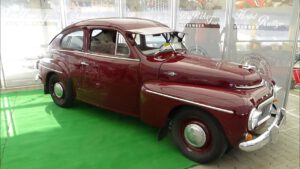
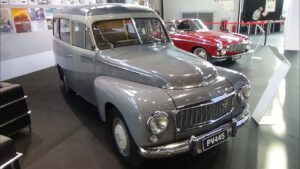
1962 Volvo PV544 – Auto Show Veterama Hockenheim 2015
By 1962, the Volvo PV544 no longer resembled the future of the automobile industry. Compact family cars across Europe were becoming flatter, wider, and visually lighter, while the PV544 still carried rounded contours inherited from the immediate post-war period. Yet the car’s continued success revealed something important about Volvo’s priorities: the company was less interested in annual styling revolutions than in refining a machine that customers already trusted completely.
Technical Details
The 1962 Volvo PV544 represented one of the mechanically most mature stages of the PV series. At the center of the car was Volvo’s increasingly respected B18 engine, a 1.8-liter inline four-cylinder unit that had transformed the PV544’s performance and durability characteristics. The engine used overhead valves and a five-bearing crankshaft, an unusually robust construction for a mass-market family sedan of the era. Depending on specification, output ranged from roughly 75 horsepower in standard versions to approximately 90 horsepower in more powerful Sport configurations equipped with dual carburetors.
Power was delivered through a rear-wheel-drive layout using a four-speed manual gearbox. Many higher-equipped versions were fitted with overdrive, allowing lower engine speeds during long-distance highway travel. This gave the 1962 PV544 notably relaxed cruising characteristics despite its relatively modest size.
The chassis reflected Volvo’s engineering conservatism. Independent front suspension used coil springs and wishbones, while the rear employed a solid axle suspended by leaf springs. Although technically traditional, the setup was extremely durable and capable of handling poor road conditions with little mechanical complaint. This robustness contributed heavily to the model’s strong reputation in Scandinavia, Britain, and export markets with rougher infrastructure.
One increasingly important feature by 1962 was braking performance. Front disc brakes had become available on parts of the PV544 range, significantly improving stopping consistency compared with fully drum-braked competitors. Combined with the car’s rigid structure and predictable handling, the PV544 developed a reputation for stability and control that aligned closely with Volvo’s growing safety-oriented image.
- Manufacturer: Volvo
- Model name: Volvo PV544
- Year of manufacturing: 1962
Design
The design of the 1962 Volvo PV544 deliberately resisted contemporary fashion trends. Instead of adopting dramatic fins or excessive chrome detailing, Volvo continued refining the established PV silhouette that had evolved from the earlier PV444 introduced in the 1940s.
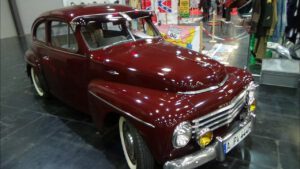
The body remained compact and upright, with a pronounced curved roofline and rounded rear section. The front fascia was clean and restrained, using a narrow grille and circular headlamps without ornamental excess. Thick body pillars and relatively small windows contributed to a sense of solidity rather than openness.
Inside, however, the 1962 model showed how far the PV544 had evolved beyond its origins. The cabin became more practical and ergonomically organized than earlier versions. Instruments were clear and functional, reflecting Volvo’s increasing focus on driver usability rather than decorative styling. Seating comfort improved, and the upright driving position provided excellent outward visibility, particularly useful during winter driving conditions.
Material choices also reflected Scandinavian priorities. Surfaces emphasized durability and functionality over luxury presentation. Volvo increasingly integrated safety considerations into interior design during this period, including padded dashboard sections and improved structural reinforcement around the passenger compartment.
One reason enthusiasts continue appreciating the PV544’s design is precisely because it avoided trend-driven excess. The car never attempted to appear futuristic. Instead, its shape communicated continuity, familiarity, and mechanical honesty.
Historical Significance
The 1962 Volvo PV544 illustrates the point at which Volvo’s international identity became firmly established. Earlier PV models had helped Volvo survive the post-war era, but by the early 1960s the company increasingly became recognized for qualities that later defined the brand globally: structural durability, safety awareness, and mechanical longevity.
Export success played an important role. In markets such as the United States, Canada, and Britain, the PV544 attracted buyers who valued reliability and winter capability more than fashion-conscious styling. The car’s reputation for surviving extremely high mileage became one of Volvo’s strongest marketing advantages.
The PV544 also remained closely tied to motorsport. By 1962, the model had already achieved major international rally victories, particularly through the efforts of Swedish driver Erik Carlsson. The car’s combination of strong traction, durable mechanicals, and manageable size made it highly competitive in endurance events on snow, gravel, and mud. These rally successes gave Volvo unexpected sporting credibility and demonstrated the toughness of the B18-powered platform.
At the same time, Volvo increasingly developed its broader safety philosophy during the PV544 era. Structural strength and occupant protection became engineering priorities long before many competitors treated them systematically. The PV544 therefore occupies an important transitional place in Volvo history: old in appearance, but increasingly modern in engineering philosophy.
Production of the PV544 continued because buyers remained loyal to its proven strengths. Rather than replacing it prematurely, Volvo refined the concept year after year until the model finally ended production in the mid-1960s.
Quirks and Pop Culture
The Volvo PV544 became famous partly because of how visually misleading it was. To outsiders, the rounded body shape suggested a slow and outdated family car. Yet in rally competition, PV544s routinely defeated more modern-looking machines under difficult conditions.
Another notable characteristic was the car’s durability in extreme climates. In Scandinavia especially, the PV544 developed a reputation for dependable cold-weather starting and strong performance on snow-covered roads. Owners often treated the cars less as collectible objects and more as permanent household tools.
The model also became deeply associated with practical middle-class Scandinavian life during the early 1960s. It served simultaneously as commuter vehicle, family transport, cargo carrier, and amateur competition machine. That versatility helped the PV544 achieve cultural importance beyond its production numbers.
Today, surviving 1962 PV544s are particularly valued among enthusiasts because they combine the stronger B18 mechanical package with the classic rounded body shape that disappeared from mainstream automotive design soon afterward.
Display and preservation
We filmed this car at the Veterama Hockenheim 2015, held from March 20 to 22 at the legendary Hockenheimring. The circuit hosted Europe’s largest marketplace for classic car enthusiasts. Known as a “screwdrivers’ paradise,” the event ranged from rare treasures to forgotten relics, with vast areas filled with parts, tools, literature, and complete vehicles. Special highlights included a historic wall of death show and anniversary displays such as 40 years of the BMW 3 Series.
Conclusion
The 1962 Volvo PV544 succeeded not because it embraced automotive fashion, but because it refined a proven formula with unusual discipline. Beneath its conservative exterior lay durable engineering, strong rally capability, and increasingly advanced safety thinking. The combination of the B18 engine, robust chassis design, and practical functionality helped transform the PV544 into one of the defining Volvos of the twentieth century. By 1962, the model represented far more than an aging family sedan: it had become the foundation of Volvo’s international reputation for resilience and engineering integrity.