1954 Volvo PV444 – Veterama Mannheim 2015
The 1954 Volvo PV444 looked modest beside larger American sedans and more flamboyant European sports cars, yet it became one of the vehicles that reshaped Sweden’s automotive industry after the Second World War. Its compact dimensions concealed unusually strong construction, and its success helped Volvo transform from a small regional manufacturer into an internationally recognized car company.
By the mid-1950s, the Volvo PV444 had already built a reputation for surviving difficult winters, poor road conditions and extremely high mileages. That durability would later make the model popular far beyond Scandinavia, especially among drivers who valued reliability over fashion.
Technical Details
The 1954 Volvo PV444 used a front-mounted inline four-cylinder engine driving the rear wheels through a manual gearbox. Most versions from this period were equipped with Volvo’s B4B engine, a 1.4-litre overhead-valve unit producing approximately 44 horsepower. While modest in output, the engine emphasized durability, fuel efficiency and ease of maintenance. A three-speed manual transmission was standard, though later variants introduced improved gearboxes and optional overdrive systems.
The car featured a unitary body structure rather than a separate body-on-frame chassis, a relatively advanced approach for a European family car in the 1940s and early 1950s. Independent front suspension with coil springs improved ride quality and handling stability compared with many competitors using more traditional setups. Hydraulic drum brakes were fitted on all four wheels. Engineers also paid considerable attention to structural rigidity, which contributed to the Volvo PV444’s reputation for safety and longevity.
The Volvo PV444’s mechanical layout was intentionally straightforward. Components were designed for easy servicing in harsh Nordic conditions, where cold temperatures and rough roads demanded reliability above all else. This engineering philosophy later became a defining characteristic of Volvo vehicles.
- Manufacturer: Volvo
- Model name: Volvo PV444
- Year of manufacturing: 1954
Design
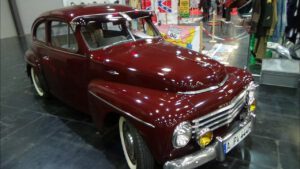
The Volvo PV444 carried clear American influences, particularly in its rounded bodywork and split windshield design seen on early examples. Its profile echoed the streamlined forms popular in the United States during the 1940s, though scaled down significantly for European roads and fuel prices. The sloping rear section, prominent fenders and compact proportions gave the car a distinctive silhouette that differed from the boxier sedans appearing elsewhere in Europe during the same period.
Chrome detailing remained relatively restrained. A simple front grille, rounded headlights and subtle bumper elements created a balanced appearance without excessive ornamentation. The design communicated solidity rather than luxury. Narrow tires and relatively tall body proportions reflected practical priorities, including good ground clearance for winter driving.
Inside, the Volvo PV444 offered a straightforward and functional cabin. Large gauges, simple switchgear and durable upholstery materials emphasized practicality. The seating position was upright, visibility was good and interior heating systems were particularly valued in Scandinavian climates. Compared with many small European cars of the early 1950s, the Volvo also provided comparatively generous luggage space and passenger comfort.
Historical Significance
Development of the Volvo PV444 began during the Second World War, although production started shortly afterward. Volvo introduced the model in 1944 during a period of material shortages and economic uncertainty. The company displayed the car before production was fully established, generating enormous public interest in Sweden. Thousands of advance orders reportedly arrived before the first customer cars were delivered.
The Volvo PV444 marked a major shift in Volvo’s direction. Earlier Volvo models had largely targeted limited domestic markets, but the Volvo PV444 created opportunities for broader exports. The car became particularly important in the United States during the 1950s, where buyers appreciated its durability, fuel economy and compact size at a time when most American vehicles remained very large.
The model also contributed to Volvo’s growing reputation for safety-conscious engineering. Although later Volvo cars became more closely associated with safety innovations, the Volvo PV444’s strong body construction and stable driving characteristics already reflected that philosophy. The car’s robust engineering allowed many examples to remain operational for decades, especially in Scandinavia where owners often repaired and maintained vehicles rather than replacing them quickly.
Production of the Volvo PV444 eventually paved the way for the later Volvo PV544, which introduced mechanical refinements while retaining much of the same basic structure and visual identity.
Quirks and pop culture
In Sweden, the Volvo PV444 became associated with postwar optimism and increasing personal mobility. For many families, it represented the possibility of independent travel at a time when car ownership was still expanding rapidly. Its reliability in winter conditions also earned it strong loyalty among rural drivers.
The model became known informally as the “Humpback Volvo” because of its curved rear body shape. In German-speaking regions, enthusiasts later adopted the nickname “Buckelvolvo.” That distinctive profile helped the car remain instantly recognizable even decades after production ended.
The Volvo PV444 also found a second life in motorsport and enthusiast culture. Amateur rally drivers appreciated the car’s durability and predictable handling, especially on gravel roads. In the United States, customized Volvo PV444s became popular among hot rod builders because the sturdy body and lightweight construction adapted well to engine modifications.
Today, restored Volvo PV444s frequently appear at classic car rallies across Scandinavia, Germany and the Netherlands. Many surviving examples continue to be driven regularly rather than treated solely as museum pieces, reflecting the model’s original character as a dependable everyday vehicle.
Display and preservation
This car was displayed at the Veterama Mannheim 2015, held from October 9 to 11 at the Maimarkt grounds. Spanning 260,000 square meters outdoors and 15,000 square meters of indoor space, the event offered everything from rare spare parts to complete classic vehicles. Dealers, restorers, accessory specialists, and publishers created a vibrant marketplace for collectors and hobbyists alike.
Conclusion
The 1954 Volvo PV444 succeeded not through extravagance or high performance, but through careful engineering, structural strength and practical usability. Its compact dimensions, reliable mechanical components and durable construction matched the needs of postwar motorists across Europe and beyond. At the same time, its rounded styling and distinctive proportions gave it a memorable identity that still stands out among classic cars today.
More importantly, the Volvo PV444 established principles that would shape Volvo for decades: durability, safety awareness and engineering designed for real-world driving conditions. That combination turned a modest Swedish sedan into one of the company’s most influential early successes.