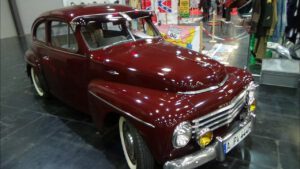
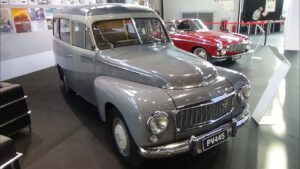
1955 Volvo Duett PV445 – Auto d’Epoca Padova 2017
Most classic Volvos are remembered for their role as family cars, but the Volvo Duett was designed with a broader mission. Introduced as a vehicle that could serve both work and private life, it helped define an entirely new category of practical automobiles. The 1955 Volvo Duett PV445 stands at an interesting point in that story, representing the period when Volvo’s versatile utility vehicle was becoming a familiar sight on Scandinavian roads, construction sites, farms, and small businesses.
Technical Details
The 1955 Volvo Duett PV445 was built on Volvo’s PV445 chassis, a robust platform derived from the company’s passenger-car engineering but adapted for commercial use. Power came from Volvo’s B4B inline four-cylinder engine with a displacement of 1,414 cc. The engine produced approximately 44 horsepower and was paired with a three-speed manual gearbox driving the rear wheels. While performance was modest by modern standards, the emphasis was on durability, simplicity, and ease of maintenance.
Unlike the self-supporting bodies that would become common later, the PV445 used a separate ladder-frame chassis. This construction allowed a variety of body styles to be fitted, including panel vans, pickups, ambulances, delivery vehicles, and estate cars. The sturdy rear suspension was designed to handle substantial payloads, making the Duett particularly attractive to tradespeople and rural users. Drum brakes were fitted on all four wheels, and the vehicle’s straightforward mechanical layout reflected Volvo’s focus on reliability under demanding conditions.
The chassis design was one of the Duett’s greatest strengths. It allowed owners to use the vehicle for commercial work during the week and family transportation on weekends, a concept that would later inspire Volvo’s long tradition of practical estate cars.
- Manufacturer: Volvo
- Model name: Volvo Duett PV445
- Year of manufacturing: 1955
Design
The design of the 1955 Volvo Duett PV445 prioritized function above fashion. Its appearance was dominated by a tall roofline, upright body sides, and a large cargo area. The front section closely resembled contemporary Volvo passenger cars, featuring rounded fenders, a simple grille, and integrated headlights. Behind the cabin, however, practicality took over.
The estate version offered generous cargo capacity and excellent accessibility through large rear doors. The high roof created a spacious interior that could accommodate both passengers and goods. Large windows provided excellent visibility, a valuable feature for commercial operators as well as families.
Inside, the cabin reflected the utilitarian nature of the vehicle. Controls were straightforward, materials were durable, and comfort was adequate rather than luxurious. Yet the interior possessed a welcoming simplicity that contributed to the Duett’s enduring charm. It was a vehicle designed to be used rather than admired, and its honest appearance remains one of its most appealing characteristics today.
Historical Significance
The Volvo Duett occupies a unique place in Volvo history because it effectively created the template for the company’s future estate-car philosophy. Introduced in 1953, the model was conceived as a vehicle capable of performing a “dual role,” which inspired the name “Duett.” Volvo recognized that many customers needed a vehicle that could combine commercial utility with private transportation.
The PV445 chassis provided the foundation for this concept. In Sweden during the 1950s, small business owners, farmers, craftsmen, and professionals often required a vehicle that could carry equipment during the workday while remaining suitable for family use. The Duett addressed this need exceptionally well.
Production expanded steadily throughout the decade, and the model became a familiar feature of Swedish daily life. The success of the Duett demonstrated the commercial viability of combining passenger-car comfort with cargo-carrying capability. This concept would later evolve into iconic Volvo estate models such as the Amazon Estate, 145, 245, and V70.
For Volvo, the Duett represented more than a successful product. It established a design philosophy centered on practicality, versatility, and durability—values that would become closely associated with the brand for decades.
Quirks and Pop Culture
The Volvo Duett earned a reputation as one of Sweden’s most versatile vehicles. It became popular with everyone from delivery companies and government agencies to families and outdoor enthusiasts. Because of its rugged chassis and adaptable body structure, many examples were converted into specialized vehicles, including ambulances, postal vans, and service vehicles.
In Sweden, the Duett became an enduring cultural symbol of the post-war years. It is often associated with the country’s period of economic growth during the 1950s and 1960s. Generations of Swedes grew up seeing Duetts in everyday use, giving the vehicle a nostalgic status that continues today.
The model also enjoys a strong following among classic-car enthusiasts. Its simple engineering makes restoration relatively straightforward, while its distinctive shape ensures immediate recognition. Unlike many collector cars that are admired for performance or rarity, the Duett is celebrated for its usefulness and honesty.
Another interesting aspect is that the Duett helped establish Volvo’s reputation for building vehicles capable of surviving decades of hard work. Many examples remained in active service long after newer vehicles had been retired, reinforcing the image of Volvo as a manufacturer of exceptionally durable automobiles.
Display and preservation
This car was shown at the Auto e Moto d’Epoca Padova 2017. The event took place from October, 26th to the 29th. Hosted at PadovaFiere, the event attracted over 115,000 visitors and presented more than 5,000 vehicles. Alongside the impressive display blending heritage, modern automotive trends, and passionate collectors, the event hosted Bonhams sales highlighting a shifting market.
Conclusion
The 1955 Volvo Duett PV445 was not designed to be glamorous or sporty. Instead, it excelled through practicality, versatility, and reliability. Its sturdy chassis, dependable four-cylinder engine, and adaptable body made it one of the most useful vehicles available in post-war Scandinavia. More importantly, it introduced a concept that would shape Volvo’s identity for generations: the idea that a vehicle could successfully combine work and family life. Today, the Volvo Duett PV445 remains an important milestone in automotive history and a clear precursor to the estate cars that would later become one of Volvo’s defining specialties.