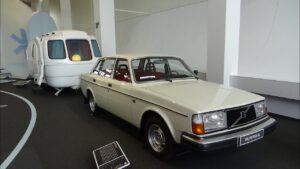
1978 Volvo P244 GL & Schäfer Suleica Rally 70 – Hymer Museum Bad Waldsee
The combination of a Volvo P244 GL and a Schäfer Suleica Rally 70 caravan captures a particular vision of European travel in the late 1970s. The Volvo represented safety, durability, and long-distance comfort, while the compact German caravan offered the freedom to explore without sacrificing basic conveniences. Together, they formed a practical touring outfit designed not for speed or luxury, but for weeks of reliable travel across Scandinavia, Germany, and beyond.
Technical Details
The 1978 Volvo P244 GL was powered by Volvo’s proven B21-series inline four-cylinder engine with a displacement of 2.1 litres. Depending on market specification, output ranged around 100 horsepower. Power was transmitted to the rear wheels through either a four-speed manual gearbox, often equipped with overdrive, or an automatic transmission. The 240-series platform featured independent front suspension, a solid rear axle, front disc brakes, and a structure engineered with a strong emphasis on occupant protection. These characteristics made the Volvo P244 GL particularly suitable as a towing vehicle, combining stability with durability.
The Schäfer Suleica Rally 70 caravan was designed as a lightweight touring caravan that could be comfortably towed by mid-sized European family cars. Its construction used a steel chassis with lightweight body panels to keep overall weight manageable. The caravan typically provided sleeping accommodation for two to four occupants and included essential camping equipment such as seating areas, storage compartments, cooking facilities, and electrical connections. Its relatively modest weight and compact dimensions made it a practical companion for vehicles such as the Volvo 244.
- Manufacturer (Car): Volvo
- Model name (Car): Volvo P244 GL
- Year of manufacturing (Car): 1978
- Manufacturer (Caravan): Schäfer
- Model name (Caravan): Suleica Rally 70
- Year of manufacturing (Caravan): Late 1970s
Design
The Volvo P244 GL reflected the design philosophy that would become synonymous with Volvo throughout the 1970s and 1980s. Its upright proportions, large glass areas, thin pillars, and clean body lines prioritized visibility and practicality. Chrome trim around the grille and windows distinguished the GL specification from more basic models, while the spacious interior offered comfortable seating and excellent ergonomics for long journeys. The design was intentionally restrained, communicating reliability rather than fashion.
The Schäfer Suleica Rally 70 followed a different set of priorities. The caravan’s boxy profile maximized interior volume while remaining compact enough for easy towing. Large side windows brought natural light into the cabin, and the interior was organized around efficient use of space. Folding tables, convertible seating, storage lockers, and compact kitchen facilities allowed the caravan to function as a temporary home. While visually simple, the design reflected the practical camping culture of the era, where functionality mattered more than ornamentation.
Historical Significance
The Volvo 240 series became one of the most successful models in Volvo’s history. By 1978, the Volvo P244 GL represented a mature version of a platform that had already earned a reputation for safety, reliability, and longevity. It appealed to families, professionals, and long-distance travellers alike. The model’s strong construction and dependable mechanicals also made it popular among caravan owners throughout Northern Europe, where towing stability and reliability were highly valued.
The Schäfer Suleica Rally 70 belonged to a period when caravan tourism was expanding rapidly across Western Europe. Improvements in road infrastructure and rising household incomes encouraged families to travel independently rather than rely solely on hotels. Manufacturers such as Schäfer responded by producing practical, affordable caravans that could be towed by ordinary passenger cars. The Rally 70 reflects this broader shift toward flexible, self-directed tourism during the 1970s.
Quirks and Pop Culture
The Volvo P244 GL developed a reputation for extraordinary durability. Many examples accumulated hundreds of thousands of kilometres while remaining in daily use. Among enthusiasts, the 240 series became known for surviving conditions that would retire less robust vehicles. The model also appeared frequently in Scandinavian films and television productions, where its familiar shape became part of everyday visual culture.
The Schäfer Suleica Rally 70 evokes a different kind of nostalgia. It recalls an era when summer holidays often involved crossing borders at a leisurely pace, staying at campsites, and travelling with much of the family’s household equipment in tow. Vintage caravans such as the Rally 70 have become increasingly popular at classic camping gatherings, where owners celebrate the aesthetics and travel culture of the 1960s, 1970s, and 1980s. When paired with a period-correct towing vehicle like the Volvo P244 GL, the combination offers an authentic glimpse into European holiday travel of the late twentieth century.
Display and preservation
This car was filmed at the Hymer Museum in Bad Waldsee. The museum presents the history of mobile travel through a refreshingly personal perspective. Across more than 6,000 square meters, over 80 historic caravans, motorhomes, and leisure vehicles guide visitors along iconic dream routes—from the Alps to North America. Many exhibits remain in original condition or have been carefully restored, preserving their authentic character. Supported by an extensive collection of around 250 vehicles and archival material, the museum emphasizes both technical development and cultural context. Its interactive approach ensures that the spirit of travel, innovation, and preservation remains vivid and accessible to every visitor.
Conclusion
The 1978 Volvo P244 GL and Schäfer Suleica Rally 70 represent two complementary approaches to practical mobility. The Volvo provided dependable engineering, comfort, and towing capability, while the caravan supplied compact living space and travel freedom. Together they formed a highly functional touring combination that reflected the growing popularity of independent road travel during the 1970s. Today, this pairing offers not only historical interest but also a vivid reminder of a period when the journey itself was often as important as the destination.