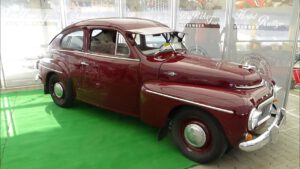
1953 Volvo PV444 – MotoTechnica Augsburg 2015
The Volvo PV444 was already a familiar sight on Swedish roads by 1953, but that year marked a turning point. It became Sweden’s best-selling passenger car, production accelerated significantly, and Volvo’s compact post-war model evolved from an ambitious project into a commercial success. The 1953 Volvo PV444 demonstrates how a relatively small manufacturer used practical engineering and careful development to build a reputation that would eventually reach far beyond Scandinavia.
Technical Details
The 1953 Volvo PV444 was powered by Volvo’s B4B engine, a front-mounted 1.4-litre inline four-cylinder unit with overhead valves. The engine produced approximately 44 horsepower and drove the rear wheels through a three-speed manual gearbox. While modest in output, the powertrain was designed for reliability and ease of maintenance rather than outright performance. One of the Volvo PV444’s most important technical features was its self-supporting monocoque body construction, a modern approach that improved rigidity while reducing weight compared with traditional body-on-frame designs. The front suspension employed independent control arms with coil springs, while the rear used a live axle supported by coil springs and shock absorbers. Hydraulic drum brakes provided stopping power on all four wheels. By 1953, Volvo had refined many details of the car, improving comfort, heating, durability, and overall build quality. These developments contributed to the model’s growing popularity and helped establish a reputation for robust engineering.
- Manufacturer: Volvo
- Model name: Volvo PV444
- Year of manufacturing: 1953
Design
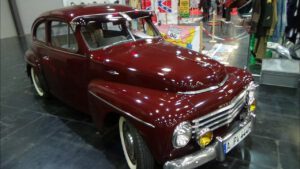
The Volvo PV444 stood apart from many contemporary European cars thanks to its distinctly American-inspired styling. Its rounded roofline, integrated fenders, and flowing fastback profile reflected trends that had emerged in the United States during the late 1930s and early 1940s. While the overall dimensions were compact by American standards, the visual impression was considerably more substantial than that of many European competitors.
The front featured a prominent grille flanked by round headlamps, while the curved body panels gave the car a smooth and cohesive appearance. The split front windscreen and divided rear window were characteristic features of the era and became closely associated with the model’s identity. Inside, the design emphasized practicality. Controls were clearly arranged, visibility was good, and the interior offered straightforward functionality. During the early 1950s Volvo gradually expanded trim and colour options, allowing buyers more choice than had been available immediately after the war. The result was a car that balanced conservative Scandinavian practicality with a surprisingly modern visual character.
Historical Significance
The Volvo PV444 originated during the Second World War, when Volvo sought to develop a smaller and more affordable passenger car for the post-war market. Although the prototype was unveiled in 1944, production did not begin until 1947 because of material shortages and industrial constraints. By 1953, however, the model had matured considerably and become a central part of Volvo’s business.
That year proved especially important because the Volvo PV444 became Sweden’s best-selling automobile. Production volumes increased substantially, demonstrating the growing confidence of both consumers and the company itself. The success of the Volvo PV444 helped Volvo expand its manufacturing operations and provided the financial foundation for future development. The model also introduced engineering principles that would remain associated with Volvo for decades, including durable construction, practical design, and a strong emphasis on safety-oriented structural integrity.
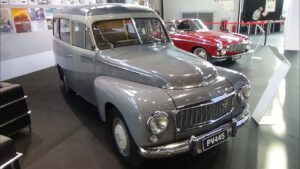
Another significant development during 1953 was the introduction of the Volvo PV445 Duett, a utility and estate derivative based on the same mechanical platform. Together, the Volvo PV444 and Duett broadened Volvo’s appeal and helped transform the company from a niche Scandinavian manufacturer into a growing international automotive brand.
Quirks and Pop Culture
The Volvo PV444 became widely known by the nickname “Buckelvolvo,” or “Humpback Volvo,” a reference to its rounded rear profile. What began as a descriptive term eventually became a badge of affection among owners and enthusiasts. The nickname remains closely associated with the model today.
The car earned a reputation for surviving difficult road conditions and harsh Nordic winters, making it popular in rural areas as well as cities. Owners frequently praised its durability and straightforward mechanical design. In later decades, many Volvo PV444s found a second life in historic motorsport, particularly rallying, where their sturdy construction and dependable engines proved advantageous.
The Volvo PV444 also played an important role in shaping public perceptions of Volvo. Long before the company became internationally associated with safety and durability, the Volvo PV444 demonstrated those qualities in everyday use. As a result, it became one of the foundational vehicles in Volvo’s corporate story and remains a popular exhibit at automotive museums and classic-car gatherings throughout Scandinavia.
Display and preservation
This car was shown at the MotoTechnica Augsburg 2015. Held on January 10 and 11, the event marked the 16th edition of this popular gathering for classic vehicle enthusiasts. Around 500 exhibitors and approximately 20,000 visitors filled 20,000 square meters of indoor space and 10,000 square meters outdoors. The event combined rare vehicles—from microcars to American cruisers—with club displays, a model car exchange, and a vast parts market. A major highlight was the open classic car meeting, welcoming pre-1985 vehicles.
Conclusion
The 1953 Volvo PV444 represents a crucial chapter in Volvo’s development. Its reliable engineering, modern monocoque construction, and distinctive styling helped make it Sweden’s best-selling car and provided the foundation for Volvo’s future growth. More than simply a successful family automobile, the Volvo PV444 established many of the values that would later define the brand. Today, its characteristic “humpback” silhouette and reputation for durability ensure its place among the most significant Scandinavian automobiles of the post-war era.