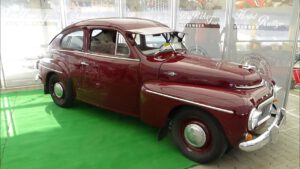
1946 Volvo PV60 – Classic-Gala Schwetzingen 2015
The Volvo PV60 was already an old design when production finally began after the Second World War. Conceived before the conflict but delivered into a completely different post-war Europe, it became Volvo’s last passenger car with a separate chassis and traditional pre-war engineering. The 1946 model therefore stands at a fascinating crossroads between two automotive eras: one ending and another just beginning.
Technical Details
The 1946 Volvo PV60 was powered by a front-mounted 3.0-litre inline six-cylinder engine with side valves. The engine displaced 3,670 cc and produced approximately 90 horsepower, making it one of the most powerful Swedish passenger cars available immediately after the war. Power was transmitted to the rear wheels through a three-speed manual gearbox with synchromesh on the upper gears.
Unlike Volvo’s later passenger cars, the Volvo PV60 used a traditional body-on-frame construction. The robust ladder chassis provided durability and flexibility but added weight compared with the unitary body designs that would soon become common. Independent front suspension with coil springs improved ride comfort, while the rear axle was suspended on leaf springs. Hydraulic drum brakes were fitted on all four wheels. The combination of a large six-cylinder engine and substantial chassis gave the Volvo PV60 smooth performance and comfortable cruising characteristics, qualities valued by business users and government officials in the immediate post-war years.
- Manufacturer: Volvo
- Model name: Volvo PV60
- Year of manufacturing: 1946
Design
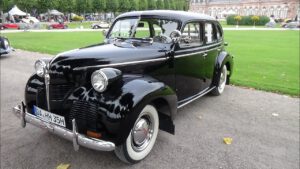
The design of the Volvo PV60 reflected its origins in the late 1930s. Development began before the outbreak of the Second World War, and the styling retained many characteristics of contemporary American automobiles. The body featured flowing fenders integrated into the overall shape, a long hood accommodating the six-cylinder engine, and a prominent upright grille.
Compared with Volvo’s smaller post-war models, the Volvo PV60 projected a sense of formality and prestige. Chrome trim was used sparingly but effectively, emphasizing the car’s status without excessive ornamentation. The proportions were substantial, reflecting its role as Volvo’s flagship passenger car.
Inside, the cabin prioritized comfort and space. Broad seats, generous legroom, and a wide dashboard created an environment suited to long-distance travel. The controls followed traditional pre-war layouts, emphasizing simplicity and durability rather than innovation. The overall impression was one of solid craftsmanship and understated elegance, characteristics that appealed to professional and official buyers.
Historical Significance
The Volvo PV60 occupies a unique place in Volvo history because it was effectively a pre-war car introduced into the post-war market. Development began around 1941, but wartime conditions prevented production. When peace returned, Volvo chose to proceed with the project because demand for new vehicles was exceptionally strong and developing an entirely new model would have required additional time and resources.
As a result, the Volvo PV60 entered production in 1946 carrying design and engineering principles from an earlier era. While this made it somewhat conservative compared with newer international competitors, it also provided customers with a proven and reliable vehicle during a period when many manufacturers were struggling to resume production.
The model became Volvo’s final passenger car to use a separate chassis. Future Volvo cars would increasingly adopt unit-body construction and more modern engineering concepts. In this sense, the Volvo PV60 represents the end of Volvo’s traditional pre-war lineage, while models such as the PV444 pointed toward the company’s future. Production continued until 1950, with approximately 3,000 examples built, making the car relatively uncommon even during its own period.
Quirks and Pop Culture
The PV60 is often overshadowed by the PV444, which arrived shortly afterward and transformed Volvo’s fortunes. Yet this contrast is precisely what makes the Volvo PV60 interesting. While the PV444 symbolized post-war modernity, the Volvo PV60 remained rooted in the automotive thinking of the 1930s and early 1940s.
A particularly unusual chapter in the model’s history concerns the chassis. After passenger-car production ended, Volvo used a number of remaining Volvo PV60 chassis as the basis for commercial and special-purpose vehicles. Some were supplied to coachbuilders who created hearses, ambulances, and other specialist bodies, extending the platform’s usefulness well beyond its original role.
The Volvo PV60 also gained a reputation among enthusiasts for the smoothness of its large six-cylinder engine. While later Volvos became known for efficiency and practicality, the Volvo PV60 offered a level of refinement and effortless cruising ability rarely associated with the brand today. As a result, surviving examples are valued not only for their rarity but also for representing a distinctly different chapter in Volvo’s history.
Display and preservation
This vehicle was filmed at the 2015 Classic-Gala Schwetzingen. Held from 4 to 6 September in the magnificent gardens of the Baroque palace, the show attracted more than 20,000 visitors who gathered to admire over 200 carefully preserved vehicles representing every era of motoring. Rare classics, distinguished collector cars, and historic automobiles from clubs and specialist exhibitors created a remarkable display within one of Germany’s most impressive palace settings.
Conclusion
The 1946 Volvo PV60 was a car born in one era and delivered in another. Its powerful six-cylinder engine, separate chassis construction, and American-influenced styling reflected pre-war automotive values, while its post-war production helped Volvo bridge the gap to a new generation of vehicles. Historically significant as Volvo’s last traditional flagship and final passenger car with body-on-frame construction, the Volvo PV60 remains an important milestone in the company’s evolution. Today it serves as a reminder of the transitional years when European manufacturers were rebuilding and redefining themselves after the Second World War.