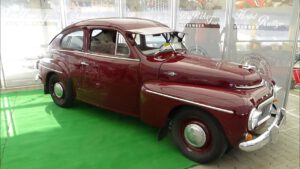
1912 Ford Model T Touring – Retro Classics Stuttgart 2018
The 1912 Ford Model T Touring arrived during the years when the automobile was beginning to establish itself as practical family transportation rather than an expensive curiosity. More spacious and versatile than the smaller Runabout, the Touring version became one of the most recognizable body styles in the Ford Model T range. Its open body, simple engineering, and comparatively accessible price helped introduce large numbers of people to motoring for the first time.
Technical Details
The 1912 Ford Model T Touring used the same core mechanical layout as the broader Ford Model T family. Power came from a front-mounted inline four-cylinder gasoline engine with a displacement of 2.9 liters (177 cubic inches). Producing approximately 20 horsepower, the engine emphasized reliability and low-speed torque rather than outright performance. Depending on road conditions and passenger load, the car could achieve top speeds of around 65–70 km/h.
Like other Model Ts of the period, the Touring employed Ford’s planetary two-speed transmission. Operated through pedals and hand controls instead of a conventional gear lever, the system simplified driving for inexperienced owners at a time when many motorists were completely unfamiliar with automobiles. Power was transmitted to the rear wheels through a driveshaft enclosed in a torque tube, contributing to durability and ease of maintenance.
The chassis relied on transverse semi-elliptical leaf springs at both front and rear axles, providing generous suspension movement over rough and uneven roads. Lightweight vanadium steel components improved structural strength while keeping weight relatively low. Braking remained mechanically simple, centered around a transmission brake supported by separate rear-wheel mechanical brakes.
Compared with lighter variants such as the Runabout, the Touring carried additional weight due to its larger body and expanded passenger accommodation. Nevertheless, its mechanical simplicity made it practical to maintain even in rural areas with limited access to professional servicing or spare parts.
- Manufacturer: Ford Motor Company
- Model name: Ford Model T Touring
- Year of manufacturing: 1912
Design
The design of the 1912 Ford Model T Touring reflected the practical priorities of early twentieth-century motoring. The Touring body style offered seating for up to five passengers, making it well suited to family use and longer journeys. Its open-body configuration remained typical for the period, when fully enclosed automobiles were still comparatively expensive and less common.
The exterior retained the familiar brass-era Ford appearance. An upright brass radiator surround, exposed circular headlamps, curved fenders, and narrow hood proportions gave the car its characteristic early automotive identity. The elevated ride height reflected the realities of poor road infrastructure rather than stylistic ambition.
Large wooden artillery wheels and narrow tires reinforced the lightweight, utilitarian nature of the vehicle. A folding canvas roof provided limited weather protection, while removable side curtains could be attached during rain or colder conditions. Entry to the rear seating area was straightforward thanks to the open-sided layout and integrated running boards.
Inside, the Touring featured simple bench seating and minimal instrumentation. Controls remained exposed and functional rather than decorative. The cabin prioritized passenger capacity and practicality over luxury, yet the open design also contributed to a strong sense of freedom and visibility that became closely associated with early motoring culture.
Historical Significance
The Ford Model T Touring played a major role in expanding automobile ownership beyond wealthy urban buyers. By 1912, Ford was already refining production methods that would soon culminate in the moving assembly line introduced in 1913. The Touring body style became especially important because it appealed directly to families seeking practical transportation rather than recreational novelty.
The versatility of the Touring helped demonstrate the broader usefulness of the automobile. Owners used these cars for commuting, rural travel, social visits, agricultural work, and small-business transport. In many regions, the Ford Model T became the first automobile capable of handling rough roads consistently enough to replace horse-drawn transport in everyday life.
Henry Ford’s emphasis on affordability and standardized production transformed the economics of car manufacturing. As production expanded and prices gradually declined, the Touring model became one of the clearest examples of mass mobility entering ordinary households. Over the course of production, the wider Model T range exceeded 15 million units, making it one of the most influential automobiles in history.
The Touring version in particular became symbolic of early family motoring. It allowed passengers to travel farther and more independently than previous generations, reshaping patterns of work, leisure, and social interaction.
Quirks and Pop Culture
The Ford Model T quickly earned the nickname “Tin Lizzy,” a name that reflected both affection and familiarity. The Touring model became one of the most visible representatives of this identity because of its popularity and widespread use.
One of the car’s most unusual features for modern observers is its driving system. The pedal-operated planetary transmission differs completely from later manual or automatic gearboxes, giving the Ford Model T a driving experience unlike almost any modern car. Learning to drive one became part of the early culture of motoring.
The Touring also became strongly associated with rural and small-town life. Families used it for weekend outings, church visits, and journeys that would previously have required trains or horse-drawn wagons. Because the Ford Model T was mechanically straightforward, owners often repaired and modified the cars themselves, reinforcing its image as a practical and adaptable machine.
In period photography and silent-era film, the open Touring body became one of the defining visual symbols of the early automobile age. Its folding roof, exposed seating, and upright stance continue to evoke the earliest years of accessible mass transportation.
Display and preservation
This car was filmed at the 18th edition of Retro Classics Stuttgart in 2018. This is one of Europe’s premier classic car gatherings, attracting around 87,000 visitors and spread across 140,000 square meters. The exhibition offered a rich blend of international dealers, clubs, specialists, and parts suppliers. Unique highlights included the Neo Classics segment, showcasing modern coachbuilt and one-off creations, alongside themed halls such as the chrome-filled American Way of Drive. From pre-war automotive artistry to rare Soviet state limousines, the event celebrated preservation through diversity, craftsmanship, and historical depth.
Conclusion
The 1912 Ford Model T Touring distilled the central ideas behind Henry Ford’s automotive vision into a highly practical family vehicle. Its reliable four-cylinder engine, planetary transmission, and durable chassis made it suitable for everyday use across a wide variety of conditions. The open Touring body emphasized passenger capacity and flexibility while maintaining the simplicity that defined the Model T philosophy. Historically, it helped normalize automobile ownership for ordinary households and contributed directly to the rise of mass mobility. More than a century later, the Ford Model T Touring remains one of the clearest representations of how the automobile entered everyday life on a truly industrial scale.