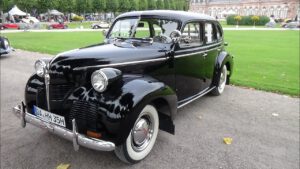
1912 Ford Model T – Retro Classics Stuttgart 2018
By 1912, the Ford Model T was no longer an experiment in affordable motoring. It had already become a machine that altered the rhythm of daily life. Doctors used it to reach remote patients, farmers adapted it to rural work, and entire families encountered long-distance travel for the first time behind its simple steering wheel. The 1912 model sits at an interesting midpoint: early enough to retain many Brass Era characteristics, yet already unmistakably part of the industrial future Henry Ford was building.
Technical Details
The 1912 Ford Model T used a front-mounted inline four-cylinder petrol engine with a displacement of 2.9 liters (177 cubic inches). The engine produced approximately 20 horsepower and transmitted power to the rear wheels through Ford’s distinctive two-speed planetary transmission. Unlike later manual gearboxes with a conventional gear lever and clutch pedal arrangement, the Ford Model T relied on a pedal-operated planetary system that many first-time drivers initially found confusing. One pedal selected low gear, another engaged reverse, while a hand lever controlled parking and high gear operation.
The engine block and cylinder head were cast as a single unit, a relatively advanced manufacturing solution for the time. Vanadium steel was used extensively throughout the chassis and suspension, giving the Ford Model T unusual durability on poor roads. Semi-elliptic leaf springs handled suspension duties front and rear, while braking remained mechanically simple, relying primarily on transmission braking supplemented by rear wheel parking brakes.
The car was designed to tolerate rough surfaces, inconsistent fuel quality, and limited maintenance infrastructure. Its relatively high ground clearance made it practical on unpaved rural roads, while the simplicity of the mechanical layout allowed owners to carry out repairs themselves. In 1912, this mattered enormously. Many owners lived far from professional workshops and depended on the car’s ability to remain serviceable with basic tools and mechanical knowledge.
- Manufacturer: Ford Motor Company
- Model name: Ford Model T
- Year of manufacturing: 1912
Design
The 1912 Ford Model T still carried clear visual traces of the Brass Era automobile. Tall narrow wheels, exposed fenders, upright proportions, and a relatively high seating position reflected carriage design traditions that had not yet fully disappeared from automotive styling. Unlike later streamlined cars of the 1920s and 1930s, the Ford Model T presented its mechanical structure openly and honestly.
The radiator stood vertically at the front, framed by brass lighting equipment and simple body panels. The hood was narrow and long, emphasizing the engine compartment rather than passenger luxury. Most body styles remained open to the elements, with folding canvas tops rather than permanent enclosed cabins. Interiors were sparse, using durable materials and straightforward layouts rather than decorative excess.
What makes the 1912 version visually interesting is its transitional quality. Earlier automobiles often appeared delicate and handcrafted, while later mass-produced cars became more standardized and enclosed. The 1912 Ford Model T sits directly between these worlds. It still looked mechanical and lightly built, yet it was already being manufactured in quantities previously unimaginable in the automotive industry.
Historical Significance
The importance of the 1912 Ford Model T lies not only in the car itself, but in the broader industrial system surrounding it. Ford had not yet fully perfected the moving assembly line that would later define modern automobile production, but the company was already reorganizing manufacturing around interchangeability, standardization, and efficiency. The 1912 Ford Model T therefore belongs to the period just before Ford’s production revolution reached full scale.
Henry Ford’s central idea was straightforward but radical: build a car inexpensive enough that ordinary workers could realistically own one. Prior to this period, automobiles largely remained luxury objects or specialist machines for wealthy enthusiasts. The Ford Model T disrupted this pattern by reducing complexity and prioritizing large-scale production over exclusivity.
The timing was also significant. In the years immediately before the First World War, road networks improved rapidly and demand for personal mobility expanded. The Ford Model T became deeply integrated into this transformation. In North America especially, it helped connect isolated communities and reshaped commercial activity in rural regions. Its influence reached beyond transport itself, affecting settlement patterns, retail distribution, tourism, and agricultural work.
The 1912 model also belongs to the era before Ford standardized black paint exclusively. Contrary to popular myth, early Ford Model Ts appeared in several colors, including red, blue, green, and gray. The later association of the Ford Model T solely with black emerged primarily from production efficiency considerations after 1913.
Quirks and Pop Culture
The Ford Model T generated an unusual culture of improvisation around itself. Owners modified the cars constantly, often out of necessity. Rural drivers converted them into sawmills, tractors, water pumps, and snow vehicles. Accessory manufacturers sold countless aftermarket parts ranging from heating systems to auxiliary truck bodies. In many areas, the Ford Model T became less a finished product than a mechanical platform adaptable to almost any purpose.
One curious aspect of early Ford Model T ownership was the learning process required to drive one properly. The unconventional pedal arrangement confused many new owners accustomed either to horses or to later automotive controls. Contemporary accounts describe beginners accidentally launching the car forward or stalling it while trying to understand the planetary transmission.
The car also developed an enormous joke culture during the 1910s and 1920s. Newspapers and vaudeville routines regularly featured Ford Model T humor, often focusing on breakdowns, rattles, difficult starting procedures, or overloaded family journeys. Rather than damaging the car’s reputation, these jokes reinforced its familiarity. The Ford Model T had become so common that nearly everyone understood the references.
Even today, the phrase “Tin Lizzie” remains associated with the Ford Model T, although the nickname only became widespread after the car was already firmly established. Its cultural presence survives because the Ford Model T was among the first automobiles to become part of ordinary life rather than an object of spectacle.
Display and preservation
This car was filmed at the 18th edition of Retro Classics Stuttgart in 2018. This is one of Europe’s premier classic car gatherings, attracting around 87,000 visitors and spread across 140,000 square meters. The exhibition offered a rich blend of international dealers, clubs, specialists, and parts suppliers. Unique highlights included the Neo Classics segment, showcasing modern coachbuilt and one-off creations, alongside themed halls such as the chrome-filled American Way of Drive. From pre-war automotive artistry to rare Soviet state limousines, the event celebrated preservation through diversity, craftsmanship, and historical depth.
Conclusion
The 1912 Ford Model T captures an important transition in automotive history. Technically, it remained rooted in early motoring traditions, with exposed mechanical components, a planetary transmission, and carriage-inspired proportions. Yet historically, it already pointed toward the industrial future of mass production and widespread car ownership. Its design emphasized practicality, durability, and adaptability rather than status. More importantly, the 1912 Ford Model T helped normalize the idea that mobility could belong to ordinary people. That shift would permanently transform transportation, industry, and everyday life across much of the world.