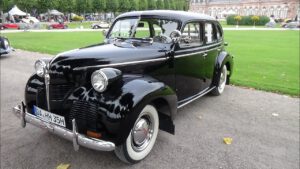
1912 Ford Model T Touring – Retro Classics Stuttgart 2024
The 1912 Ford Model T Touring arrived at a moment when the automobile was beginning to reshape daily life beyond wealthy urban circles. More spacious than the Runabout and versatile enough for family travel, the Touring model became one of the most recognizable versions of the Ford Model T. It combined mechanical simplicity with enough passenger capacity to serve both practical and social purposes, helping establish the car as an everyday presence across rural roads and growing towns alike.
Technical Details
The 1912 Ford Model T Touring used the same mechanical foundation as the broader Model T range. Power came from a front-mounted inline four-cylinder gasoline engine with a displacement of 2.9 liters (177 cubic inches). Producing approximately 20 horsepower, the engine was designed less for speed than for reliability and ease of maintenance. The car could reach speeds of roughly 65–70 km/h, depending on road conditions and load.
A defining technical feature of the Model T was its two-speed planetary transmission. Operated through pedals and hand levers instead of a conventional gear lever, the system simplified operation for many first-time drivers, even if it appears unusual by modern standards. Power was sent to the rear wheels through a driveshaft enclosed within a torque tube, a durable arrangement suited to rough roads and long-distance use.
The chassis relied on transverse semi-elliptical leaf springs front and rear, giving the Touring considerable suspension movement over uneven terrain. Ford’s use of lightweight vanadium steel contributed to durability while helping reduce overall weight. Braking remained basic, centered around a transmission brake supported by mechanical rear-wheel parking brakes.
Compared with smaller body styles such as the Runabout, the Touring carried additional weight due to its larger passenger compartment and folding rear seating area. Nevertheless, the Model T’s straightforward engineering and interchangeable parts made servicing relatively simple, a major advantage in areas with limited automotive infrastructure.
- Manufacturer: Ford Motor Company
- Model name: Ford Model T Touring
- Year of manufacturing: 1912
Design
The 1912 Ford Model T Touring was designed around practicality and passenger capacity. Unlike the compact two-seat Runabout, the Touring offered seating for up to five passengers, making it more suitable for family transport and longer journeys. Its open-body configuration reflected the prevailing automotive design language of the early 1910s, when enclosed cabins remained comparatively expensive and uncommon.
The exterior retained the familiar brass-era Ford appearance, with a tall radiator shell, exposed circular headlamps, flowing fenders, and narrow hood proportions. The elevated ride height was not stylistic excess but a response to primitive road conditions. Large wooden artillery wheels and narrow tires reinforced the lightweight, utilitarian character of the vehicle.
The Touring’s folding canvas roof could be raised for basic weather protection, while removable side curtains provided limited shielding from rain and wind. Entry to the rear seats was facilitated by an open-sided layout and simple step plates mounted below the doors. The body itself remained visually restrained, prioritizing utility over ornamentation.
Inside, the Touring featured straightforward bench seating upholstered in durable materials. Instrumentation was minimal, with most controls concentrated around the steering column and pedal-operated transmission system. Despite its simplicity, the Touring conveyed a sense of openness and freedom that became closely associated with early automobile travel.
Historical Significance
The Ford Model T Touring played a major role in expanding automobile ownership in the United States and beyond. By 1912, Ford was already refining production methods that would soon culminate in the moving assembly line introduced the following year. The Touring body style became especially important because it appealed to families and middle-class buyers seeking practical transportation rather than novelty or luxury.
The Touring also demonstrated how adaptable the Model T platform could be. Owners used these cars for commuting, long-distance rural travel, farming tasks, and small business operations. In many parts of North America, the Model T became the first automobile capable of handling poor roads consistently enough to replace horse-drawn transport on a daily basis.
Henry Ford’s emphasis on standardization and affordability transformed the economics of automobile manufacturing. As prices gradually declined, the Touring helped normalize car ownership for ordinary households. The broader Model T range ultimately surpassed 15 million units in production, making it one of the most influential automobiles ever built.
The Touring variant in particular became symbolic of early family motoring. It represented the transition from isolated local travel to flexible personal mobility, allowing people to travel farther and more independently than previous generations.
Quirks and Pop Culture
Few automobiles became as culturally recognizable as the Ford Model T. The nickname “Tin Lizzy” became closely associated with the entire range, including the Touring model, reflecting the car’s humble appearance and dependable reputation.
One of the more unusual aspects of the Touring was its driving system. Modern drivers often find the pedal-operated transmission confusing, but during the 1910s it was considered approachable for newcomers with no prior motoring experience. Learning to operate the Model T became almost a rite of passage for early motorists.
The Touring also became deeply connected to American rural life. Families used it for weekend outings, church visits, and cross-country journeys at a time when paved roads remained limited. Owners frequently improvised repairs themselves, contributing to the Model T’s image as a machine that encouraged mechanical self-reliance.
In popular memory and period photography, the open Touring body became one of the defining visual symbols of the brass-era automobile. Its folding roof, crowded bench seating, and exposed driving environment continue to evoke the earliest years of mass motoring.
Display and preservation
The vehicle was presented at Retro Classics Stuttgart 2024, one of Europe’s largest gatherings for historic mobility. From 25 to 28 April 2024, more than 70,000 visitors explored around 80,000 square metres of exhibition space, with over 2,000 classic vehicles displayed across six packed halls. The show combined strong commercial activity with carefully curated anniversary themes, including 50 years of the Porsche 911 Turbo, 60 years of the Ford Mustang, and 70 years of the Mercedes-Benz 300 SL “Gullwing” with a special exhibition on tuning culture from the 1970s to the 1990s.
Conclusion
The 1912 Ford Model T Touring captured the central ideas behind Henry Ford’s automotive vision: affordability, durability, and everyday usability. Technically straightforward yet highly adaptable, it combined a reliable four-cylinder engine with a lightweight chassis and spacious open-body design. Its practical layout made automobile ownership realistic for families and rural buyers, while its historical importance lies in helping transform the car from a luxury object into a normal part of daily life. Through its widespread use, distinctive controls, and enduring cultural identity, the Model T Touring became one of the defining automobiles of the early twentieth century.