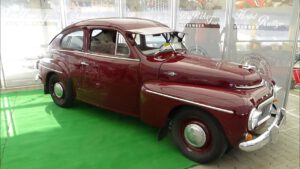
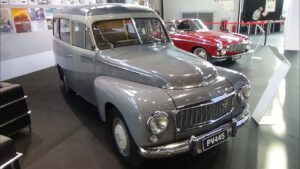
1956 Volvo PV444 – Oldtimer Meeting Baden-Baden 2015
The 1956 Volvo PV444 belonged to a generation of European cars built during reconstruction rather than abundance. Compact, mechanically straightforward and unusually solid for its class, it became one of the vehicles that helped normalize private car ownership in Sweden during the postwar years. Its rounded body shape already looked rooted in an earlier decade, yet buyers continued to trust the model because it consistently handled difficult weather, long distances and demanding daily use.
Outside Scandinavia, the Volvo PV444 gradually earned recognition for another reason: longevity. At a time when many small European cars were viewed as disposable, Volvo’s compact sedan developed a reputation for surviving decades of regular use with remarkably little mechanical drama.
Technical Details
The 1956 Volvo PV444 was powered by Volvo’s B16 inline four-cylinder engine, an overhead-valve unit with a displacement of 1.6 litres. Depending on version and carburetor configuration, power output ranged around 60 horsepower. The engine drove the rear wheels through a manual transmission, typically a three-speed gearbox with column-mounted shifting on many versions. The mechanical layout prioritized simplicity, serviceability and reliability over outright performance.
The Volvo PV444 used a unibody construction, which remained relatively modern for a European family sedan of its era. Independent front suspension with coil springs improved ride comfort and road holding, while the rear axle used a durable leaf-spring arrangement capable of tolerating uneven rural roads and heavy use. Hydraulic drum brakes were fitted at all four corners.
One of the car’s defining technical characteristics was structural rigidity. Volvo engineers designed the body to withstand demanding Nordic driving conditions, including rough gravel roads and severe winter weather. Heating and ventilation systems also received considerable attention compared with many contemporaries, an important practical feature in Scandinavia. Fuel consumption remained moderate, and the car’s mechanical components became known for surviving extremely high mileages when maintained properly.
- Manufacturer: Volvo
- Model name: Volvo PV444
- Year of manufacturing: 1956
Design
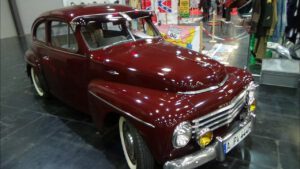
The Volvo PV444 combined American-inspired styling cues with distinctly Scandinavian restraint. Its curved roofline, integrated front fenders and rounded rear bodywork reflected trends that had emerged in the United States during the 1940s, though adapted to a smaller and more practical European format. The compact proportions suited narrow roads and limited parking spaces while still offering a relatively spacious cabin for a car of its size.
The front end featured round headlights, a modest chrome grille and carefully integrated bumpers that emphasized symmetry rather than ornamentation. Unlike many mid-1950s American cars, the Volvo PV444 avoided excessive decorative details. Its appearance communicated solidity and practicality more than status.
Inside, the cabin layout remained straightforward and functional. Large gauges, simple switchgear and durable upholstery materials reflected Volvo’s utilitarian engineering culture. The high roofline improved headroom, while upright seating positions enhanced visibility. The dashboard design prioritized clarity over visual experimentation, making the car easy to operate in poor weather or during long-distance travel.
Paint colors offered during the mid-1950s often reflected broader automotive trends of the era, including muted blues, greys, greens and cream tones. Chrome hubcaps and whitewall tires occasionally added a more fashionable touch without fundamentally altering the car’s restrained identity.
Historical Significance
The Volvo PV444 played a major role in Volvo’s transition from a relatively small Swedish manufacturer into a serious international automotive company. Introduced shortly after the Second World War, the model arrived at a moment when European economies were rebuilding and demand for affordable personal transportation was expanding rapidly.
By 1956, the Volvo PV444 had matured into a highly refined and trusted platform. The model became especially important in export markets, including the United States, where its compact size and fuel efficiency contrasted sharply with the large domestic American sedans of the period. American buyers also appreciated the car’s durability and ability to handle harsh winter conditions in northern states.
The Volvo PV444 additionally helped establish Volvo’s early reputation for safety-oriented engineering. Although later Volvo models became more closely associated with formal safety innovations, the Volvo PV444 already emphasized strong body construction and predictable handling characteristics. These priorities reflected a broader Swedish engineering culture focused on long-term reliability and occupant protection.
The car’s success also laid the groundwork for later Volvo models such as the PV544 and Amazon. Many mechanical and engineering principles developed during the Volvo PV444 era remained visible in Volvo vehicles for decades afterward.
Quirks and pop culture
The Volvo PV444 became widely known in Sweden and Germany for its rounded rear profile, leading to nicknames such as “Buckelvolvo,” or “humpback Volvo.” The shape made the car instantly recognizable even among larger American-influenced sedans of the 1950s.
Owners frequently praised the car’s ability to start reliably during extremely cold winters, something that contributed heavily to its popularity across northern Europe. In rural regions, the Volvo PV444 often served simultaneously as family transport, work vehicle and long-distance touring car.
The model also found an unexpected afterlife within enthusiast and motorsport circles. Amateur rally drivers appreciated its strong chassis and predictable handling on gravel roads, while hot rod builders in the United States occasionally modified Volvo PV444s with larger engines due to the car’s sturdy construction and low weight.
Today, surviving examples regularly appear at Scandinavian classic car gatherings and historic rallies. Restored Volvo PV444s often retain period accessories such as auxiliary fog lamps, roof racks and winter equipment, helping preserve the atmosphere of postwar European motoring culture.
Display and preservation
This car was displayed at the International Oldtimer-Meeting Baden-Baden 2015. Set against the elegant backdrop of the Kurpark, the show transformed the spa town into a refined celebration of automotive heritage. From July 10 to 12, around 360 classic vehicles were carefully presented in an open-air setting that emphasized both preservation and atmosphere. Honored guest Rolls-Royce marked its 111th anniversary with an exceptional display of 111 luxury automobiles, creating a living exhibition of craftsmanship and history. With approximately 20,000 visitors, the event blended elegance, authenticity, and a deep respect for classic motoring culture.
Conclusion
The 1956 Volvo PV444 succeeded through engineering discipline rather than spectacle. Its compact dimensions, reliable mechanical systems and unusually strong construction allowed it to perform consistently in demanding real-world conditions. While its styling reflected an earlier automotive era, the car’s practicality and durability kept it relevant throughout the 1950s.
More importantly, the Volvo PV444 helped establish the qualities that later defined Volvo internationally: structural strength, functional design and an emphasis on dependable everyday transportation. Decades after production ended, the model remains an important symbol of postwar Scandinavian automotive engineering.