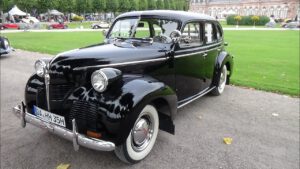
1911 Ford Model T – Retro Classics meets Barock Ludwigsburg 2017
It is easy to focus on what the Ford Model T did for mobility, but the 1911 version reveals something more specific: how a single, standardized machine could be adapted endlessly to different needs. By this point, the Ford Model T was no longer just a new invention—it had become a flexible platform used in ways its creators could not fully predict.
Technical Details
The 1911 Ford Model T retained the core engineering principles that defined the entire model line. It was powered by a front-mounted inline four-cylinder gasoline engine with a displacement of 2.9 liters, producing around 20 horsepower. This engine was designed for low-speed torque and durability rather than high performance, making it suitable for uneven roads and variable conditions.
A defining technical feature was its planetary transmission, operated by pedals rather than a conventional gear lever. This system simplified driving, particularly for first-time users unfamiliar with manual gearboxes. Power was transmitted to the rear wheels via a driveshaft, following a front-engine, rear-wheel-drive layout that would become standard across the industry.
The chassis consisted of a steel frame with transverse leaf springs at both axles, providing flexibility on rough terrain. The car’s high ground clearance and relatively light weight allowed it to handle rural roads with ease. Mechanically, the Ford Model T avoided complexity: it had no fuel pump, relying on gravity-fed fuel delivery, and no oil filter. These omissions were deliberate, reducing potential failure points and making maintenance easier for owners with limited technical resources.
- Manufacturer: Ford Motor Company
- Model name: Ford Model T
- Year of manufacturing: 1911
Design
The design of the 1911 Ford Model T was not defined by a single body style but by its adaptability. Ford offered the chassis with multiple configurations, including touring cars, runabouts, and utility forms, allowing customers to select a version suited to their needs. This modular approach was unusual at the time and contributed to the car’s widespread adoption.
Visually, the Ford Model T remained upright and narrow, with exposed mechanical elements that reflected early automotive construction. The radiator, lamps, and fenders were clearly separated rather than integrated into a single form. Around 1911, Ford began standardizing the color black more consistently, partly for production reasons, as the paint dried quickly and suited increasing manufacturing speeds.
The interior was minimal, focusing entirely on function. Controls were unconventional by later standards, with pedals managing gear selection and braking. Seating was simple, and materials were chosen for durability rather than comfort. The overall design communicated utility and accessibility, reinforcing the Ford Model T’s role as a practical tool.
Historical Significance
By 1911, the Ford Model T had moved beyond its initial introduction phase and was becoming a defining product of industrial modernity. While the moving assembly line would be fully implemented shortly afterward, the principles behind it—standardization, interchangeability, and efficiency—were already shaping the car’s development.
The Ford Model T’s significance lies in how it changed expectations. Instead of producing small numbers of varied vehicles, Ford focused on building large volumes of a single, standardized design. This approach reduced costs and ensured consistency, allowing more people to afford a car. Over time, this strategy would lead to production figures exceeding 15 million units, an unprecedented scale for the era .
In 1911, the Ford Model T was already contributing to broader social changes. It enabled greater personal mobility, particularly in rural areas where transportation options had been limited. The car became a link between communities, supporting economic activity and altering patterns of daily life.
Quirks and Pop Culture
One of the most distinctive aspects of the Ford Model T was how owners interacted with it. Because of its mechanical simplicity, drivers were often expected to perform their own repairs and adjustments. This hands-on relationship gave the car a reputation as both dependable and demanding.
The Ford Model T’s adaptability also became a defining quirk. Owners modified their cars extensively, turning them into delivery vehicles, agricultural machines, or even improvised tractors. This flexibility was not part of a formal design strategy but emerged naturally from the car’s straightforward construction.
Culturally, the Ford Model T quickly became a familiar presence. It appeared in early films, cartoons, and popular anecdotes, often representing modern life and technological progress. Its widespread use meant that it was not associated with a particular social group but was instead shared across different segments of society.
Display and preservation
This car was filmed at the 2017 edition of Retro Classics meets Barock in Ludwigsburg. Held on June 17 and 18, the event attracted around 20,000 visitors to the courtyard of Ludwigsburg Palace, where approximately 100 classic automobiles were presented. Highlights included a special showcase dedicated to Delage, celebrating the marque’s elegance and racing pedigree, as well as the iconic Borgward Isabella Coupé, marking its 60th anniversary. Complemented by guided tours and themed events, the exhibition emphasized both historical context and careful preservation.
Conclusion
The 1911 Ford Model T illustrates how a single, well-conceived design can evolve into something far larger than its original purpose. Technically simple yet carefully engineered, it combined durability with ease of use. Its adaptable design allowed it to serve multiple roles, while its standardized production laid the groundwork for modern manufacturing. By this stage, the Ford Model T was no longer just a car—it was a system that connected technology, industry, and everyday life in a new and lasting way.