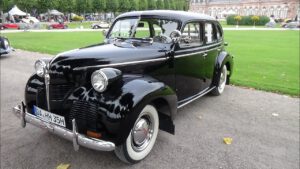
1908 – 1927 Ford Model T – Retro Classics meets Barock Ludwigsburg 2016
It was not the fastest car of its time, nor the most advanced in pure engineering terms—yet the 1908–1927 Ford Model T fundamentally changed how the world moved. By turning the automobile into a product for the many rather than the few, Henry Ford transformed both industry and everyday life. The Ford Model T’s significance lies as much in how it was built as in what it was.
Technical Details
The Ford Model T was powered by a front-mounted inline four-cylinder gasoline engine with a displacement of 2.9 liters. It produced approximately 20 horsepower, delivering modest but sufficient performance for early road conditions. The engine used a simple and robust design, optimized for reliability and ease of maintenance rather than refinement. Power was transmitted to the rear wheels via a planetary transmission system, which differed significantly from conventional manual gearboxes. This system used pedals instead of a gear lever, allowing drivers to control forward speeds and reverse through a unique arrangement.
The chassis consisted of a steel frame with rigid axles and transverse leaf springs, providing durability on rough and unpaved roads. Braking was mechanical and primarily acted on the transmission rather than directly on the wheels. The Ford Model T’s high ground clearance and flexible suspension made it particularly suitable for rural environments, where infrastructure was often limited.
- Manufacturer: Ford Motor Company
- Model name: Ford Model T
- Year of manufacturing: 1908–1927
Design
The design of the Ford Model T followed a strictly functional approach. Its proportions were upright and narrow, with large spoked wheels and minimal overhangs. The body evolved over time, ranging from open touring cars to closed sedans, pickups, and utility variants. Despite these variations, the underlying structure remained consistent, reinforcing Ford’s strategy of standardization.
A defining visual feature was its simplicity. Early versions were available in multiple colors, but by the mid-1910s, black became dominant due to faster drying times in the production process. The exterior avoided unnecessary decoration, focusing instead on practicality and ease of manufacture. Inside, the cabin was sparse, with basic seating and controls designed for straightforward operation rather than comfort or luxury.
Historical Significance
The importance of the Ford Model T is inseparable from its method of production. Ford introduced the moving assembly line, revolutionizing industrial manufacturing. Instead of building cars individually, production was broken down into repetitive tasks performed by workers as the vehicle moved along the line. This dramatically reduced production time and cost.
The impact was immediate and far-reaching. The price of the Ford Model T fell significantly over its production run, making it accessible to a broad segment of the population. By 1927, more than 15 million units had been produced, making it the most widely sold car in the world at that time. The Ford Model T enabled personal mobility on an unprecedented scale, reshaping cities, rural life, and economic structures.
It also influenced global industry. Ford’s production methods were adopted and adapted worldwide, laying the foundation for modern mass manufacturing far beyond the automotive sector.
Quirks and Pop Culture
The Ford Model T became widely known as “Tin Lizzy,” a nickname that reflected both its simple construction and its reliability. Its unusual driving controls—particularly the pedal-operated transmission—set it apart from later cars and required a different kind of driver familiarity.
Another notable aspect was its versatility. Owners adapted the Ford Model T for a wide range of uses, from farm equipment to delivery vehicles. Specialized kits even allowed the car to function as a tractor substitute. This adaptability contributed to its deep integration into everyday life.
The Ford Model T also became a cultural symbol of early 20th-century modernity. It appeared in advertisements, literature, and films, representing independence and technological progress.
Display and preservation
This car was filmed in Ludwigsburg. “Retro Classics meets Barock” 2016 offered a refined interpretation of classic car display, set against the grand courtyard of the Royal Palace. Limited to vehicles built between 1886 and 1968, the Concours d’Élégance emphasized authenticity, craftsmanship, and historical relevance. The baroque backdrop, enhanced by evening illuminations and artistic performances, elevated the presentation into a cultural experience. Highlights such as the rare Facel Vega gathering underscored the exclusivity of the event. Rather than sheer quantity, the focus lay on careful selection and elegant staging—demonstrating how preservation can merge seamlessly with heritage and atmosphere.
Conclusion
The 1908–1927 Ford Model T stands as a turning point in automotive and industrial history. Technically simple yet thoughtfully engineered, it combined a durable four-cylinder engine with an unconventional transmission and a robust chassis. Its design emphasized function and adaptability, while its production system redefined manufacturing. More than just a car, the Ford Model T became a catalyst for social and economic change, establishing the automobile as an essential part of modern life.