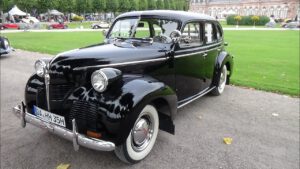
1911 Ford Model T – Retro Classics meets Barock Ludwigsburg 2015
The 1911 Ford Model T was not a rare machine, a glamorous machine, or even a technically advanced machine by European luxury-car standards. Its importance came from something far more disruptive: it changed who could realistically own an automobile. By 1911, the Ford Model T had already begun turning the car from an expensive curiosity into part of everyday life. Farmers, shopkeepers, doctors, mechanics, and families increasingly encountered the same machine on roads across the United States and beyond. Few automobiles altered society as directly as the Ford Model T, and the 1911 version belongs to the crucial early phase before the car became fully industrialized through the moving assembly line.
Technical Details
The 1911 Ford Model T used a front-mounted inline four-cylinder engine with a displacement of 2.9 liters. The engine produced approximately 20 horsepower, which was sufficient to move the lightweight car at speeds approaching 70 km/h depending on body style and road conditions. Rather than chasing high performance, Ford engineered the Ford Model T around mechanical durability, ease of repair, and adaptability to poor roads.
One of the defining technical features of the Ford Model T was its planetary transmission. Instead of a conventional manual gearbox with a gear lever and clutch arrangement familiar today, the car used a pedal-operated planetary gear system. Drivers controlled the transmission through a combination of pedals and hand levers, a setup that initially confused inexperienced motorists but proved relatively robust once mastered. The layout also simplified driving for owners who had never previously operated machinery.
The chassis used vanadium steel, an advanced material choice at the time that improved strength without excessive weight. The suspension relied on transverse leaf springs front and rear, helping the Ford Model T cope with rough and deeply uneven roads. Large wheels and substantial ground clearance further reinforced its usability outside cities, particularly in rural America where paved roads remained uncommon in 1911.
The engine was intentionally simple to maintain. It lacked many components that later became standard in automobiles, including a fuel pump and oil filter. Fuel was gravity-fed, and much of the maintenance could be performed with basic tools. This simplicity became one of the Model T’s greatest advantages, especially in remote areas where professional servicing barely existed.
- Manufacturer: Ford Motor Company
- Model name: Ford Model T
- Year of manufacturing: 1911
Design
The 1911 Ford Model T reflected an era when automobile design was still heavily shaped by practicality rather than brand identity. Early Ford Model Ts varied considerably in appearance depending on body style, but most shared tall proportions, narrow tires, upright seating positions, and exposed mechanical elements.
The body sat relatively high above the road, an intentional decision that improved clearance on muddy or damaged surfaces. Thin fenders followed the shape of the wheels closely, while brass lamps and exposed radiators gave the car its distinctly pre-war appearance. Compared with later automobiles, the Ford Model T looked almost skeletal, with visible structural and mechanical components forming part of the visual character.
Interior design was sparse even by the standards of the period. The dashboard carried only essential controls and gauges, while seating materials prioritized durability over luxury. The driving position was upright and commanding, giving drivers a clear view over difficult roads and primitive traffic conditions.
Unlike later standardized black Ford Model Ts, many 1911 examples were available in several colors. The famous “any color so long as it’s black” approach only became dominant later, when Ford optimized paint choices for faster industrial production. The 1911 cars therefore retain a slightly more varied and less standardized visual identity than the Model Ts most people imagine today.
Historical Significance
The historical significance of the 1911 Ford Model T lies less in individual technical innovation than in its broader social effect. Introduced in 1908, the Ford Model T rapidly expanded automobile ownership in ways previously considered unrealistic. By 1911, Ford had already produced hundreds of thousands of units, and the company was refining the manufacturing methods that would soon revolutionize global industry.
Importantly, the 1911 Ford Model T predates Ford’s fully developed moving assembly line, introduced in 1913. This places it in a fascinating transitional period. Production was already becoming increasingly organized and efficient, but the car had not yet reached the extreme industrial standardization associated with later Ford Model Ts. The 1911 version therefore represents the bridge between early handcrafted automobile production and true industrial mass manufacturing.
The Ford Model T also reshaped patterns of mobility. In rural regions especially, it reduced isolation by making personal transport more accessible and dependable. Farmers adapted the cars for agricultural work, doctors used them to reach remote patients, and small businesses expanded their operating range dramatically. The Ford Model T became woven into daily economic and social life in a way earlier automobiles never had.
Internationally, Ford’s success also influenced industrial practices far beyond the automotive world. The Ford Model T demonstrated that manufacturing efficiency could fundamentally change consumer markets, labor organization, and pricing structures. Its impact extended into industrial history as much as automotive history.
Quirks and Pop Culture
The Ford Model T accumulated countless nicknames and stories during its long life, but perhaps the most famous was “Tin Lizzy.” The nickname reflected both affection and practicality: the car was simple, lightweight, and nearly impossible to ignore in everyday American life.
One of the more unusual aspects of the Ford Model T was its extraordinary adaptability. Owners converted them into pickup trucks, tractors, delivery vans, snow vehicles, and improvised machinery. Aftermarket kits allowed farmers to use the engine as a stationary power source for tools and equipment, turning the automobile into a multi-purpose machine rather than merely transportation.
The driving experience itself also became part of Ford Model T folklore. Starting the engine by hand crank could be physically demanding and potentially dangerous if performed incorrectly. Learning the pedal-and-lever transmission system became a rite of passage for early motorists.
In film and comedy, the Ford Model T became one of the defining visual symbols of the early twentieth century. Silent-era comedians frequently used the car for mechanical gags, breakdown scenes, and chaotic chase sequences. Its instantly recognizable proportions helped turn it into a cultural shorthand for the dawn of everyday motoring.
Display and preservation
This car was filmed at the 12th edition of Retro Classics meets Barock. Set against the ornate gardens of Ludwigsburg, the 2015 show offered a refined celebration of automotive heritage. From June 5th to 7th, around 25,000 visitors gathered in the grounds of the Blühendes Barock, where historic vehicles were displayed against the striking backdrop of the royal palace. The event combined a prestigious Concours d’Elegance with a vibrant festival atmosphere, featuring 47 exceptional premium cars and around 140 classic vehicles. Awards for authenticity, design, and even period-correct fashion added a distinctive cultural dimension, culminating in a gala evening and fireworks.
Conclusion
The 1911 Ford Model T occupies a uniquely important position in automotive history. Technically straightforward but intelligently engineered, it prioritized durability, affordability, and usability over prestige or complexity. Its tall, practical design reflected the realities of early roads, while its mechanical simplicity made car ownership possible for people far beyond wealthy urban elites. Historically, the 1911 version captures the Ford Model T at a transitional moment just before Ford’s assembly-line revolution transformed industrial production worldwide. More than simply a successful automobile, the Ford Model T changed how ordinary people interacted with mobility, work, and distance, making it one of the most consequential cars ever built.