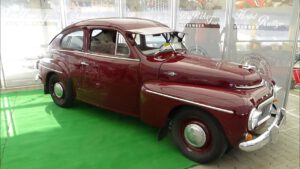
1960 Volvo PV544 – Classic Expo Salzburg 2016
The 1960 Volvo PV544 looked almost stubbornly out of step with the automotive world around it. While European manufacturers rushed toward tailfins, panoramic windshields, and low, horizontal bodywork, Volvo continued selling a compact sedan whose silhouette still echoed the immediate post-war period. Yet beneath that conservative shell sat one of the toughest and most competition-proven Scandinavian cars of its generation.
Technical Details
For the 1960 model year, the Volvo PV544 benefited from one of the most important technical upgrades in the model’s history: the broader adoption of Volvo’s B18 engine family. Earlier PV models had relied on smaller-displacement units, but by 1960 the stronger 1.8-liter inline four-cylinder increasingly defined the car’s character. The B18 engine used a five-bearing crankshaft configuration, giving it exceptional durability under continuous stress and higher engine speeds. Depending on specification, power output generally ranged between 75 and 90 horsepower.
The engine was mounted longitudinally at the front and connected to a rear-wheel-drive drivetrain through a four-speed manual gearbox. Some versions were equipped with Laycock de Normanville overdrive, effectively creating a long-distance cruising gear that reduced engine strain at higher speeds. This made the PV544 surprisingly capable on extended motorway journeys despite its compact dimensions.
Structurally, the Volvo PV544 remained deliberately straightforward. The front suspension used independent wishbones with coil springs, while the rear retained a solid axle with leaf springs. Rather than pursuing technical complexity, Volvo prioritized reliability on uneven roads and in harsh winter conditions. The suspension setup also proved highly resistant to punishment during rally competition.
A particularly significant improvement around this era was braking performance. Front disc brakes became increasingly available during the PV544’s later production period, giving the car stronger and more consistent stopping power compared with many rivals still relying entirely on drum systems. Combined with a relatively lightweight body and durable drivetrain, the mechanical package gave the PV544 a reputation for surviving conditions that destroyed less robust competitors.
- Manufacturer: Volvo
- Model name: Volvo PV544
- Year of manufacturing: 1960
Design
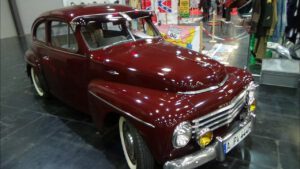
The design of the 1960 Volvo PV544 was defined by continuity rather than reinvention. Its body shape traced directly back to the earlier PV444 introduced during the 1940s, itself heavily influenced by streamlined American sedans of the pre-war era. By 1960, this gave the PV544 an unmistakably old-fashioned appearance beside newer European competitors.
The car’s proportions were compact and upright. Rounded fenders blended into the body sides, while the curved roofline tapered smoothly toward the rear. The front fascia remained restrained, using a modest grille flanked by simple circular headlamps. There was little chrome excess and virtually no stylistic experimentation. Volvo’s design priorities were clarity, durability, and manufacturing consistency rather than annual visual change.
Inside, however, the 1960 PV544 had evolved noticeably from its origins. The cabin became more driver-oriented than earlier versions, with redesigned instrumentation and improved ergonomics. Large, clearly legible gauges reflected the car’s growing sporting reputation, particularly among rally drivers. The seating position remained high and commanding, providing excellent visibility on narrow roads and rough terrain.
One notable aspect of the interior was Volvo’s increasing attention to occupant safety. By this period, padded dashboard elements and improved structural reinforcement reflected the company’s early movement toward systematic automotive safety engineering. Rather than treating safety as a luxury feature, Volvo increasingly integrated it into ordinary production vehicles like the PV544.
Historical Significance
The 1960 Volvo PV544 represents a fascinating contradiction in automotive history: a car whose styling increasingly belonged to the past, yet whose engineering pointed directly toward Volvo’s future.
During the late 1950s and early 1960s, Volvo transformed from a relatively regional manufacturer into an internationally respected brand. The PV544 played a central role in that process. Its export success, particularly in North America and Europe, demonstrated that reliability and structural integrity could become marketable qualities in their own right.
Perhaps even more importantly, the PV544 established Volvo’s competition credentials. The car became highly successful in international rallying, especially under Swedish driver Erik Carlsson. Using lightweight construction, strong traction on rough surfaces, and the durability of the B18 engine, the PV544 achieved victories in demanding endurance events including the RAC Rally and Safari Rally. These wins were not isolated publicity exercises; they fundamentally changed how Volvo was perceived internationally.
The model also became an important testing ground for Volvo’s safety philosophy. Features that later became associated with the brand—strong passenger protection, practical ergonomics, and structural durability—were increasingly visible in the PV544 generation. In many ways, the car bridged Volvo’s transition from a small practical manufacturer into a company recognized for engineering discipline and long-term durability.
Production of the PV544 continued well beyond what industry analysts expected. By 1960, its appearance already looked outdated, yet customer demand remained strong because owners valued dependability over fashion trends.
Quirks and Pop Culture
The Volvo PV544 earned a surprisingly rebellious reputation despite its conservative appearance. In rally circles, the rounded Swedish sedan became famous for humiliating faster-looking competitors on snow, gravel, and mud. Drivers appreciated its predictable balance and ability to absorb punishment without mechanical failure.
One of the car’s most recognizable quirks was its sound. The B18 engine developed a distinctive mechanical note under load, particularly in rally-prepared versions fitted with twin carburetors. Enthusiasts often described the car as feeling tougher and more aggressive than its modest exterior suggested.
The PV544 also became deeply embedded in Scandinavian daily life. It served as a family car, rural workhorse, winter commuter, and competition machine simultaneously. In Sweden particularly, the model became associated with practical resilience rather than prestige.
Unlike many 1960s classics celebrated for glamour, the PV544 gained cultural significance through usefulness. Owners often kept them running for decades, and stories of extraordinarily high mileage became common. This longevity helped create the mythology surrounding Volvo durability that still exists today.
Display and preservation
This car was filmed at the Classic Expo Salzburg 2016, held from October 14 to 16. An impressive 40,000 square meters of exhibition space set the stage for an immersive journey through automotive history. Over 200 international classic car dealers showcased remarkable vehicles, while a private sales area featured around 150 collector-owned automobiles. The vibrant parts market attracted enthusiasts searching for rare components and unique finds. A highlight of the event was the special exhibition celebrating 70 years of Vespa, presented in the newly renovated Hall 1. Exceptional sales results further underscored the event’s significance.
Conclusion
The 1960 Volvo PV544 succeeded by refusing to follow fashion. While its rounded body shape increasingly appeared anachronistic, its engineering evolved steadily beneath the surface. Durable mechanicals, strong rally performance, and early safety-focused development transformed the PV544 from a modest Scandinavian sedan into an internationally respected automobile. More than simply a survivor from an earlier design era, the 1960 PV544 became one of the cars that defined Volvo’s long-term identity: practical, resilient, and engineered for endurance rather than spectacle.