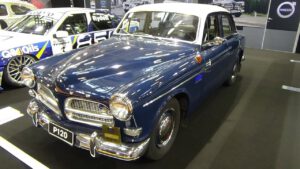
1965 Volvo P121 Amazon – Classic Expo Salzburg 2019
Few cars illustrate Volvo’s transition from a conservative manufacturer into a globally respected automotive brand as clearly as the 1965 Volvo P121 Amazon. By the mid-1960s, the Amazon had already earned a reputation for reliability and safety, but it also introduced a level of style and driving refinement that distinguished it from many practical family sedans of its era. The 1965 model sits at an especially interesting point in the car’s evolution, combining the elegant early body design with the increasingly mature engineering that would make the Amazon one of Volvo’s defining postwar automobiles.
Technical Details
The 1965 Volvo P121 Amazon was powered by Volvo’s B18 inline four-cylinder engine with a displacement of 1,778 cc. The engine used an overhead-valve layout and was widely respected for its durability and mechanical simplicity. Depending on market specification and carburetor setup, power output varied, but most P121 versions produced around 75 to 90 horsepower. While these figures were modest compared with contemporary sports sedans, the B18 engine compensated through reliability, smooth operation, and strong low-end torque.
Power was delivered to the rear wheels through a four-speed manual gearbox, with some versions optionally equipped with Volvo’s electrically engaged overdrive system. The overdrive effectively acted as a cruising gear, improving comfort and reducing engine speed at higher road speeds. The Amazon’s suspension layout followed conventional but carefully tuned engineering principles. At the front, the car used independent suspension with coil springs and wishbones, while the rear relied on a solid axle with trailing arms and coil springs. This setup produced predictable handling and good ride comfort, particularly on uneven roads.
One of the Amazon’s most important technical contributions involved safety. Volvo introduced the three-point seatbelt during the Amazon’s production run, and by the mid-1960s the system had become increasingly integrated into the car. Developed by Volvo engineer Nils Bohlin, the design became one of the most influential safety innovations in automotive history. Disc brakes at the front and drum brakes at the rear improved braking stability, while the strong unibody structure contributed to the car’s reputation for occupant protection.
Mechanically, the Amazon was designed to withstand harsh Scandinavian conditions. Robust construction, simple servicing, and dependable drivetrains helped establish the car’s reputation as a durable long-distance vehicle capable of surviving decades of everyday use.
- Manufacturer: Volvo
- Model name: Volvo P121 Amazon
- Year of manufacturing: 1965
Design
The design of the Volvo Amazon represented a major stylistic shift for Volvo during the 1950s and 1960s. Introduced earlier in the decade, the body was heavily influenced by contemporary American styling trends, yet interpreted through a more restrained Scandinavian lens. By 1965, the Amazon retained its elegant proportions while appearing cleaner and more mature than some earlier versions.
The body featured softly rounded lines, pronounced rear fenders, and subtle tailfin-inspired contours that reflected transatlantic design influences without becoming exaggerated. The front end combined a broad grille with twin round headlamps and carefully integrated chrome trim. Compared with many European sedans of the era, the Amazon projected a surprisingly confident and upscale appearance.
The proportions were balanced and upright, giving the car excellent visibility and a practical cabin layout. Chrome details around the windows and bumpers added refinement without overwhelming the design. Unlike more aggressively styled American sedans of the period, the Amazon maintained a sense of visual discipline and simplicity.
Inside, the Amazon combined functionality with understated elegance. The dashboard layout was clean and logical, with large instruments and clearly arranged controls. Thin steering wheels, chrome accents, and durable upholstery reflected Volvo’s focus on practicality while still creating a pleasant driving environment. The seats themselves became particularly significant, as Volvo increasingly emphasized ergonomics and occupant safety during this period.
The Amazon’s design succeeded because it balanced family-car practicality with genuine visual character. Even decades later, its silhouette remains immediately recognizable.
Historical Significance
The Volvo Amazon played a crucial role in Volvo’s postwar expansion and international recognition. Introduced in 1956, the model was intended to modernize Volvo’s lineup and compete more effectively in export markets, particularly in Europe and North America. By 1965, the Amazon had become one of Volvo’s most successful and important cars.
The model also marked an important transition in Volvo’s public identity. Before the Amazon, Volvo was primarily associated with solid but relatively conservative automobiles. The Amazon introduced more emotional styling while retaining the company’s traditional focus on durability and practicality. This combination helped Volvo broaden its appeal significantly.
Historically, the Amazon is perhaps best remembered for its role in advancing automotive safety. In 1959, Volvo introduced the modern three-point seatbelt in the Amazon and PV544. Rather than restricting the invention through aggressive patent enforcement, Volvo allowed other manufacturers to use the design freely, accelerating the global adoption of one of the most important safety systems ever developed for passenger cars.
Production of the Amazon continued until 1970, with more than 660,000 units built. The model became especially important in export markets and helped establish Volvo’s reputation for building safe, reliable, long-lasting automobiles suitable for demanding climates and road conditions.
The Amazon also formed the mechanical foundation for several later Volvo models, including performance-oriented variants and rally cars. Its B18 engine gained legendary status for durability and became closely associated with Volvo engineering during the 1960s.
Quirks and Pop Culture
The name “Amazon” itself created an unusual historical footnote. Volvo originally intended to use the name internationally, but trademark conflicts with a German motorcycle manufacturer forced the company to market the car simply as the “120 Series” in many regions. Despite this, enthusiasts and owners continued referring to the model as the Amazon, and the nickname ultimately became inseparable from the car’s identity.
The Amazon also developed a strong reputation in rallying. Although outwardly conservative, the car proved durable and capable on rough roads, particularly in Scandinavian motorsport events. Its sturdy construction and dependable drivetrain made it highly competitive in endurance-oriented rally competitions during the 1960s.
Another notable aspect of the Amazon’s legacy is how many examples survived extensive daily use in northern climates. The car became closely associated with Scandinavian practicality and resilience, frequently appearing in snowy landscapes, rural settings, and long-distance touring imagery.
In enthusiast culture, the Amazon is often admired for combining elegant 1960s styling with unusual usability. Unlike many classic sedans that became difficult to maintain, the Volvo developed a reputation as a car that owners could still drive regularly decades after production ended.
Display and preservation
The vehicle was exhibited at Classic Expo Salzburg in 2019, when the fair celebrated its 15th anniversary from 18 to 20 October. The event occupied ten spacious halls as well as the inner courtyard, which also served as the starting point for the Salz & Öl Rallye. More than 1,000 vehicles were presented, ranging from privately offered classics to dealer cars, club displays, parts-market finds, and auction entries. Special exhibitions marked 60 years of the Steyr-Puch Haflinger, 60 years of Mini, and 100 years of Zagato, while the relaxed atmosphere gave the show a distinctly Austrian character.
Conclusion
The 1965 Volvo P121 Amazon represents one of the clearest expressions of Volvo’s mid-century identity. Technically robust, visually distinctive, and historically important, it combined practical engineering with elegant Scandinavian-influenced design. Its durable B18 engine, strong construction, and pioneering safety innovations helped establish Volvo’s global reputation during a transformative period for the automotive industry.
At the same time, the Amazon avoided becoming purely utilitarian. Its balanced proportions, restrained chrome detailing, and comfortable interior gave the car a warmth and personality that distinguished it from many rivals. More than half a century later, the 1965 Volvo Amazon remains admired not only as a dependable classic sedan, but also as one of the cars that defined Volvo’s modern character.