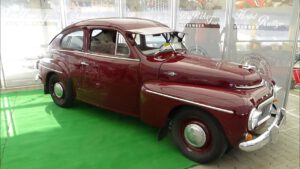
1963 Volvo P1800 S – Retro Classics Stuttgart 2023
In 1963, the Volvo P1800 S was still a relatively unusual sight on European roads. It did not fit neatly into the categories that defined most sporting cars of the period. It was neither a lightweight roadster nor a luxury coupé in the traditional continental sense. Instead, the 1963 Volvo P1800 S presented a different proposition: a car that combined understated Scandinavian engineering with international styling and the ability to cover long distances reliably in all conditions.
Technical Details
The 1963 Volvo P1800 S was powered by Volvo’s B18 inline four-cylinder engine, a robust overhead-valve unit with a displacement of 1,778 cc. In the P1800 S, the engine used twin SU carburetors and produced around 100 horsepower, depending on specification and market configuration. Power was delivered through a four-speed manual gearbox to the rear wheels, following the conventional front-engine, rear-wheel-drive layout favored by European GT cars of the era.
Mechanically, the B18 engine became one of the defining elements of the car’s reputation. Volvo engineered it with unusually strong internal components for a relatively compact engine, including a five-bearing crankshaft designed for durability during sustained high-speed operation. Rather than chasing high output figures, Volvo concentrated on reliability, torque delivery, and long service life.
The suspension layout reflected the same philosophy. Independent front suspension used coil springs and wishbones, while the rear relied on a solid axle with trailing arms and coil springs. This arrangement did not produce razor-sharp handling in the style of lighter Italian sports cars, but it gave the P1800 S stable and predictable road manners, particularly on uneven surfaces and during long-distance cruising.
The “S” in P1800 S indicated Swedish production. Earlier P1800 cars had been assembled in Britain by Jensen Motors, but in 1963 Volvo increasingly shifted manufacturing responsibilities to Gothenburg. This transition improved consistency in body assembly and mechanical integration. Swedish-built cars quickly gained a stronger reputation for build quality than the early British-produced examples.
- Manufacturer: Volvo
- Model name: Volvo P1800 S
- Year of manufacturing: 1963
Design
The design of the 1963 Volvo P1800 S carried influences from several countries yet remained visually cohesive. Pelle Petterson, working under Pietro Frua in Italy, contributed to a body shape that combined restrained elegance with subtle sporting cues. Unlike the dramatic fins and oversized chrome details still common in the early 1960s, the P1800 S relied on proportion and surface tension rather than decoration.
The front section featured a low grille opening flanked by round headlamps integrated cleanly into the fenders. The hood stretched far forward, visually emphasizing the car’s grand touring purpose. Along the sides, the rising beltline and curved rear fenders gave the car movement without relying on aggressive sculpting.
One of the most distinctive visual elements was the slim roof structure combined with large glass areas. The cabin appeared light and airy compared with many contemporary coupés, while the gently curved rear window flowed naturally into the short rear deck. Chrome trim was present but carefully controlled, outlining details rather than dominating the design.
The interior reflected Volvo’s practical priorities. Large gauges and straightforward switchgear emphasized usability, while slim pillars improved visibility. Seating comfort was especially important in the P1800 S, reinforcing the car’s role as a machine for extended journeys rather than brief bursts of sporting driving. Even visually, the cabin suggested order and function more than theatricality.
Historical Significance
The 1963 Volvo P1800 S represents a crucial transitional phase in the model’s development. Volvo had launched the original P1800 partly to challenge perceptions that the company only built practical sedans and station wagons. By 1963, however, the company was beginning to integrate the car more fully into its own manufacturing and engineering culture.
This model year also coincided with growing international recognition for Volvo as an export-oriented manufacturer. The P1800 S helped the brand enter markets where style and image mattered alongside durability. In North America especially, the car provided Volvo dealers with a more emotional product that could attract customers into showrooms dominated by family-oriented vehicles.
The broader automotive environment of 1963 is also important. European manufacturers were experimenting heavily with sports-car concepts, but many models of the period sacrificed comfort or reliability in pursuit of speed and visual drama. Volvo deliberately chose another direction. The P1800 S aimed to be usable year-round, mechanically durable, and refined enough for long-distance touring. That approach would later become common among premium GT cars, but in the early 1960s it remained relatively unusual.
The gradual transfer of production from Britain to Sweden during this period also shaped the model’s future reputation. Swedish-built P1800 S cars increasingly demonstrated the quality standards that would later become central to Volvo’s identity.
Quirks and Pop Culture
Although the Volvo P1800 is now strongly associated with television fame, in 1963 the connection with The Saint was still relatively fresh. Roger Moore’s appearance behind the wheel gave the car visibility far beyond Volvo’s normal audience. Interestingly, the P1800’s calm and intelligent image contrasted with the louder, more aggressive personalities projected by many sports cars of the era.
Another curious aspect of the 1963 P1800 S was its international identity. Few European cars of the time combined Swedish engineering, Italian-influenced styling, and partial British production history in the same package. This unusual mix gave the car a character distinct from both Scandinavian sedans and Mediterranean sports coupés.
Owners also quickly noticed the car’s practicality. Unlike many low-slung sports cars of the period, the P1800 S offered comparatively generous luggage space, good visibility, and comfortable seating. It became known among enthusiasts less as a weekend toy and more as a serious touring companion capable of crossing countries without complaint.
Display and preservation
This car was filmed at the Retro Classics Stuttgart 2023. From 23 to 26 February, more than 82,000 visitors explored seven packed halls covering 105,000 square meters, showcasing the full spectrum of historic mobility. International dealers, restoration experts, and dedicated clubs created a rich and immersive atmosphere, complemented by a lively parts market and vehicle sales exchange. Highlights included special exhibitions celebrating the 60th anniversary of the Porsche 911 and 75 years of Porsche, alongside themed displays of American classics and vibrant club presentations.
Conclusion
The 1963 Volvo P1800 S occupied a unique position within the European car market of the early 1960s. Mechanically durable, visually refined, and increasingly well-built as production moved to Sweden, it offered a distinctly rational interpretation of the sporting coupé. Rather than competing directly with fragile high-performance exotics, the P1800 S emphasized endurance, comfort, and understated style. That combination helped shape Volvo’s evolving international image and ensured that the car would remain relevant long after many more flamboyant contemporaries disappeared from the roads.