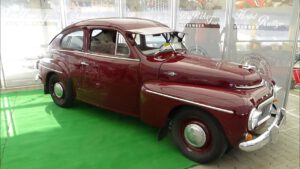
1911 Austro-Daimler 20 HP Double Phaeton – Classic Expo Salzburg 2016
In 1911, the automobile world was still far from standardized. While some manufacturers pursued simplicity and scale, others focused on engineering depth and refinement. The 1911 Austro-Daimler 20 HP Double Phaeton belongs firmly to the latter group—a car shaped by technical ambition rather than production efficiency.
Technical Details
The 1911 Austro-Daimler 20 HP Double Phaeton was built around a front-mounted inline four-cylinder engine, typical of the period but executed with notable precision. Output, indicated by its “20 HP” designation, placed it within the mid-range of touring cars, offering sufficient power for long-distance travel while maintaining mechanical reliability.
The drivetrain followed a conventional front-engine, rear-wheel-drive layout, with power delivered through a manual gearbox. Compared to simpler systems used in mass-produced cars, Austro-Daimler employed a more traditional and mechanically involved transmission, requiring greater driver input but offering finer control.
The chassis was constructed on a robust ladder frame, paired with rigid axles and leaf spring suspension. This configuration was designed to handle uneven road conditions while supporting a larger and heavier body than many contemporaries. Braking systems were mechanically operated and typically limited to the rear wheels, consistent with early automotive engineering practices.
A distinguishing aspect of Austro-Daimler’s engineering approach was its attention to mechanical balance and durability. Rather than minimizing components, the design emphasized precision and structural integrity, aligning with the company’s broader technical philosophy.
- Manufacturer: Austro-Daimler
- Model name: Austro-Daimler 20 HP Double Phaeton
- Year of manufacturing: 1911
Design
The Double Phaeton body style defined the visual and functional character of this car. Unlike simpler open vehicles, it offered two rows of seating in a more substantial and elongated structure. The proportions were larger and more imposing, with a long bonnet leading into a spacious passenger compartment.
Externally, the design followed the established language of early luxury touring cars. The upright radiator, separate fenders, and exposed lighting elements created a clear, mechanical appearance. However, compared to more utilitarian vehicles, the detailing was more refined. Elements such as the radiator shape and body panels conveyed a sense of craftsmanship and brand identity.
The interior reflected the car’s positioning as a higher-end touring vehicle. Seating was arranged to accommodate multiple passengers comfortably, and materials were typically of higher quality than those found in more basic cars. The open configuration, combined with a folding soft top, allowed for flexibility in different weather conditions while maintaining the traditional touring experience.
Historical Significance
Austro-Daimler was one of the most technically advanced manufacturers in Central Europe during the early 20th century. Closely associated with engineer Ferdinand Porsche, the company developed a reputation for innovation and engineering rigor.
By 1911, Austro-Daimler had already begun to distinguish itself through both road cars and competition success. The Austro-Daimler 20 HP model fits into this broader context as a refined touring car that benefited from the company’s engineering expertise. While not a racing machine, it shared design principles with vehicles developed under Porsche’s direction, emphasizing efficiency, strength, and technical coherence.
The Double Phaeton body style also reflects the expectations of the time, when cars were often used for extended travel rather than short urban trips. Vehicles like this were designed to carry multiple passengers over long distances, reinforcing their role as early grand touring machines.
Quirks and Pop Culture
Cars like the Austro-Daimler 20 HP Double Phaeton occupy a different cultural space from mass-produced automobiles. Rather than becoming widespread cultural symbols, they were associated with a smaller, more affluent group of owners. Their presence was often linked to travel, leisure, and early automotive tourism.
One notable characteristic of vehicles from this period is their variability. Coachbuilt bodies meant that individual examples could differ in detail, even within the same model designation. This gives surviving cars a degree of uniqueness that contrasts with later standardized production.
The connection to Ferdinand Porsche adds an additional layer of historical interest. While later known for other automotive achievements, his early work at Austro-Daimler contributed to the technical direction of cars like the Austro-Daimler 20 HP, linking them to a broader narrative of engineering development.
Display and preservation
This car was filmed at the Classic Expo Salzburg 2016, held from October 14 to 16. An impressive 40,000 square meters of exhibition space set the stage for an immersive journey through automotive history. Over 200 international classic car dealers showcased remarkable vehicles, while a private sales area featured around 150 collector-owned automobiles. The vibrant parts market attracted enthusiasts searching for rare components and unique finds. A highlight of the event was the special exhibition celebrating 70 years of Vespa, presented in the newly renovated Hall 1. Exceptional sales results further underscored the event’s significance.
Conclusion
The 1911 Austro-Daimler 20 HP Double Phaeton represents a strand of early automotive history focused on engineering quality and touring capability. Its technically conventional yet carefully executed design reflects a manufacturer prioritizing refinement over mass production. The spacious Double Phaeton body underscores its role as a long-distance vehicle, while its historical context connects it to one of the most influential engineering figures of the era. Together, these elements position the car as a clear example of how different approaches to automobile design coexisted in the early 20th century.