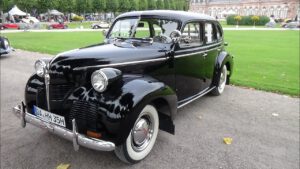
1908 Ford Model T – Geneva International Motor Show 2024
It was not the first car, nor the most advanced, yet the Ford Model T changed how cars were built and who could own one. Introduced in 1908, it quickly moved from being a product to becoming a system of production and mobility. Its impact lies less in engineering novelty than in how it reshaped access to transportation.
Technical Details
The 1908 Ford Model T was powered by a front-mounted inline four-cylinder engine with a displacement of 2,896 cc (2.9 liters). It produced approximately 20 horsepower at around 1,600 rpm, delivering power to the rear wheels through a planetary transmission system. This transmission differed significantly from later manual gearboxes, using a combination of pedals and levers rather than a conventional gear stick, making it easier to operate for inexperienced drivers.
The drivetrain followed a front-engine, rear-wheel-drive layout. The engine was designed for durability and flexibility, capable of running on gasoline as well as alternative fuels such as ethanol or kerosene, depending on adjustment. The chassis used a simple but robust steel frame, with transverse leaf springs providing suspension at both the front and rear.
Braking was handled by a transmission brake acting on the driveshaft, supplemented by mechanical brakes on the rear wheels. The Ford Model T had a top speed of approximately 65–70 km/h. Its relatively high ground clearance and flexible suspension made it suitable for poor road conditions, particularly in rural areas. The technical philosophy emphasized reliability, ease of maintenance, and adaptability rather than precision or performance.
- Manufacturer: Ford Motor Company
- Model name: Ford Model T
- Year of manufacturing: 1908
Design
The design of the 1908 Ford Model T reflected its utilitarian purpose. Early versions were available in several body styles, including touring cars, runabouts, and coupes, allowing customers to choose configurations suited to different needs. The body sat high on large wheels, giving the car a tall, narrow stance appropriate for unpaved roads.
Externally, the Ford Model T featured simple, functional lines with minimal ornamentation. The radiator grille was upright and narrow, flanked by exposed headlamps. Fenders were separate and curved, following the wheels closely. The overall shape remained influenced by carriage design, but the integration of mechanical components into a coherent structure marked a step toward modern automotive form.
Inside, the layout was basic. Controls were unconventional by later standards, with pedals operating not only the clutch and brake but also the transmission functions. Seating was straightforward, and comfort features were minimal. The emphasis was on usability and durability rather than refinement or aesthetics.
Historical Significance
The Ford Model T is inseparable from the work of Henry Ford and his vision of mass mobility. When introduced in 1908, automobiles were still relatively expensive and limited to wealthier buyers. Ford’s goal was to produce a car that ordinary people could afford and use.
While the early Ford Model T itself was not radically different from other cars of the period, its production methods soon became transformative. In 1913, Ford introduced the moving assembly line, drastically reducing manufacturing time and costs. This allowed the price of the Ford Model T to fall significantly over time, expanding its accessibility. By the mid-1910s, it had become a dominant presence on American roads.
Production of the Ford Model T continued until 1927, with more than 15 million units built. This scale of production fundamentally altered the automotive industry and established mass production as the standard approach. The 1908 version represents the starting point of this transformation, before the full industrial system was implemented.
Quirks and Pop Culture
The Ford Model T quickly became embedded in everyday life and culture. It earned the nickname “Tin Lizzy,” reflecting both its simplicity and its familiarity. Because it was widely used across urban and rural environments, it appeared in countless anecdotes, early films, and illustrations, often symbolizing modernity and independence.
One of the notable quirks of the Ford Model T was its unconventional control system. Drivers had to learn a unique combination of pedals and levers, which differed from later standardized controls. This system became second nature to owners but could be confusing for newcomers.
Its versatility also contributed to its cultural presence. The Ford Model T was adapted for numerous purposes, from passenger transport to farming and light commercial use. This adaptability reinforced its role as a practical tool rather than a specialized machine.
Display and preservation
This car was displayed at the 2024 Geneva International Motor Show. Marking its 100-year anniversary, the spotlight on heritage proved more compelling than the scaled-down main exhibition. While the modern displays felt restrained, the carefully curated “Classic Gallery” stood out as a celebration of automotive preservation at its finest. The exhibition brought together icons spanning decades—from the Ferrari F40 and Porsche 959 to the humble Renault 16 and VW Beetle.
The displays highlighted not only the aesthetic and technical evolution of the automobile but also the importance of preserving these machines as cultural artifacts, allowing visitors to experience automotive history in a tangible, vivid way.
Conclusion
The 1908 Ford Model T marks the beginning of a fundamental shift in automotive history. Technically straightforward but thoughtfully engineered, it combined a durable engine, simple drivetrain, and adaptable chassis. Its design emphasized function and accessibility, while its historical importance lies in enabling mass production and widespread car ownership. Through its production methods, cultural presence, and long lifespan, the Ford Model T transformed the automobile from a niche invention into an everyday necessity.