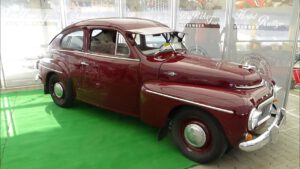
1903 – Leon Buat Phaeton 3,5CV – Retro Classics Stuttgart 2016
At a time when the automobile was still competing with the horse-drawn carriage, small manufacturers experimented with compact and affordable designs. The 1903 Léon Buat Phaeton 3,5CV reflects this moment of transition, where simplicity and lightness defined early motoring. It is a reminder that the spread of the automobile depended not only on large firms, but also on lesser-known builders.
Technical Details
The Léon Buat Phaeton 3,5CV was conceived as a lightweight voiturette, designed for modest power and ease of operation. It was equipped with a small internal combustion engine, typically a single-cylinder unit, producing output consistent with its 3.5 CV fiscal rating. This classification placed it among the smallest and most economical vehicles of its time, aimed at reducing taxation and running costs.
The engine was mounted at the front, driving the rear wheels through a simple mechanical transmission system. In many vehicles of this category, power was transferred via chain drive, reflecting common engineering practice before enclosed driveshafts became widespread. Ignition relied on early magneto or battery systems, while fuel was delivered through a basic carburetor.
The chassis followed a straightforward ladder-frame construction, with rigid axles and leaf springs providing suspension. Braking systems were minimal, usually acting only on the rear wheels and operated mechanically. The technical philosophy emphasized low weight and mechanical accessibility rather than speed or refinement, aligning with the needs of early motorists.
- Manufacturer: Léon Buat
- Model name: Phaeton 3,5CV
- Year of manufacturing: 1903
Design
The design of the Léon Buat Phaeton 3,5CV clearly reflects its origins in carriage construction. The phaeton body style, inherited directly from horse-drawn vehicles, featured an open layout with minimal bodywork and no fixed roof. This configuration emphasized lightness and simplicity, suitable for short-distance travel in fair weather.
Visually, the car was defined by its exposed mechanical elements and narrow proportions. The engine compartment was only partially enclosed, and the radiator—if present in a distinct form—was integrated in a functional rather than stylistic manner. Large, thin spoked wheels and narrow tires contributed to a delicate, almost fragile appearance.
The seating position was upright, with passengers sitting high relative to the chassis. Inside, controls were sparse and mechanical in nature. Steering was typically via a simple wheel, while instrumentation was minimal or entirely absent. The overall impression was one of directness: a machine built to move rather than to comfort.
Historical Significance
Léon Buat was among the many small French manufacturers active during the early years of the automobile industry. Around 1900, France was the global center of automotive innovation, with numerous firms experimenting with different technical solutions and market positions. The Léon Buat Phaeton 3,5CV phaeton fits within the category of voiturettes—small, lightweight cars intended to make motoring more accessible.
This segment played a crucial role in expanding the automobile beyond wealthy early adopters. By offering simpler and less expensive vehicles, manufacturers like Léon Buat contributed to the gradual normalization of car ownership. Although production volumes remained limited, these cars helped establish technical conventions and user expectations.
The Léon Buat brand itself did not achieve the long-term recognition of larger contemporaries. Like many early manufacturers, it eventually disappeared as the industry consolidated and production methods became more industrialized. Nevertheless, its vehicles illustrate the diversity and experimentation that characterized the period.
Quirks and Pop Culture
The Léon Buat Phaeton 3,5CV belongs to a category of early automobiles that retained strong visual and conceptual ties to horse-drawn transport. The very term “phaeton” originates from carriage design, highlighting how early cars were often understood as motorized adaptations rather than entirely new creations.
Operating such a vehicle required familiarity with its mechanical systems. Starting the engine, adjusting ignition timing, and managing fuel mixture were often manual processes, turning each journey into a hands-on experience. This complexity limited ownership to technically inclined individuals or enthusiasts.
Unlike later classic cars, vehicles of this type rarely appear in films or popular media. Their cultural presence is instead found in museums and historic exhibitions, where they represent the formative years of automotive development. Their rarity today underscores how few examples have survived from this experimental era.
Display and preservation
This car was displayed at the Retro Classics Stuttgart 2016. It was held from 17 to 20 March 2016, spread across 125,000 square meters and featured 1,555 exhibitors. The fully booked event attracted over 90,000 visitors. Across fully occupied halls, rare originals, such as those from the Louwman Museum and a striking lineup of Veritas sports and racing cars, were displayed with an emphasis on authenticity and historical context. With around 2,000 vehicles on show, the exhibition balanced high-profile brands with lesser-known treasures. The thoughtful staging and diversity of exhibits ensured not only visual impact but also a meaningful preservation of automotive history for a wide audience. Beyond exhibition, the fair also functioned as a major marketplace, with numerous vehicles offered for sale.
Conclusion
The 1903 Léon Buat Phaeton 3,5CV illustrates a formative stage in automotive history, where small manufacturers explored practical solutions for everyday mobility. Its simple engineering, carriage-derived design, and modest performance reflect the realities of early motoring.
While the brand itself did not endure, the principles embodied in the Léon Buat Phaeton 3,5CV—lightweight construction, affordability, and mechanical accessibility—contributed to the broader evolution of the automobile. As such, it remains a valuable reference point for understanding how the car developed from a niche invention into a widely adopted means of transport.