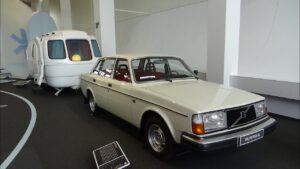
1956 Volvo PV444 – Oldtimer-Meeting Baden-Baden 2019
The 1956 Volvo PV444 belonged to a category of European cars that emerged from necessity rather than optimism. Developed during and immediately after the Second World War, it was conceived for a market that demanded fuel economy, mechanical simplicity, and long-term durability. By the middle of the 1950s, however, the PV444 had evolved into something larger than basic transport: it became the car that introduced Volvo to international export markets and established the company’s reputation for structural solidity.
Technical Details
The 1956 Volvo PV444 used a front-mounted inline four-cylinder engine from Volvo’s B4B and later B14 series, depending on exact specification and production timing. These engines displaced approximately 1.4 liters and were built around a durable cast-iron block with overhead valves. Output generally ranged between 44 and 70 horsepower depending on carburetion and trim level, placing the PV444 among the stronger performers in the European small-family-car segment of the period.
Power was delivered to the rear wheels through a manual transmission, most commonly a three-speed gearbox with column-mounted shifting on standard versions. The mechanical layout followed traditional engineering principles, but Volvo placed strong emphasis on reliability and structural integrity. The drivetrain components were deliberately over-engineered compared with many competitors, reflecting Scandinavian expectations regarding rough roads and severe winter conditions.
The chassis construction was especially significant. Unlike many earlier European sedans still relying heavily on separate-frame concepts, the PV444 used a unitary steel body structure. This contributed to greater rigidity and improved crash resistance, even though occupant safety was not yet marketed as aggressively as it later would be by Volvo.
Suspension design remained relatively conventional, with independent front suspension and a live rear axle. Yet the car’s weight distribution and robust build quality gave it stable road manners for its class. Owners particularly appreciated the PV444’s ability to tolerate long distances and difficult weather conditions with minimal mechanical drama.
By 1956, Volvo had already refined many early production weaknesses, making later PV444 models notably more reliable and better assembled than the first post-war examples.
- Manufacturer: Volvo
- Model name: Volvo PV444
- Year of manufacturing: 1956
Design
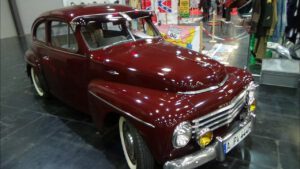
The visual identity of the 1956 Volvo PV444 reflected strong American influence filtered through Scandinavian practicality. Its rounded silhouette drew inspiration from pre-war streamlined sedans, particularly contemporary fastback forms popular in the United States during the 1930s and early 1940s.
The body shape featured curved fenders integrated into a compact two-door structure with a smoothly descending rear roofline. Compared with many small European cars of the early 1950s, the PV444 looked unusually substantial and solid. The front grille was simple and upright, while rounded headlamps and restrained chrome trim reinforced the car’s clean appearance.
Despite its compact dimensions, the PV444 projected visual toughness rather than fragility. Thick steel panels and relatively narrow windows contributed to this impression. Volvo did not pursue delicate proportions or decorative excess; instead, the car conveyed permanence and functionality.
Inside, the cabin remained straightforward and highly practical. Instrumentation was simple and easy to read, with controls positioned for usability rather than stylistic effect. Seating comfort and heating performance were particularly important in Scandinavian markets, and Volvo paid close attention to cold-weather practicality.
One unusual aspect of the PV444’s design history is how little it changed visually during its long production life. While competitors frequently redesigned their models, Volvo chose gradual refinement over stylistic reinvention. This continuity later became one of the company’s defining characteristics.
Historical Significance
The 1956 Volvo PV444 occupies a crucial position in Volvo’s transformation from a relatively small domestic manufacturer into an internationally recognized automotive company.
The PV444 itself had originally been unveiled during the final years of the Second World War, but large-scale production only became possible afterward due to material shortages and industrial disruption. When full production accelerated in the late 1940s and early 1950s, the car quickly became central to Volvo’s growth strategy.
Most importantly, the PV444 opened export opportunities. Volvo increasingly targeted foreign markets, especially the United States, where buyers appreciated the car’s durability and economy. The company learned that Scandinavian engineering could appeal internationally if presented as practical and dependable rather than luxurious.
The PV444 also established engineering habits that shaped Volvo for decades. Structural robustness, mechanical longevity, and cautious development became core elements of the company’s philosophy. Later Volvo safety innovations did not emerge suddenly; they evolved from the same mindset already visible in the PV444 era.
Another important historical factor was the car’s role in Swedish society. During the post-war economic expansion, the PV444 became accessible to a growing middle class. It represented mobility and stability at a time when car ownership was becoming increasingly achievable for ordinary families.
By 1956, the PV444 had therefore become far more than a successful model. It had become the foundation upon which Volvo built its international identity.
Quirks and Pop Culture
The Volvo PV444 acquired several affectionate nicknames over time, particularly in Scandinavia, where its rounded shape inspired comparisons to small animals and compact household objects. Its unusually stout appearance made it instantly recognizable on European roads crowded with thinner and more delicate-looking competitors.
In Sweden, the PV444 also became associated with winter resilience. Stories of cars surviving extreme cold, rough forestry roads, and very high mileage became part of the model’s folklore. Many owners treated the car less as a status symbol and more as an indispensable utility machine.
Another curiosity lies in the model’s transatlantic inspiration. Although deeply Scandinavian in engineering philosophy, the PV444’s styling borrowed noticeably from American automotive trends. This mixture of American visual influence and Swedish mechanical conservatism gave the car a unique identity among post-war European sedans.
The PV444 later became popular in amateur motorsport and historic rallying because of its rugged construction and relatively light weight. Enthusiasts discovered that beneath its modest appearance was a surprisingly capable chassis.
Display and preservation
The vehicle was exhibited at the Oldtimer-Meeting Baden-Baden in 2019, one of Germany’s most elegant open-air gatherings for historic automobiles. Held from 12 to 14 July in the Kurpark, the event presented more than 350 exclusive classic cars spanning nine decades of motoring history and attracted over 20,000 visitors. The 2019 edition paid tribute to Bentley’s centenary with a special guest display dedicated to the British marque. As a traditional Concours d’élégance, the meeting concluded with awards for 120 outstanding vehicles, while jazz, fashion elements, and evening garden festivities added to its distinctive atmosphere.
Conclusion
The 1956 Volvo PV444 helped define the values that later became inseparable from the Volvo brand. Its durable engineering, structurally strong body, and restrained design established a reputation for reliability that proved more valuable than fashionable styling trends. As both a practical family car and a key export success, the PV444 laid the groundwork for Volvo’s future growth and engineering direction. Today, it stands as one of the most important early post-war Scandinavian automobiles: modest in concept, but enormously influential in long-term impact.