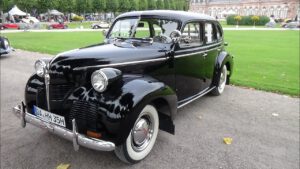
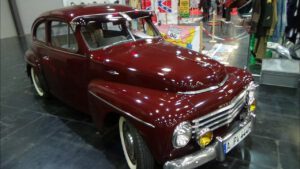
1948 Peugeot 203 – Retro Classics Stuttgart 2023
Emerging in the immediate aftermath of the Second World War, the Peugeot 203 marked a decisive restart for the French manufacturer. It was the first entirely new Peugeot developed after the war, and it introduced a level of technical and stylistic coherence that would define the brand for years. At a time when resources were scarce and rebuilding was the priority, the Peugeot 203 demonstrated how thoughtful engineering could support both reliability and modernity.
Technical Details
The Peugeot 203 was built around a front-mounted inline four-cylinder engine with a displacement of 1,290 cc. This engine produced approximately 42 horsepower at around 4,500 rpm, enabling a top speed close to 115 km/h. While modest in output, the engine was designed for durability and efficiency, characteristics that were essential in the post-war European context. A notable feature was its hemispherical combustion chamber design, which improved efficiency and combustion compared to more conventional layouts of the period.
Power was delivered to the rear wheels through a four-speed manual gearbox, with the fourth gear acting as an overdrive. This allowed the car to maintain relatively low engine speeds during cruising, improving fuel economy and mechanical longevity. The Peugeot 203 used a monocoque (unitary) body construction, a significant step forward compared to pre-war body-on-frame designs. Independent front suspension further improved ride comfort and handling, while hydraulic drum brakes provided reliable stopping power. Together, these elements positioned the Peugeot 203 as a technically advanced and well-balanced vehicle for its class.
- Manufacturer: Peugeot
- Model name: Peugeot 203
- Year of manufacturing: 1948–1960
Design
The design of the Peugeot 203 reflected a clear departure from pre-war styling conventions. Its body adopted the ponton form, with integrated fenders and smooth, continuous surfaces that replaced the previously separate, more upright elements. The front end featured a prominent grille flanked by integrated headlights, creating a cohesive and modern appearance.
The overall proportions were rounded and compact, with a gently sloping rear that hinted at aerodynamic considerations without fully adopting the streamlining seen in earlier models like the 402. Chrome detailing was present but restrained, contributing to a sense of understated refinement rather than ornamentation. Inside, the cabin emphasized practicality and clarity. The dashboard layout was simple and functional, with easily readable instruments and straightforward controls. The interior materials reflected the economic realities of the time, but the overall impression was one of durability and thoughtful design.
Historical Significance
The Peugeot 203 holds a central place in the company’s post-war history. It was the first new model Peugeot introduced after 1945 and effectively re-established the brand in a recovering European market. Production began in 1948, and for several years, the Peugeot 203 was the only model Peugeot offered, underscoring its importance to the company’s survival and growth.
The car was produced in large numbers for its time, with more than 680,000 units built by the end of production in 1960. This made it one of Peugeot’s first true mass-production successes. Its robust engineering and reliability helped build a strong reputation, particularly in export markets. The Peugeot 203 also laid the groundwork for future Peugeot models, introducing design and engineering principles that would be refined in later vehicles such as the 403 and 404. In this sense, it represents a bridge between pre-war traditions and modern automotive production.
Quirks and Pop Culture
One of the more distinctive technical features of the Peugeot 203 was its hemispherical combustion chamber, a design choice that was relatively advanced for a mass-produced car of the late 1940s. This contributed to the engine’s efficiency and durability, qualities that owners came to value highly.
The Peugeot 203 also became closely associated with everyday life in post-war France. It was used as a family car, a taxi, and even as a commercial vehicle in its various body styles, including estate and pickup versions. Its versatility made it a familiar presence on European roads during the 1950s. While it did not achieve the iconic pop culture status of some contemporaries, it remains a recognizable symbol of France’s economic recovery and the normalization of private car ownership in the post-war period.
Display and preservation
This car was filmed at the Retro Classics Stuttgart 2023. From 23 to 26 February, more than 82,000 visitors explored seven packed halls covering 105,000 square meters, showcasing the full spectrum of historic mobility. International dealers, restoration experts, and dedicated clubs created a rich and immersive atmosphere, complemented by a lively parts market and vehicle sales exchange. Highlights included special exhibitions celebrating the 60th anniversary of the Porsche 911 and 75 years of Porsche, alongside themed displays of American classics and vibrant club presentations.
Conclusion
The 1948 Peugeot 203 represents a foundational moment in Peugeot’s modern history. Technically advanced for its class, with features such as a monocoque body, independent front suspension, and an efficient engine design, it offered a reliable and forward-looking package. Its design reflected the transition to post-war automotive styling, while its production success re-established Peugeot as a major manufacturer. As both a practical vehicle and a historical milestone, the Peugeot 203 remains a key reference point in the evolution of European automobiles.