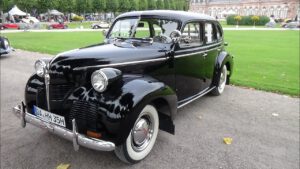
1954 Peugeot 203 C Limousine – Retro Classics Stuttgart 2024
In the early 1950s, Peugeot was rebuilding its identity in a recovering Europe, and the Peugeot 203 became its defining model. The Peugeot 203 C Limousine represents a mature phase of this development—technically conservative in some respects, yet forward-looking in construction and design. It was not a luxury car, but it played a crucial role in re-establishing everyday mobility.
Technical Details
The 1954 Peugeot 203 C Limousine was powered by a front-mounted inline four-cylinder gasoline engine with a displacement of 1,290 cc. The engine featured overhead valves, a relatively advanced solution for its class at the time, and produced approximately 42 horsepower at around 4,500 rpm. Power was transmitted to the rear wheels via a four-speed manual gearbox, with the first gear typically unsynchronized, reflecting common practice in early 1950s European cars.
One of the most significant technical features of the Peugeot 203 was its monocoque (self-supporting) body construction. This was Peugeot’s first model to adopt such a design, replacing the traditional body-on-frame approach and resulting in improved rigidity and reduced weight. The chassis incorporated independent front suspension with coil springs, while the rear used a rigid axle supported by leaf springs, balancing comfort with durability.
Braking was provided by hydraulic drum brakes on all four wheels. The car’s engineering emphasized reliability and ease of maintenance, qualities that made it particularly suitable for long-distance driving and export markets. With a top speed of approximately 115–120 km/h, the Peugeot 203 C Limousine was well suited to both urban and intercity travel in post-war Europe.
- Manufacturer: Peugeot
- Model name: Peugeot 203 C Limousine
- Year of manufacturing: 1948–1960 (example year: 1954)
Design
The design of the Peugeot 203 marked a clear departure from pre-war styling. It adopted a fully integrated ponton body, with smooth, rounded surfaces and enclosed fenders that reflected contemporary American influences while remaining distinctly European in proportion.
The front end featured a narrow, vertical grille framed by integrated headlights, creating a cohesive and modern appearance. The body was relatively tall and narrow, maximizing interior space while maintaining manageable external dimensions. Subtle chrome accents highlighted key elements such as the grille and bumpers without dominating the design.
At the rear, the Peugeot 203 displayed a gently sloping profile, giving it a balanced silhouette. The “Limousine” designation referred to the four-door sedan configuration, designed to accommodate families and professionals alike. Inside, the cabin emphasized clarity and functionality. The dashboard layout was simple, with centrally positioned instruments and straightforward controls, while materials were durable rather than decorative. Large windows contributed to good visibility and a sense of openness.
Historical Significance
The Peugeot 203 was introduced in 1948 as the company’s first entirely new model after the Second World War. At a time when resources were limited and the European automotive industry was rebuilding, Peugeot focused on creating a single, versatile model that could meet a wide range of needs.
This strategy proved highly successful. The Peugeot 203 remained Peugeot’s sole model for several years, effectively carrying the brand through the early post-war period. Its combination of modern construction, dependable engineering, and practical design made it popular both in France and in export markets.
By the mid-1950s, the Peugeot 203 C represented a refined version of the original concept, benefiting from incremental improvements in production and equipment. Total production exceeded 680,000 units by the end of its lifecycle in 1960, a significant figure for the time and a clear indication of its importance to Peugeot’s recovery and growth.
Quirks and Pop Culture
The Peugeot 203 developed a reputation for durability that extended beyond Europe. It was widely used in regions with challenging road conditions, particularly in Africa, where its robust construction and simple mechanics proved advantageous. This contributed to its image as a reliable and long-lasting vehicle rather than a fashionable one.
A notable technical quirk is its early adoption of monocoque construction within Peugeot’s lineup, a feature that would later become standard across the industry. At the time, this approach distinguished the Peugeot 203 from many competitors that still relied on separate frames.
While the Peugeot 203 did not achieve the same level of pop culture recognition as some later models, it remains an important reference point in French automotive history. It is often associated with the broader narrative of post-war reconstruction and the return of everyday mobility.
Display and preservation
The vehicle was presented at Retro Classics Stuttgart 2024, one of Europe’s largest gatherings for historic mobility. From 25 to 28 April 2024, more than 70,000 visitors explored around 80,000 square metres of exhibition space, with over 2,000 classic vehicles displayed across six packed halls. The show combined strong commercial activity with carefully curated anniversary themes, including 50 years of the Porsche 911 Turbo, 60 years of the Ford Mustang, and 70 years of the Mercedes-Benz 300 SL “Gullwing” with a special exhibition on tuning culture from the 1970s to the 1990s.
Conclusion
The 1954 Peugeot 203 C Limousine stands as a key model in Peugeot’s post-war development. Technically, it combined a modest but capable engine with modern construction methods and proven mechanical solutions. Its design introduced a new visual language for the brand, moving away from pre-war forms toward a more integrated and contemporary style.
Historically, it played a central role in stabilizing Peugeot during a critical period, serving as the company’s primary model for several years. Although not a car of extremes, the Peugeot 203’s balance of reliability, practicality, and modernity ensured its lasting significance. Today, it is best understood as a foundational vehicle—one that quietly shaped Peugeot’s future direction.