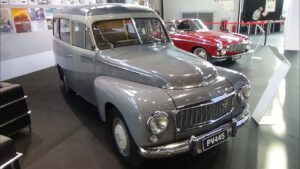
1989 Peugeot 205 CJ Cabrio – Exterior and Interior – Classic Expo Salzburg 2024
By the late 1980s, the Peugeot 205 had already established itself as one of Europe’s defining small cars. The CJ Cabriolet added a lighter, more lifestyle-oriented dimension to the range, offering open-top driving without the performance focus of the GTI. It reflected a different side of the 205’s versatility—accessible, stylish, and designed for everyday enjoyment.
Technical Details
The 1989 Peugeot 205 CJ Cabriolet was based on the standard Peugeot 205 platform, retaining its front-engine, front-wheel-drive layout and compact mechanical package. It was typically powered by a 1.1-liter inline four-cylinder gasoline engine (TU series), producing approximately 55 horsepower. This modest output was paired with a four- or five-speed manual transmission, emphasizing efficiency and ease of use rather than performance.
The cabriolet conversion was carried out by Pininfarina, who adapted the three-door hatchback body into an open-top configuration. As with most conversions of this type, structural reinforcements were added to the floorpan and side sills to maintain rigidity in the absence of a fixed roof. The suspension setup remained unchanged from the standard Peugeot 205, with independent front suspension and Peugeot’s characteristic torsion-bar rear axle, a compact and space-efficient solution widely used across the brand’s small cars.
Braking was handled by front disc brakes and rear drum brakes, consistent with the CJ’s positioning as an entry-level variant. The lightweight construction and relatively small engine contributed to low fuel consumption and straightforward maintenance, key attributes for its target audience. Performance figures placed the car firmly in the urban and leisure category, with a top speed of around 140 km/h depending on specification.
- Manufacturer: Peugeot
- Model name: Peugeot 205 CJ Cabriolet
- Year of manufacturing: 1986–1994 (example year: 1989)
Design
The design of the Peugeot 205 CJ Cabriolet closely followed the clean, compact lines of the original hatchback, while adapting them to an open configuration. The transformation into a cabriolet was handled with restraint: the basic proportions remained intact, preserving the visual balance that had made the Peugeot 205 so successful.
With the roof folded, the car presented a simple, horizontal profile, enhanced by the absence of a B-pillar. The soft top was manually operated and designed to be compact when stowed, maintaining a tidy rear silhouette. Compared to more performance-oriented variants, the CJ featured understated exterior details, often including simpler wheel designs and minimal trim.
Inside, the cabin emphasized functionality and lightness. Materials were straightforward, reflecting the CJ’s position as an entry-level model within the cabriolet range. The open-top layout, however, transformed the driving experience, making even short journeys feel more engaging. The compact dimensions and excellent visibility contributed to ease of use in urban environments.
Historical Significance
The Peugeot 205 played a central role in Peugeot’s recovery during the 1980s, helping to stabilize the company financially and re-establish its reputation in the small-car segment. Introduced in 1983, the Peugeot 205 quickly became a commercial success across Europe, with a wide range of variants covering everything from basic transport to high-performance models like the GTI.
Within this lineup, the cabriolet versions—produced by Pininfarina in Italy—added an aspirational element. The CJ, introduced as a more affordable alternative to the better-equipped CT and CTI variants, made open-top motoring accessible to a broader audience. It demonstrated Peugeot’s ability to diversify a successful platform into multiple niches without fundamentally altering its technical base.
Production of the Peugeot 205 Cabriolet continued into the early 1990s, even as the broader market began shifting toward more practical body styles. The CJ variant, in particular, reflects a period when small, affordable convertibles were still a viable part of European automotive culture.
Quirks and Pop Culture
Unlike the high-profile GTI models, the Peugeot 205 CJ Cabriolet did not become a performance icon, but it developed a quieter cultural presence. It was often associated with leisure driving, coastal roads, and everyday enjoyment rather than speed or competition.
One of its defining quirks lies in its positioning: it offered the cabriolet experience without the cost or complexity typically associated with open-top cars. This made it popular among younger buyers and those seeking a second car for recreational use. In period advertising and automotive press, the CJ was frequently portrayed as approachable and unpretentious, reinforcing its role as a lifestyle vehicle.
The involvement of Pininfarina also adds a layer of interest. While better known for high-end Italian sports cars, the design house applied its expertise here in a subtle way, focusing on proportion and structural adaptation rather than dramatic styling changes.
Display and preservation
This car was shown at the Classic Expo Salzburg 2024. Around 23,000 visitors gathered from 18th to 20th October 2024 at the Messezentrum Salzburg to experience a blend of professional dealers, private sellers, and specialist service providers. A high-quality parts market spread across two halls offered everything from rare components to literature and accessories. Auctions of vintage vehicles, expert talks, and club presentations added depth to the event, highlighting not only the vehicles themselves but also the knowledge, networks, and dedication essential for their long-term preservation.
Conclusion
The 1989 Peugeot 205 CJ Cabriolet represents a distinct interpretation of the successful Peugeot 205 formula. Technically simple and efficient, it retained the strengths of the base model while introducing the added appeal of open-top driving. Its design, shaped in collaboration with Pininfarina, balanced practicality with a sense of lightness and freedom.
Historically, it reflects Peugeot’s strategy of expanding a strong core model into multiple segments, including the niche of affordable convertibles. While it lacks the fame of the GTI, the CJ offers a different kind of appeal—accessible, relaxed, and rooted in everyday usability. As such, it remains a characteristic example of late-1980s European automotive culture.