1937 Renault Vivaquatre – Retro Classics meets Barock Ludwigsburg 2016
A six-cylinder Renault positioned for the middle class is not something immediately associated with the brand today. Yet in the late 1930s, the Renault Vivaquatre represented exactly that: a technically conservative but notably refined step above small family cars. Its combination of size, smoothness, and understated presence reflects a transitional moment just before European automotive design and engineering changed dramatically.
Technical Details
The 1937 Renault Vivaquatre was built around a front-mounted inline six-cylinder engine, a configuration that distinguished it within Renault’s mid-range lineup. Displacement is commonly cited at around 2.4 liters, delivering approximately 50 to 56 horsepower depending on the specific version and source. This six-cylinder layout emphasized smooth operation and steady torque rather than outright performance, aligning with the car’s role as a comfortable touring vehicle.
Power was transmitted to the rear wheels through a manual gearbox, following the conventional front-engine, rear-wheel-drive architecture typical of the period. One notable technical characteristic of Renault at the time was the placement of the radiator behind the engine, a legacy of earlier Renault designs that influenced airflow and front-end styling.
The chassis relied on a body-on-frame construction, with rigid axles and leaf spring suspension, reflecting established engineering practice rather than innovation. Braking was handled by mechanical drum brakes on all four wheels, a standard solution in the mid-1930s, though increasingly challenged by emerging hydraulic systems from competitors. Overall, the Renault Vivaquatre’s technical concept prioritized durability, ease of maintenance, and smooth running characteristics over experimentation.
- Manufacturer: Renault
- Model name: Renault Vivaquatre
- Year of manufacturing: 1937
Design
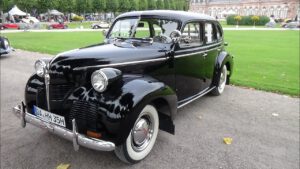
The design of the 1937 Renault Vivaquatre reflects the gradual shift from upright, pre-war forms toward more streamlined shapes. While still clearly rooted in traditional proportions, the body shows early aerodynamic influence, with a slightly sloping grille and more integrated fenders compared to earlier models of the decade.
A defining feature is the long hood, necessary to accommodate the inline six-cylinder engine, which gives the car a balanced and elongated profile. The front end retains Renault’s characteristic layout, influenced by the rear-mounted radiator, resulting in a distinctive grille shape that differs from many contemporaries. Headlights were typically mounted separately on the fenders, a common design element of the era.
The body was offered in several variants, including saloon and limousine configurations, allowing the Renault Vivaquatre to serve both private owners and professional uses such as taxis. The overall appearance is restrained, with minimal ornamentation, relying instead on proportion and surface continuity to convey presence. Inside, the cabin emphasized practicality and space, with upright seating and a straightforward dashboard layout consistent with late-1930s design principles.
Historical Significance
The Renault Vivaquatre belongs to a broader family of “Viva” models introduced in the early 1930s, which included the Vivastella and Vivasport. These cars formed Renault’s attempt to cover a wider range of market segments, from accessible family vehicles to more prestigious offerings. The Renault Vivaquatre occupied a middle position, offering six-cylinder refinement without entering the luxury category.
By 1937, the European automotive industry was undergoing a gradual transition toward more modern construction methods and aerodynamic styling. However, the Renault Vivaquatre remained rooted in established engineering solutions such as body-on-frame construction and mechanical brakes. This makes it representative of a phase where manufacturers balanced innovation with proven reliability, particularly in markets where durability and serviceability were critical.
Production of the Renault Vivaquatre continued until the late 1930s, ending as the Second World War disrupted civilian automobile manufacturing across Europe. In this sense, the model stands as part of the final generation of pre-war Renault passenger cars, just before the company’s post-war reinvention with models like the 4CV.
Quirks and Pop Culture
One of the more distinctive aspects of the Vivaquatre is its six-cylinder engine in a segment where many competitors relied on four-cylinder units. This gave the car a smoother and quieter driving experience, a feature appreciated by drivers covering longer distances or operating in professional roles.
Another notable quirk is Renault’s continued use of the rear-mounted radiator layout during this period. While largely phased out by other manufacturers, Renault maintained this configuration well into the 1930s, contributing to the brand’s unique front-end design and engineering identity.
Although the Renault Vivaquatre does not have a strong presence in modern popular culture, it was a familiar sight in pre-war France, often used as a taxi or administrative vehicle. Its role was less about symbolism and more about everyday utility, embedding it quietly into the fabric of urban and intercity transport of the time.
Display and preservation
This car was filmed in Ludwigsburg. “Retro Classics meets Barock” 2016 offered a refined interpretation of classic car display, set against the grand courtyard of the Royal Palace. Limited to vehicles built between 1886 and 1968, the Concours d’Élégance emphasized authenticity, craftsmanship, and historical relevance. The baroque backdrop, enhanced by evening illuminations and artistic performances, elevated the presentation into a cultural experience. Highlights such as the rare Facel Vega gathering underscored the exclusivity of the event. Rather than sheer quantity, the focus lay on careful selection and elegant staging—demonstrating how preservation can merge seamlessly with heritage and atmosphere.
Conclusion
The 1937 Renault Vivaquatre represents a measured approach to mid-range motoring in the late 1930s. Its six-cylinder engine provided refinement, while its conventional chassis and braking systems reflected a preference for reliability over innovation. In design, it bridges older upright forms and emerging streamlined trends. Historically, it captures a moment just before the disruptions of war reshaped the automotive industry. As such, the Renault Vivaquatre stands as a clear example of Renault’s pre-war strategy: practical, slightly understated, and technically conservative, yet thoughtfully executed.