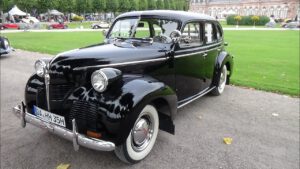
1960 – Renault 4CV – Retro Classics Stuttgart 2016
By 1960, the Renault 4CV was nearing the end of a production run that had already reshaped post-war mobility in France. What began as a compact, affordable car in the late 1940s had become a familiar presence across Europe. In its final years, the 4CV was no longer a novelty, but a proven and widely adopted solution for everyday transportation.
Technical Details
The 1960 Renault 4CV retained its original rear-engine, rear-wheel-drive configuration. It was powered by a water-cooled inline four-cylinder engine with a displacement of 747 cc. Output was typically around 21 horsepower, a modest figure that reflected the car’s focus on efficiency and accessibility rather than performance. Top speed was generally in the range of 90–100 km/h.
The engine was mounted behind the rear axle, driving the rear wheels through a three-speed manual gearbox. This layout provided good traction, particularly at low speeds and on uneven surfaces, although it also influenced handling characteristics at higher speeds.
Suspension was independent on all four wheels, using coil springs, which contributed to a relatively comfortable ride for a car of its size and era. Braking was handled by drum brakes on all four wheels. The overall mechanical design emphasized simplicity, durability, and ease of maintenance—key considerations for a car aimed at a broad customer base.
- Manufacturer: Renault
- Model name: Renault 4CV
- Year of manufacturing: 1960
Design
The Renault 4CV’s design reflected its origins in the immediate post-war period. Its rounded, compact shape featured integrated fenders and a smooth, continuous body line, characteristic of early ponton styling. The proportions were small and upright, maximizing interior space within limited dimensions.
At the front, the design was simple and approachable, with small headlights and minimal grille openings. The absence of a front-mounted engine allowed for a front luggage compartment, while the rear housed the engine beneath a vented cover.
Inside, the cabin was basic but functional. Seating for four passengers was arranged efficiently, and the dashboard layout was straightforward, with controls designed for ease of use. Materials were minimal, reflecting cost constraints, but the overall design prioritized practicality.
The car’s compact dimensions made it well suited to narrow streets and urban environments, reinforcing its role as an accessible city car.
Historical Significance
The Renault 4CV was introduced in 1947 and became the first French car to exceed one million units in production, a milestone achieved in 1954. By 1960, it had firmly established itself as a key vehicle in the reconstruction and modernization of post-war France.
Developed during the Second World War and brought to market in its aftermath, the 4CV played a central role in making car ownership accessible to a wider population. It was part of a broader movement toward affordable, mass-produced vehicles that transformed mobility across Europe.
By the late 1950s, however, the automotive landscape was changing. Newer models, including the Renault Dauphine, offered more space, comfort, and modern features. The 4CV continued in production due to its reliability and established reputation, but it was gradually being phased out.
Production ended in 1961, with total output exceeding 1.1 million units. The 1960 model represents one of the final iterations of a car that had already achieved lasting significance.
Quirks and Pop Culture
The Renault 4CV was widely known by the nickname “La motte de beurre” (“the pat of butter”), a reference to its original yellow color and rounded shape. This nickname reflects how closely the car became associated with everyday life in post-war France.
Its rear-engine layout gave it distinctive driving characteristics, including strong traction but also a tendency toward oversteer under certain conditions. These traits became part of its identity among drivers.
The 4CV also had a presence in motorsport, particularly in endurance racing events such as Le Mans, where modified versions demonstrated the potential of its simple mechanical design.
In cultural terms, the Renault 4CV became a symbol of recovery and modernization. It appeared frequently in photographs and films of the period, representing a new era of mobility for ordinary people.
Display and preservation
This car was displayed at the Retro Classics Stuttgart 2016. It was held from 17 to 20 March 2016, spread across 125,000 square meters and featured 1,555 exhibitors. The fully booked event attracted over 90,000 visitors. Across fully occupied halls, rare originals, such as those from the Louwman Museum and a striking lineup of Veritas sports and racing cars, were displayed with an emphasis on authenticity and historical context. With around 2,000 vehicles on show, the exhibition balanced high-profile brands with lesser-known treasures. The thoughtful staging and diversity of exhibits ensured not only visual impact but also a meaningful preservation of automotive history for a wide audience. Beyond exhibition, the fair also functioned as a major marketplace, with numerous vehicles offered for sale.
Conclusion
The 1960 Renault 4CV stands as the final chapter of one of the most important small cars of the post-war era. Technically simple yet effective, it combined a rear-engine layout with practical engineering solutions. Its design was compact and functional, suited to the needs of a changing society.
Historically, it played a crucial role in making car ownership accessible and in shaping the development of Renault as a mass-market manufacturer. As production came to an end shortly after 1960, the 4CV remained a clear example of how a modest, well-designed car could have a lasting impact on both industry and society.