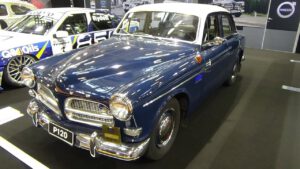
1964 Volvo PV544 – Classic Expo Salzburg 2023
The 1964 Volvo PV544 arrived at a moment when automotive fashion was moving rapidly toward angular bodywork and larger dimensions. Yet Volvo continued refining a shape rooted in the 1940s, combining old-world styling with surprisingly modern engineering underneath. By the mid-1960s, the PV544 had earned a reputation not through glamour, but through endurance rallies, structural strength, and reliability in difficult climates.
Technical Details
The 1964 Volvo PV544 was powered by Volvo’s well-known B18 inline four-cylinder engine, a unit that became one of the company’s most respected powerplants. Depending on specification and market, the car was available with versions producing between approximately 75 and 90 horsepower. The engine displaced 1.8 liters and used overhead valves with a durable cast-iron construction designed for long service life. Power was sent to the rear wheels through a four-speed manual transmission, and some versions were equipped with an electrically operated overdrive, effectively providing a fifth cruising ratio for lower engine speeds at highway velocity.
One of the major engineering strengths of the PV544 was its robust chassis structure. While the body retained pre-war visual influences, Volvo continuously modernized the mechanical package. The car featured independent front suspension with coil springs and a live rear axle supported by leaf springs, a configuration chosen for durability and predictable handling on rough roads. Disc brakes were introduced at the front during the model’s production life, giving the PV544 stronger stopping performance than many contemporary family sedans.
The B18 engine itself contributed heavily to the model’s reputation. Known for its longevity, it was engineered with a five-bearing crankshaft that improved smoothness and durability under sustained use. Combined with relatively low vehicle weight, the drivetrain gave the 1964 Volvo PV544 respectable performance and strong reliability in cold-weather and long-distance driving conditions. The car’s straightforward mechanical layout also made maintenance relatively simple, particularly important in Scandinavian rural environments where service infrastructure could be limited.
- Manufacturer: Volvo
- Model name: Volvo PV544
- Year of manufacturing: 1964
Design
Visually, the 1964 Volvo PV544 looked markedly different from most mid-1960s European sedans. Its rounded roofline, separate fenders, and upright proportions traced their origins back to the earlier PV444 introduced during the Second World War era. Rather than abandoning the design entirely, Volvo gradually evolved it over two decades, creating a car that appeared conservative but highly recognizable.
The front end featured a simple oval grille flanked by round headlamps, while the sloping rear roofline gave the car an almost fastback-like silhouette. The body shape was compact but solid, with thick pillars and relatively small glass surfaces compared with newer competitors. These proportions reinforced the feeling of sturdiness that became central to Volvo’s identity.
Inside, the PV544 received meaningful improvements over earlier PV models. The dashboard layout was more modernized by the 1960s, and the addition of a padded dashboard reflected Volvo’s growing emphasis on safety engineering. Seating was upright and practical rather than luxurious, prioritizing visibility and comfort during long journeys. The large steering wheel, simple gauges, and restrained interior decoration reflected Scandinavian functionalism more than decorative automotive trends.
The car’s appearance increasingly stood apart from contemporary styling trends by 1964. While competitors adopted flatter lines and expansive glass areas, the PV544 maintained its rounded form. This gave it an almost timeless quality, particularly in northern Europe, where practicality often mattered more than fashion.
Historical Significance
The Volvo PV544 occupies an important place in Volvo’s transition from a regional Scandinavian manufacturer into a globally respected automotive brand. The earlier PV444 had introduced Volvo to post-war mass production, and the later PV544 refined the concept while improving safety, drivability, and durability.
By 1964, the PV544 was competing against much more modern-looking vehicles, yet it continued to sell because of its mechanical reliability and strong reputation in difficult conditions. Volvo used the model to reinforce an image built around longevity and engineering honesty rather than luxury or performance excess.
The PV544 also became highly significant in motorsport, particularly rallying. Lightweight construction combined with the strong B18 engine made the car unexpectedly competitive in endurance events. Volvo driver Erik Carlsson achieved major international rally success in PV544-based cars during the late 1950s and early 1960s, including victories at the RAC Rally and the Safari Rally. These achievements gave the PV544 credibility far beyond Scandinavia and demonstrated that durability could also translate into competitive success.
Safety development during the PV544 era also shaped Volvo’s future direction. The company increasingly focused on occupant protection, incorporating features such as padded dashboards and improved seatbelt mounting points. These ideas later became defining elements of Volvo engineering philosophy.
Production of the PV544 continued until 1965, unusually long for a car whose styling roots stretched back decades. Its longevity reflected not stagnation, but Volvo’s deliberate preference for gradual technical refinement over rapid stylistic reinvention.
Quirks and Pop Culture
Among enthusiasts, the Volvo PV544 is often remembered for the contrast between its conservative appearance and its surprising rally capability. In international motorsport circles, the rounded Volvo became an unlikely competitor against more obviously sporting machines. Its success helped create the image of Volvo as a manufacturer of cars that could survive extreme punishment.
The PV544 also became associated with Scandinavian practicality. In Sweden and other Nordic countries, the car developed a reputation as a dependable all-weather machine capable of enduring snow, gravel roads, and long distances with minimal drama. Many examples accumulated extremely high mileage, reinforcing the mythology surrounding the durability of the B18 engine.
Another distinctive detail was the split-style windshield retained on earlier PV models before later revisions moved toward a single-piece design. Combined with the curved roofline, this gave the car an unmistakably vintage profile even during the 1960s.
Today, the 1964 Volvo PV544 remains popular in historic rally events and classic-car communities. Enthusiasts value not only its durability but also its mechanical simplicity and direct driving feel, qualities increasingly rare in modern automobiles.
Display and preservation
This car was shown at the Classic Expo Salzburg 2023. From 20 to 22 October, the Messezentrum Salzburg became a vibrant hub for classic car enthusiasts from across Europe. Welcoming around 23,000 visitors—an increase of nearly 15% compared to the previous year—the event demonstrated its growing appeal. With 400 exhibitors ranging from prestigious dealers to private sellers and parts specialists, the show offered an impressive diversity. Highlights included expert talks, a lively auction by Dorotheum, and the traditional Salz & Öl Rallye starting directly from the venue, bringing history to life.
Conclusion
The 1964 Volvo PV544 combined outdated styling with increasingly modern engineering, creating a car whose reputation rested on substance rather than appearance. Its durable B18 engine, robust construction, and rally success helped establish Volvo’s international image for reliability and safety. While visually rooted in an earlier automotive era, the PV544 proved remarkably adaptable, remaining competitive and relevant well into the 1960s. Today, it stands as one of the clearest expressions of Volvo’s early engineering philosophy: practical, durable, and quietly distinctive.