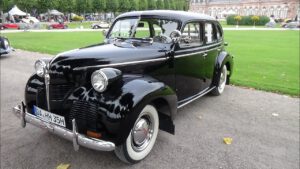
1912 Ford Model T – Auto Show Essen 2014
By 1912, the Ford Model T had already stopped being a novelty and was beginning to reshape everyday geography. Farmers used it to reach distant markets, doctors relied on it for rural visits, and entire small businesses reorganized themselves around the assumption that affordable motorized transport now existed. The 1912 Ford Model T was not yet the fully standardized black automobile later associated with Henry Ford; instead, it belonged to a transitional phase when the car still carried traces of experimentation, regional adaptation, and early automotive improvisation.
Technical Details
The 1912 Ford Model T used a front-mounted inline four-cylinder gasoline engine with a displacement of 2.9 liters. Output was rated at approximately 20 horsepower, though Ford focused less on headline performance figures than on usable torque and reliability under poor road conditions. The engine block and cylinder head were cast as a single unit, an advanced manufacturing approach for the period that simplified production and maintenance.
Perhaps the most unusual technical aspect of the Model T was its planetary transmission system. Instead of the sliding-gear manual transmissions common in later automobiles, the Ford used a two-speed planetary gearbox operated by pedals and hand controls. This arrangement reduced the need for complicated gear changes and made the car easier to operate for first-time drivers, many of whom had never handled machinery more complex than agricultural equipment.
The chassis was deliberately engineered for rough roads. High ground clearance, flexible suspension, and lightweight vanadium steel construction allowed the Model T to cope with mud tracks, ruts, and primitive rural routes that would challenge many heavier European cars of the era. Semi-elliptic leaf springs absorbed impacts, while the simple mechanical layout made roadside repairs possible with basic tools.
Unlike later standardized production years, the 1912 Ford Model T still appeared in numerous configurations and regional variations. Bodies, seating arrangements, tops, and accessories often differed depending on dealer specifications or intended use. Technically, the Model T’s genius lay not in sophistication but in adaptability. It functioned as a passenger car, utility vehicle, delivery machine, and agricultural support tool using essentially the same mechanical platform.
- Manufacturer: Ford Motor Company
- Model name: Ford Model T
- Year of manufacturing: 1912
Design
The design of the 1912 Ford Model T reflected a machine still visually connected to the carriage age, yet increasingly shaped by industrial logic rather than coachbuilding tradition. Earlier Model Ts often featured contrasting paint colors, polished brass lamps, and exposed wooden structural elements, characteristics that largely disappeared once Ford moved toward greater standardization later in the decade.
The upright seating position gave drivers a commanding view over poor roads, while the narrow body minimized weight and material costs. The fenders curved high above the wheels, partly to cope with muddy terrain and partly because wheel travel remained considerable on uneven surfaces. Running boards stretched between the axles, emphasizing the car’s height and practicality.
The interior was sparse but not crude. Controls were unconventional, with pedals operating transmission functions rather than the now-familiar clutch-brake-accelerator arrangement. The steering wheel sat high and relatively close to the driver, reflecting both carriage ergonomics and the need for leverage on rough surfaces.
One particularly distinctive feature of the 1912 Model T was its visual lightness. Compared with later mass-produced sedans of the 1920s, the car still appeared almost delicate, with thin pillars, exposed components, and minimal bodywork surrounding the passenger compartment. It retained the openness and mechanical honesty of pioneer-era automobiles before cars evolved into fully enclosed industrial consumer products.
Historical Significance
The 1912 Ford Model T arrived at a critical point in Ford Motor Company’s development. The famous moving assembly line would only be fully implemented the following year, meaning this version of the Model T represents the threshold between early automobile manufacturing and modern industrial mass production.
At the beginning of the twentieth century, automobiles were still expensive, mechanically intimidating objects for many people. Ford’s central insight was not simply to build a car cheaply, but to design a vehicle specifically for large-scale production and broad usability. The Model T’s mechanical simplicity, interchangeable parts, and durable construction all served that strategy.
By 1912, the car had already become deeply integrated into rural American life. In many regions, it effectively extended the practical distance between home, work, markets, and towns. Farmers could travel farther in less time, doctors reached isolated patients more quickly, and merchants expanded delivery ranges. The social effect was cumulative: roads improved because cars existed, and cars became more useful because roads improved.
Internationally, the Model T also accelerated the globalization of automotive manufacturing. Ford established assembly operations in multiple countries, spreading American industrial methods abroad. While European manufacturers often focused on engineering refinement or luxury craftsmanship, Ford emphasized repeatability, standardization, and production efficiency.
The 1912 version is historically significant precisely because it predates the complete industrial transformation usually associated with Fordism. It still belongs partly to the handcrafted automotive world while simultaneously pointing toward the mechanized future of twentieth-century manufacturing.
Quirks and Pop Culture
The Ford Model T accumulated countless unofficial uses and modifications, many of which emerged during the 1910s. Owners adapted the cars into tractors, sawmills, generators, and snow vehicles using aftermarket kits. In rural communities, a Model T often served as the most versatile machine a family owned.
One of the car’s enduring quirks involved starting procedure. Drivers had to crank the engine manually from the front, a process that required care because incorrect handling could cause dangerous kickback injuries. Learning to operate a Model T became almost a cultural rite of passage in some communities.
Although later generations associated the Model T exclusively with black paint, 1912 examples could still appear in other colors. The rigid “any color so long as it is black” period had not yet fully arrived. This makes surviving early Model Ts visually distinct from the simplified image often preserved in popular memory.
The Model T also became one of the first truly global automotive symbols. It appeared in silent films, newspaper cartoons, travel photography, and political commentary. More importantly, it normalized the idea that ordinary people — not only wealthy enthusiasts — could own and operate a motor vehicle.
Display and preservation
This car was filmed at the 2014 Essen Motor Show. Known as one of Germany’s great automotive gatherings, it welcomed around 352,000 enthusiasts in Essen from 29 November to 7 Dezember 2014. Visitors found a mix of performance cars, tuning culture, motorsport exhibits, motorcycles, and historic automobiles. Beyond the modern machinery, the event also celebrated automotive heritage through carefully presented classic cars and special exhibitions.
Conclusion
The 1912 Ford Model T represents a transitional moment in automotive history, positioned between the handcrafted experimentation of the early motoring era and the industrialized mass production that would soon dominate the twentieth century. Technically, it relied on simplicity, durability, and adaptability rather than refinement. Its design remained closely tied to carriage traditions while increasingly shaped by manufacturing efficiency. Historically, it helped transform mobility from a specialized luxury into an everyday reality for millions of people. More than just an early Ford, the 1912 Model T stands as evidence of how a practical machine can reorganize social habits, industry, infrastructure, and expectations on a global scale.