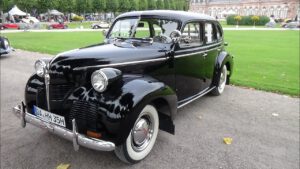
1912 Ford Model T – Retro Classics Stuttgart 2018
By 1912, the Ford Model T had already become more than a new automobile. It was turning into a machine that reshaped how ordinary people moved, worked, and traveled. Unlike many early cars aimed at wealthy buyers, the Model T was designed to survive rough roads, remain mechanically straightforward, and be affordable enough for middle-class families. The 1912 version belongs to the final years before Ford’s moving assembly line transformed industrial production entirely, making it a particularly revealing snapshot of the car’s early evolution.
Technical Details
The 1912 Ford Model T was powered by a front-mounted inline four-cylinder gasoline engine with a displacement of 2.9 liters (177 cubic inches). The engine produced approximately 20 horsepower at relatively low engine speeds, prioritizing durability and torque over outright performance. Depending on body style and conditions, the car could reach top speeds of roughly 65 to 70 km/h.
One of the Model T’s defining technical characteristics was its planetary transmission. Instead of a conventional gear lever and clutch arrangement, the car used a pedal-operated two-speed transmission controlled through a combination of pedals and hand levers. This system simplified operation for many inexperienced drivers at a time when automobiles were still unfamiliar to much of the population.
Power was transmitted to the rear wheels through a driveshaft enclosed within a torque tube. The chassis used transverse semi-elliptical leaf springs at both axles, giving the Model T substantial suspension travel for uneven roads and rural terrain. Ford also made extensive use of vanadium steel, which improved strength while reducing weight compared with more traditional materials.
Braking remained mechanically simple. The primary brake acted on the transmission, while separate mechanical brakes operated on the rear wheels for parking and emergency use. Wooden artillery wheels with narrow pneumatic tires reflected standard construction methods of the period.
Although technically uncomplicated, the Model T’s engineering was carefully optimized for reliability, ease of repair, and large-scale manufacturing. These qualities mattered more to Ford than mechanical sophistication or luxury features.
- Manufacturer: Ford Motor Company
- Model name: Ford Model T
- Year of manufacturing: 1912
Design
The design of the 1912 Ford Model T reflected the practical realities of early motoring. The car sat high above the ground to cope with deeply rutted and often unpaved roads, while its narrow body kept weight low and construction straightforward. Body styles varied widely in 1912, including Touring, Runabout, Torpedo, Town Car, and commercial variants, but all shared the same recognizable mechanical structure and proportions.
Visually, the 1912 Model T still belonged to the “brass era” of automobile design. The upright brass radiator surround, polished headlamp housings, exposed suspension elements, and curved fenders gave the car a distinctly early twentieth-century appearance. Unlike the later all-black Model Ts that became famous after large-scale assembly-line production intensified, 1912 examples could still be ordered in several dark colors, including deep blue and green tones.
The open-body Touring version was especially common, featuring folding canvas roofs and removable side curtains instead of fully enclosed cabins. Interiors remained sparse, with simple bench seating, exposed controls, and minimal instrumentation. Comfort was secondary to practicality, yet the open design created a strong sense of connection between passengers and the surrounding landscape.
The Model T’s appearance avoided unnecessary decoration. Its design communicated utility and accessibility rather than prestige, reinforcing Ford’s intention to build transportation for ordinary users rather than elite motorists.
Historical Significance
The Ford Model T occupies one of the most important positions in automotive history. Introduced in 1908, it transformed the automobile from a specialist product into a practical tool for mass mobility. By 1912, Ford was already producing vehicles at unprecedented scale, though the full moving assembly line would only arrive the following year.
Henry Ford’s philosophy centered on standardization, interchangeability, and affordability. The Model T embodied these ideas more successfully than any previous automobile. It allowed farmers, tradespeople, and middle-class families to travel independently over long distances, reducing reliance on railways and horse-drawn transportation.
The Model T also reshaped industrial manufacturing itself. Ford’s production methods dramatically lowered assembly times and vehicle prices, influencing industries far beyond automobiles. Over the course of production, more than 15 million Model Ts were built, making it the world’s best-selling automobile for many years.
The 1912 model year is historically significant because it predates the complete dominance of assembly-line standardization while already showing Ford’s transition toward industrial-scale production. It represents a moment when the automobile was rapidly becoming part of everyday life rather than an experimental luxury.
Quirks and Pop Culture
The Ford Model T quickly acquired the nickname “Tin Lizzy,” a term that captured both its humble construction and its dependable personality. By the 1910s, the Model T had become deeply embedded in popular culture, appearing in newspaper cartoons, silent films, advertisements, and countless family photographs.
Its unusual control system became one of its most memorable quirks. Drivers used pedals not only for braking but also for controlling transmission speeds and reverse gear. Starting the engine often required a hand crank, adding a physical ritual to driving that later disappeared from everyday motoring.
Because the Model T was mechanically straightforward and widely available, owners modified them extensively. Cars were converted into trucks, ambulances, racing machines, farm tractors, and homemade utility vehicles. This adaptability reinforced the Model T’s image as a practical machine rather than a fragile luxury product.
The car’s role in rural communities also became legendary. It connected isolated towns, allowed easier access to cities, and changed patterns of commerce and social interaction. Even decades later, the Model T remained shorthand for the beginning of mass automobile culture.
Display and preservation
This car was filmed at the 18th edition of Retro Classics Stuttgart in 2018. This is one of Europe’s premier classic car gatherings, attracting around 87,000 visitors and spread across 140,000 square meters. The exhibition offered a rich blend of international dealers, clubs, specialists, and parts suppliers. Unique highlights included the Neo Classics segment, showcasing modern coachbuilt and one-off creations, alongside themed halls such as the chrome-filled American Way of Drive. From pre-war automotive artistry to rare Soviet state limousines, the event celebrated preservation through diversity, craftsmanship, and historical depth.
Conclusion
The 1912 Ford Model T represents a defining stage in the early history of mass motoring. Technically simple yet highly durable, it combined a reliable four-cylinder engine with lightweight construction and practical engineering solutions suited to difficult road conditions. Its restrained design reflected function rather than luxury, while its historical importance lies in making automobile ownership accessible on an unprecedented scale. Through its industrial impact, cultural presence, and extraordinary adaptability, the Ford Model T became far more than a car. It became one of the machines that transformed everyday modern life.