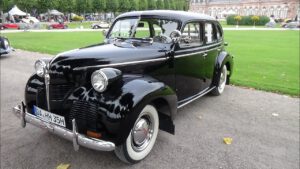
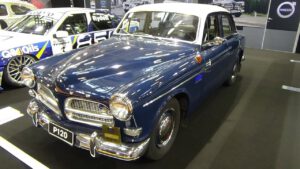
1957 – Renault 4CV – Veterama Mannheim 2015
By the late 1950s, the Renault 4CV had already become a familiar presence across Europe, but it was still evolving in detail and refinement. The 1957 model reflects a mature phase of production, where incremental improvements enhanced usability without altering the car’s fundamental concept. It remained a compact, economical vehicle shaped by post-war necessity, yet increasingly adapted to a growing and more mobile society.
Technical Details
The 1957 Renault 4CV retained its rear-mounted inline four-cylinder engine with a displacement of 747 cc. Output was typically around 21 horsepower in later versions, reflecting incremental improvements over earlier post-war models. The engine was water-cooled and positioned behind the rear axle, driving the rear wheels through a three-speed manual gearbox. This layout allowed for efficient packaging and contributed to the car’s distinctive handling characteristics.
The monocoque construction continued to provide a lightweight and rigid structure, an advanced feature in its class at the time of introduction. Suspension was independent on all four wheels, using coil springs, which contributed to a relatively comfortable ride despite the car’s small size. Hydraulic drum brakes were fitted on all four wheels, offering improved stopping performance compared to earlier mechanical systems.
The technical configuration prioritized simplicity and reliability. Fuel consumption remained low, and maintenance requirements were modest, making the Renault 4CV well suited to the economic conditions of the 1950s. While performance was limited, the car’s light weight ensured adequate responsiveness for urban and regional driving.
- Manufacturer: Renault
- Model name: Renault 4CV
- Year of manufacturing: 1957
Design
The design of the 1957 Renault 4CV is defined by compact proportions and rounded, cohesive forms. Its small footprint is complemented by smooth body panels and gently curved lines, giving the car a friendly and approachable appearance. By this stage of production, minor refinements had improved fit and finish, but the overall design remained consistent with the original concept introduced in the late 1940s.
The front end is simple, with integrated headlights and restrained chrome detailing. The absence of a front-mounted engine allows for a short hood and maximized cabin space. At the rear, the slightly raised engine compartment subtly shapes the car’s profile, while maintaining visual balance.
Inside, the cabin emphasizes practicality. Seating is upright and space-efficient, with a straightforward dashboard layout and minimal instrumentation. Materials are modest, reflecting the car’s role as an affordable vehicle, but the design is coherent and functional. Visibility is good, aided by large windows relative to the car’s size.
Historical Significance
By 1957, the Renault 4CV had firmly established itself as one of the most important cars in Renault’s history. Introduced in 1946, it played a central role in the company’s post-war recovery and in the broader expansion of affordable personal transportation in Europe.
The Renault 4CV was France’s first car to surpass one million units in production, a milestone achieved during its production run. Its success was not limited to domestic markets; it was exported widely and assembled in several countries, contributing to Renault’s growing international presence.
The 1957 model represents the later stages of this success story, just before the car was gradually replaced by more modern designs such as the Renault Dauphine. It illustrates how a fundamentally sound concept could remain competitive through incremental improvements rather than complete redesign.
Quirks and Pop Culture
The Renault 4CV is widely known by its nickname “La motte de beurre,” or “the pat of butter,” a reference to both its rounded shape and the pale yellow color of early production models. This nickname reflects the car’s integration into everyday life and popular culture in post-war France.
Its rear-engine layout contributed to distinctive handling characteristics, particularly in cornering, where weight distribution differed from front-engine cars. Drivers often needed to adapt their driving style, especially in wet conditions.
The Renault 4CV also found success in motorsport, particularly in smaller displacement categories. These achievements added an unexpected dimension to the car’s reputation, demonstrating that even an economy-focused vehicle could perform competitively under the right conditions.
Display and preservation
This car was displayed at the Veterama Mannheim 2015, held from October 9 to 11 at the Maimarkt grounds. Spanning 260,000 square meters outdoors and 15,000 square meters of indoor space, the event offered everything from rare spare parts to complete classic vehicles. Dealers, restorers, accessory specialists, and publishers created a vibrant marketplace for collectors and hobbyists alike.
Conclusion
The 1957 Renault 4CV represents the refinement of a concept that had already proven highly successful. Its compact rear-engine layout, efficient engineering, and practical design made it accessible to a wide audience. By this stage, incremental improvements had enhanced usability while preserving the car’s original strengths. As a result, the Renault 4CV remains a defining example of post-war European small cars and a key contributor to Renault’s history.