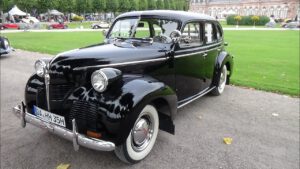
1923 – Renault KJ1 – Classic Expo Salzburg 2014
In the early 1920s, Renault began shifting from exclusively large and expensive automobiles toward more accessible models. The Renault KJ1 represents this transition: a compact, practical car designed for broader ownership without abandoning the brand’s established engineering principles. It reflects a moment when the automobile was moving from a luxury object to a more widely attainable form of transport.
Technical Details
The 1923 Renault KJ1 was powered by a front-mounted inline four-cylinder engine with a displacement of approximately 951 cc. Output is typically cited at around 10 to 12 horsepower, positioning the car within the lower tax and cost categories of the time. This modest performance was sufficient for everyday use, particularly in urban and regional contexts where high speeds were neither expected nor practical.
Power was transmitted to the rear wheels via a manual gearbox and driveshaft, consistent with Renault’s long-standing preference for shaft drive over chain systems. This configuration improved reliability and reduced maintenance requirements, especially compared to earlier automotive designs.
As with other Renault models of the period, the radiator was mounted behind the engine rather than at the front. This influenced both cooling airflow and the vehicle’s external appearance, resulting in a distinctive hood design without a prominent front grille.
The chassis was based on a ladder-frame construction with rigid axles and leaf spring suspension. Braking systems were mechanically operated, typically acting on the rear wheels. Overall, the Renault KJ1’s technical layout was conservative but proven, emphasizing durability and ease of use over innovation.
- Manufacturer: Renault
- Model name: Renault KJ1
- Year of manufacturing: 1923
Design
The design of the Renault KJ1 reflects the gradual evolution of automotive form during the early 1920s. While still influenced by pre-war conventions, the car shows a move toward more integrated and cohesive bodywork.
The proportions are compact and upright, with a relatively short wheelbase and narrow track. Separate fenders, running boards, and exposed mechanical elements remain clearly visible, maintaining a visual link to earlier automotive and carriage design traditions. The absence of a front-mounted radiator results in a smooth, often slightly sloped hood line, giving the car a distinctive Renault identity.
The Renault KJ1 was offered in several body styles, including open touring configurations and more enclosed variants, allowing it to serve a range of practical purposes. The interior was simple and functional, with minimal instrumentation and straightforward controls. Materials and finishes were modest, reflecting the car’s positioning as an accessible vehicle rather than a luxury product.
Historical Significance
The Renault KJ1 occupies an important place in the company’s transition toward mass-market production. While Renault had been producing automobiles since the late 19th century, its early focus was largely on more expensive and technically advanced vehicles aimed at wealthier customers.
By the early 1920s, changing economic conditions and increasing competition encouraged manufacturers to develop smaller, more affordable cars. The Renault KJ1 was part of this strategic shift, offering a lower-cost alternative within Renault’s lineup. It complemented models such as the Renault NN, which would further develop this approach later in the decade.
This period also saw the broader standardization of automotive engineering. The KJ1’s layout—front engine, rear-wheel drive, shaft transmission, and ladder-frame chassis—reflects a convergence toward configurations that would dominate for decades. At the same time, Renault’s continued use of the rear-mounted radiator highlights the persistence of brand-specific engineering solutions even as the industry moved toward common standards.
Quirks and Pop Culture
One of the defining quirks of the Renault KJ1 is its retention of Renault’s rear-mounted radiator design, a feature that set the brand apart visually and technically from many competitors. While other manufacturers increasingly adopted front-mounted radiators with prominent grilles, Renault maintained its established layout well into the 1920s.
The Renault KJ1 also illustrates the transitional nature of early automotive design. Features such as separate fenders, exposed lighting, and simple interiors reflect a time when cars were still evolving from carriage-based concepts into fully standardized machines.
Although the Renault KJ1 itself is not widely associated with specific cultural references, it represents a category of vehicles that became part of everyday life in the interwar period. Cars like this contributed to the gradual normalization of personal mobility, particularly in urban and semi-urban environments.
Display and preservation
This car was displayed at the Classic Expo Salzburg 2014, which marked its tenth anniversary with a comprehensive showcase of classic car preservation. Spanning 40,000 square meters and featuring over 250 exhibitors from eleven nations, the event attracted around 25,000 visitors. The exhibition combined static displays with active elements such as the Salz & Öl Rallye, linking past and present motoring culture. Special exhibitions dedicated to racing legend Otto Mathé and historic competition cars added depth, while auctions and a vast parts market supported the preservation ecosystem. Even rare aviation heritage was included, underlining a broad and engaging approach to maintaining technical history.
Conclusion
The 1923 Renault KJ1 stands as a concise example of Renault’s move toward more accessible automobiles in the early 20th century. Its modest four-cylinder engine, conventional chassis, and shaft-drive layout reflect a focus on reliability and practicality. In design, it bridges older automotive traditions and emerging standard forms. Historically, it marks a step in the broader shift toward mass-market motoring, helping to expand the reach of the automobile beyond its earlier, more exclusive audience.