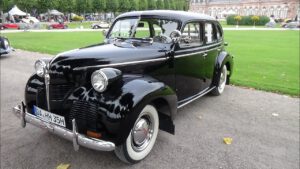
1960 Renault 4CV – Retro Classics Stuttgart 2017
Small, rear-engined, and built in large numbers, the Renault 4CV became one of the defining European cars of the post-war period. By 1960, it was already nearing the end of its production life, yet it remained widely visible on French and international roads. Its combination of compact dimensions and accessible engineering made it a cornerstone of early mass motorization in Europe.
Technical Details
The 1960 Renault 4CV was powered by a rear-mounted inline four-cylinder petrol engine with a displacement of 747 cc. Output varied slightly by version, but was typically around 21 to 26 horsepower, depending on specification and market. The engine drove the rear wheels through a three-speed manual gearbox, with a later four-speed transmission introduced in the final production years, including around 1960.
The rear-engine, rear-wheel-drive layout allowed for a compact front end and efficient packaging within a small footprint. The chassis used independent suspension on all four wheels, with coil springs and a configuration designed to provide reasonable comfort despite the car’s short wheelbase. Braking was handled by drum brakes on all four wheels, consistent with the technological standards of small cars in the 1950s.
The Renault 4CV was engineered with simplicity and affordability in mind. Its modest power output limited top speed to around 90–100 km/h, but this was sufficient for the road conditions and expectations of the time. The lightweight construction contributed to fuel efficiency and ease of maintenance, key factors in its widespread adoption.
- Manufacturer: Renault
- Model name: Renault 4CV
- Year of manufacturing: 1947–1961
Design
The design of the Renault 4CV reflected both necessity and emerging post-war optimism. Its compact, rounded body featured smooth curves and integrated fenders, giving it a cohesive and approachable appearance. The rear-mounted engine allowed for a short front overhang and a relatively spacious passenger compartment for a car of its size.
The four-door layout was notable in this class, offering practical access for families at a time when many small cars were still limited to two doors. Large windows and a high roofline created a bright interior, reinforcing the sense of usability. The front luggage compartment, located where the engine would traditionally sit, provided limited but useful storage space.
Inside, the cabin was minimal but functional. Materials and controls were simple, reflecting the car’s role as an affordable means of transport rather than a luxury product. The overall design prioritized clarity and accessibility, aligning with Renault’s broader strategy of producing cars for a wide audience.
Historical Significance
The Renault 4CV was developed during the Second World War and introduced in 1947, at a time when Europe faced significant economic and industrial challenges. It became France’s first mass-produced car after the war and played a central role in restoring mobility to a recovering population.
Its success was substantial: more than one million units were produced by the time production ended in 1961, making it the first French car to reach that milestone. The 4CV was also exported widely, contributing to Renault’s growing international presence. In addition to its civilian role, the car was used in motorsport, where specially prepared versions achieved success in events such as the 24 Hours of Le Mans in smaller displacement categories.
By 1960, the Renault 4CV was being gradually replaced by newer models, most notably the Renault 4, which adopted a front-engine, front-wheel-drive layout. This transition marked a broader shift in automotive engineering philosophy, but the 4CV remained an important reference point for Renault’s earlier approach.
Quirks and Pop Culture
The Renault 4CV became known in France as the “motte de beurre” (“lump of butter”), a nickname inspired by its rounded shape and the pale yellow color of early production models. This informal name reflects how closely the car was associated with everyday life in post-war France.
Its widespread use made it a familiar presence in films, photographs, and personal memories of the 1950s and early 1960s. The car’s modest size and approachable character contributed to its image as a practical companion rather than a status symbol. It was driven by a broad cross-section of society, from urban families to rural users.
Another notable aspect was its rear-engine layout, which influenced driving characteristics. While providing good traction, it required some adaptation from drivers accustomed to front-engine cars. This trait became part of the car’s identity among enthusiasts.
Display and preservation
This car was exhibited at the 17th edition of Retro Classics Stuttgart in 2017. Spanning around 130,000 square meters, with 1,600 exhibitors and over 3,000 vehicles, the event attracted some 90,000 visitors. Yet beyond sheer size, a noticeable shift defined the exhibition: pre-war automobiles, once dominant, had dwindled to just a small fraction, making way for younger classics and emerging collectibles. Italian automotive culture was very present in Hall C2. Rare pieces from renowned collections, alongside iconic Maserati models and lesser-seen marques, emphasized careful curation and historical depth. Beyond cars, motorcycles and even tractors were presented with equal attention. With many vehicles offered for sale, the event also reinforced its role as a living marketplace where automotive heritage continues to change hands and remain in active circulation.
Conclusion
The 1960 Renault 4CV represents the final phase of a model that played a key role in post-war European mobility. Technically simple and compact, it combined a rear-mounted engine with practical design features suited to everyday use. Its rounded styling and functional interior reflected the priorities of its time, while its production success underscored its importance to Renault’s development. As it gave way to more modern designs, the 4CV remained a clear example of how accessible engineering helped shape the early years of mass car ownership in Europe.