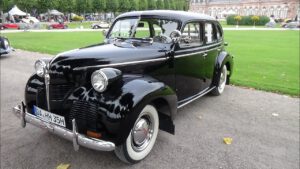
1961 Renault 4CV – Exterior and Interior – Retro Classics Stuttgart 2019
The Renault 4CV was never an exotic machine, which is precisely why it matters. By 1961, its long career was ending, yet the little rear-engined Renault still stood as one of the most important European small cars of the post-war years. A 1961 Renault 4CV therefore captures the closing moment of a model that helped put France back on wheels and helped define Alpine’s early story through Jean Rédélé’s competition successes in a tuned 4CV.
Technical Details
The Renault 4CV followed a compact and technically clear layout that was advanced in some respects and deliberately simple in others. Renault’s heritage material describes the car as a small monocoque-bodied saloon with the engine mounted in rear overhang and power sent to the rear wheels. This placed the drivetrain entirely at the back, freeing up cabin space within very modest exterior dimensions. The mechanical core was a water-cooled inline four-cylinder engine of 747 to 760 cc depending on version, with output ranging from 17 to 21 hp across the model line. Renault also specifies a three-speed gearbox and a quoted top speed of around 90 km/h for the standard 4CV. For a 1961 car, this means one of the final production examples still built around the same lightweight, accessible formula that had defined the model since 1947.
A key point in the 4CV’s technical identity was its role as practical mass transport rather than a performance car. The small displacement engine, compact body shell, and modest power output kept fuel consumption and running costs low, which was essential in post-war France. Yet the layout also gave the car a distinctive feel on the road. Rear-engine traction helped on loose or wet surfaces, while the compact size made the 4CV easy to place in town traffic and on narrow roads. Renault’s heritage page also notes rack-and-pinion steering, a useful reminder that the 4CV was not merely primitive transport but a thoughtfully engineered small car.
- Manufacturer: Renault
- Model name: Renault 4CV
- Year of manufacturing: 1961
Design
The Renault 4CV’s design belongs to the first generation of truly modern European post-war small cars. Its body was compact, upright, and rounded, with softly integrated fenders and a short front section that immediately revealed the absence of a front-mounted engine. The overall silhouette was practical but not severe. There is a certain lightness to the 4CV’s appearance, helped by its narrow width, high roofline, and gently curved surfaces. Renault’s own presentation classifies it as a small two-box car, and that description fits well: the design used very little space inefficiently.
The front end was simple and approachable rather than imposing, with small headlamps, modest grille openings, and restrained brightwork. In profile, the car’s proportions remained balanced despite the rear-mounted engine, because the cabin sat well within the wheelbase and the roofline rose cleanly above it. By 1961, the design no longer looked new in a market that was moving toward the Renault 4 and other more versatile family cars, but that slight visual datedness is part of the appeal of a late 4CV. It still carried the optimism of the late 1940s and 1950s: compact, efficient, affordable, and clearly shaped by the demands of large-scale production.
Inside, the design was correspondingly straightforward. The 4CV was built to provide usable space within a very limited footprint, and the rear-engine layout made that easier. The cabin did not pursue luxury. Instead, it prioritized visibility, ease of use, and the feeling that a small family car could still be orderly and civilized. That modest but well-resolved design character is one reason the 4CV has aged well visually.
Historical Significance
The 1961 Renault 4CV sits at the endpoint of a remarkably significant production run. Renault’s official heritage material states that 1,105,547 examples were built between 1947 and 1961, making it one of the company’s foundational post-war successes. It was the first French car to surpass one million units, and it became central to Renault’s industrial recovery after the Second World War. The Renault Group history of Île Seguin also highlights the 4CV as a defining product of the post-war factory era at Billancourt, where production began in 1947.
Its significance goes beyond production volume. The 4CV helped normalize the idea that a small car could be genuinely mass-market, technically coherent, and socially important. It gave Renault a strong position in the years before the arrival of the Renault 4, and it introduced countless buyers to private motoring. The model was also built outside France. Renault Group’s history of the Valladolid plant records that 4CV production started there in 1953, showing how the car participated in Renault’s wider European industrial expansion.
There is another historical thread that makes the 4CV more than just an economy car. Renault Group’s Alpine history explains that Jean Rédélé, Alpine’s founder, drew inspiration directly from driving a Renault 4CV in the Alps, and that the earliest Alpine cars were designed off the 4CV. This gives the model an unexpected place in French sports-car history: the humble 4CV was one of the seeds from which Alpine grew. For a 1961 example, that connection adds depth. It belongs not only to the end of Renault’s first great post-war people’s car, but also to the background story of one of France’s most celebrated performance marques.
Quirks and Pop Culture
The Renault 4CV has always carried a cultural identity larger than its engine size. In France, it became one of the emblematic small cars of the reconstruction years, familiar not as a glamorous object but as part of everyday life. That sort of visibility often gives a car a longer afterlife than rarer, faster machines enjoy. The 4CV remains instantly legible as a post-war French car, and its shape still communicates its era with unusual clarity. This broad cultural recognition is reinforced by Renault’s continued use of the car in heritage storytelling.
The model also gained a second life through sportier derivatives and tuning culture. Auto Plus, in a historical overview of Renault’s small sporting cars, describes the 4CV 1063 as an early accessible Renault performance model that effectively carried the torch before the R8 Gordini. That competition thread matters because it shows how the basic 4CV could support identities far beyond basic transport. Even when discussing the ordinary road car, enthusiasts often remember that the platform also produced lively and successful competition variants.
In later years, the 4CV also became a source of nostalgic design reference. Auto Plus noted that Renault’s 1996 Fiftie concept consciously evoked the 4CV, confirming the model’s continued symbolic value within the brand’s history. That kind of retrospective homage is revealing: Renault did not look back to the 4CV merely as an old car, but as a recognizable national and corporate icon.
Display and preservation
The vehicle was exhibited at Retro Classics Stuttgart in 2019. Spread across nine exhibition halls as well as the outdoor and entrance areas, the 19th edition welcomed more than 90,000 visitors and presented around 4,000 vehicles. Unlike earlier years, the organizers did not focus on a central special exhibition, placing even greater emphasis on the market itself. Around 1,700 of the cars on display were offered for private or trade sale, underlining the event’s strong reputation as a meeting point not only for enthusiasts, but also for collectors and buyers.
Conclusion
The 1961 Renault 4CV represents the final chapter of a car that had already done its most important work. Its rear-engine layout, monocoque construction, compact dimensions, and small four-cylinder engine made it a practical and cleverly packaged answer to post-war mobility needs. In design terms, it remains a clear and appealing example of early European mass-market modernity. Historically, its production scale, role in Renault’s recovery, international assembly, and indirect link to Alpine give it a much larger importance than its modest specification suggests. The 1961 Renault 4CV is therefore not simply a late small saloon. It is the end point of one of Renault’s formative models and a concise summary of how much influence a modest car can carry.