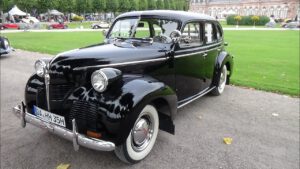
1927 Curtiss Frazer-Nash – Exterior and Interior – Auto Zürich Classic Car Show 2022
Curtiss aircraft engines powered some of the fastest airplanes of the First World War. In the late 1920s, the same engineering culture unexpectedly appeared in a small British sports car. The 1927 Curtiss Frazer-Nash combined aviation influence with lightweight automotive design, creating a machine that looked modest but delivered unusually vivid driving performance.
Technical Details
The Curtiss Frazer-Nash of 1927 was technically based on the distinctive engineering philosophy that defined Frazer-Nash cars during the 1920s. The car used a front-mounted inline four-cylinder engine supplied by Curtiss, the American company better known for aircraft engines and aviation technology. The unit displaced around 1.5 liters and delivered approximately 40 horsepower, a respectable figure for a lightweight sports car of the period. Power was transmitted to the rear wheels using the characteristic Frazer-Nash chain-drive transmission system. Instead of a conventional gearbox, the system used multiple chains and sprockets to provide different gear ratios. Each chain corresponded to a specific ratio, selected through a lever mechanism.
The chain-drive layout reduced mechanical complexity and weight while also providing extremely direct power delivery. This arrangement made the car particularly responsive, though it required careful operation and regular maintenance. The chassis followed a conventional ladder-frame construction with rigid axles and semi-elliptic leaf springs. Combined with the car’s low weight, typically well under 800 kilograms depending on body configuration, the Curtiss Frazer-Nash achieved lively acceleration and a top speed approaching 130 km/h in favorable conditions. Braking was provided by drum brakes, typical for sports cars of the late 1920s. The entire engineering concept emphasized simplicity, lightness, and mechanical immediacy rather than comfort or refinement.
-
Manufacturer: Frazer-Nash (United Kingdom) in cooperation with Curtiss (United States)
-
Model name: Curtiss Frazer-Nash
-
Year of manufacturing: 1927
Design
The visual character of the Curtiss Frazer-Nash reflected its purpose as a lightweight sporting machine rather than a luxury automobile. Most examples were bodied as compact open two-seaters or cyclecars with minimal coachwork. The body panels were typically made of aluminum mounted over a lightweight frame, keeping mass to a minimum. The long bonnet emphasized the front-mounted engine, while the cockpit sat close to the rear axle, giving the car balanced proportions despite its small size.
The front end was simple and functional, often featuring a narrow radiator grille and exposed headlights mounted on either side. Large, separate fenders covered the wire wheels, while running boards were often narrow or omitted entirely to save weight. Inside the cockpit, the layout was straightforward. Drivers faced a small cluster of essential instruments, usually including speedometer, oil pressure gauge, and engine controls. The seating position was low and close to the mechanical components, reinforcing the sense of connection between driver and machine. In keeping with the sporting ethos of the period, little attention was paid to insulation or comfort features. The design conveyed mechanical honesty rather than stylistic extravagance.
Historical Significance
The Curtiss Frazer-Nash emerged during a period when the British automotive industry was experimenting with lightweight sports cars and unconventional engineering solutions. Frazer-Nash had already gained recognition for its chain-drive transmission, which distinguished its vehicles from more conventional competitors. The collaboration with Curtiss introduced an additional international dimension. Curtiss had extensive experience building high-performance engines for aircraft during the First World War, and this expertise influenced the design and marketing of the automobile.
Although the Curtiss Frazer-Nash was produced in limited numbers, it demonstrated how cross-industry cooperation could shape automotive engineering during the interwar years. The car belonged to a generation of small British sports machines that prioritized performance through weight reduction rather than large engine displacement. This philosophy would later become a defining characteristic of many British sports car manufacturers. The model also reinforced Frazer-Nash’s reputation for unconventional mechanical solutions and motorsport-oriented design. During the late 1920s and early 1930s, Frazer-Nash cars appeared regularly in hill climbs, reliability trials, and other competitive events, helping establish the brand’s sporting credentials.
Quirks and Pop Culture
The chain-drive transmission of the Curtiss Frazer-Nash is one of the most memorable quirks in early sports car engineering. Drivers had to manage gear selection carefully, since each ratio corresponded to a separate chain. Shifting between them was not as straightforward as in a conventional gearbox, and mechanical sympathy was essential. Enthusiasts often describe the experience as both demanding and rewarding, giving the car a personality quite different from modern vehicles.
Another notable aspect of the car’s reputation lies in its aviation connection. The Curtiss name carried strong associations with early flight, and this link was sometimes emphasized in period advertising and press coverage. The idea that a sports car shared engineering DNA with aircraft engines added to the car’s appeal among technically minded enthusiasts. While the Curtiss Frazer-Nash never achieved widespread fame in films or popular media, it has remained an intriguing chapter in the story of early British sports cars.
Display and preservation
The vehicle was exhibited at the Auto Zürich Classic Car Show in 2022. The 35th edition of Auto Zürich is Switzerland’s leading automotive trade fairs, traditionally hosting numerous world and Swiss premieres. Since 2019, Hall 6 has been exclusively dedicated to classic automobiles, providing a distinguished setting for historic vehicles, while the majority of the exhibition space remained focused on modern mobility solutions. The classic cars presented at Auto Zürich were of remarkably high quality. With approximately 60,000 visitors, Auto Zürich Classic was first introduced in 2019. In 2022, a special exhibition celebrated Ferrari’s 75th anniversary, showcasing more than a dozen Ferrari models.
Conclusion
The 1927 Curtiss Frazer-Nash illustrates an experimental moment in automotive history when lightweight engineering, unconventional transmissions, and international collaboration came together in a compact sports car. Its Curtiss-supplied engine, chain-drive transmission, and minimalist construction created a machine focused on mechanical involvement and performance rather than comfort. Although produced in small numbers, the model reflects the inventive spirit of the interwar period and helped reinforce Frazer-Nash’s reputation for distinctive sports car engineering. The Curtiss Frazer-Nash remains a reminder that early automotive innovation often emerged from unexpected connections, including the world of aviation.