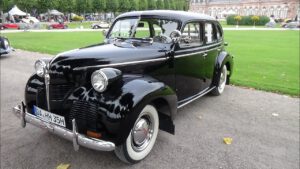
1958 Zündapp Janus – Exterior and Interior – Classic Expo Salzburg 2021
The 1958 Zündapp Janus is one of the most unconventional small cars of post-war Germany. With doors at both ends and a centrally mounted engine, it challenged conventional automotive layout. Its name, referencing the Roman god Janus, perfectly reflects its forward-and-backward design concept.
Technical Details:
The 1958 Zündapp Janus was powered by a rear-mounted single-cylinder, two-stroke engine with a displacement of 245 cc. This air-cooled unit produced approximately 14 horsepower and was derived from motorcycle engineering, consistent with the background of Zündapp. Power was transmitted through a four-speed manual gearbox to the rear wheels.
The Janus featured a steel body mounted on a central tubular frame structure. The engine was positioned centrally between the two seating compartments, effectively dividing the car into front and rear halves. Suspension consisted of independent wheel setups with coil springs, designed to keep the compact vehicle stable despite its unusual layout.
With a top speed of around 80 km/h, the Janus was intended for urban and short-distance mobility rather than highway travel. Fuel consumption was modest, aligning with its role as an economical microcar during a period of growing but still cautious consumer demand in post-war Germany.
- Manufacturer: Zündapp
- Model Name: Zündapp Janus
- Year of Manufacturing: 1957–1958
Design
The Zündapp Janus is immediately recognizable due to its symmetrical body layout. The most striking feature is its two opposing doors—one at the front and one at the rear—without conventional side doors. This arrangement allowed access to two separate bench seats positioned back-to-back.
The front and rear ends of the car appear nearly identical, reinforcing the Janus theme. Large glass areas and a relatively tall roofline contributed to a bright interior despite the car’s compact dimensions. The centrally mounted engine was housed between the seating areas, creating a distinct separation within the cabin.
Externally, the body is characterized by rounded forms and simple detailing typical of 1950s microcars. The compact proportions, narrow track, and small wheels emphasize its role as an economy vehicle rather than a traditional family car.
Historical Significance
The Janus was developed during a period when several German manufacturers experimented with microcars to address the need for affordable transportation. Zündapp, primarily known for motorcycles, sought to expand into the automobile market with this model.
Production began in 1957 and ended in 1958 after approximately 6,900 units were built. The car’s unconventional layout and limited performance made it less competitive as the German economy improved and buyers shifted toward more practical small cars such as the Volkswagen Beetle and other emerging compact models.
The Janus therefore represents a transitional moment in West Germany’s automotive history—situated between the austerity-driven microcar era and the broader adoption of conventional small family cars during the Wirtschaftswunder years.
Quirks and Pop Culture
The name “Janus” refers to the Roman god with two faces looking in opposite directions, a direct reference to the car’s symmetrical design. This dual-access concept remains one of the most unusual in automotive history.
Because of its short production run and distinctive configuration, the Janus has become a curiosity among collectors. Its layout—with passengers facing away from each other and the engine in between—gives it a character unlike almost any other production car.
Among enthusiasts, the Janus is often discussed alongside other German microcars of the 1950s, yet it stands apart due to its central engine placement and twin-door concept. Its engineering reflects the experimentation typical of small manufacturers during the post-war recovery period.
Display and preservation:
The vehicle was exhibited at the Classic Expo Salzburg in 2021. As one of Austria’s premier classic car events, the show has established itself as a central meeting point for collectors, restorers, and enthusiasts from across Central Europe. The 2021 edition took place at Messezentrum Salzburg and featured more than 250 exhibitors, along with a strong turnout of over 20,000 visitors. Attendees could explore a broad range of offerings—from historical vehicles and motorcycles to automobilia, spare parts, and literature.
Conclusion
The 1958 Zündapp Janus occupies a unique place in automotive history. Powered by a 245 cc two-stroke engine and built around a central tubular frame, it offered economical mobility with an unconventional two-door, dual-direction layout. Produced for only two years, it reflects the experimental spirit of late-1950s microcar design. Today, the Janus remains a distinctive and memorable example of Germany’s post-war automotive innovation.