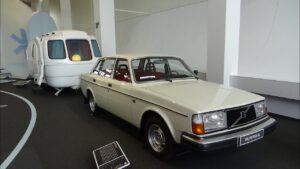
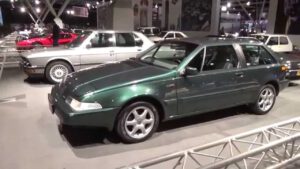
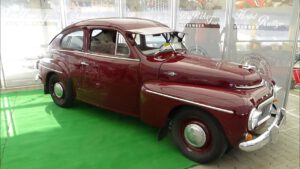
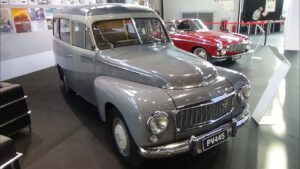
1965 Volvo P1800 S – Classic Expo Salzburg 2014
The Volvo P1800 became internationally recognizable through television, but the 1965 Volvo P1800 S represented far more than a stylish screen car. By the mid-1960s, Volvo had transformed the P1800 from an outsourced specialty coupé into a more mature grand touring machine built increasingly around Swedish engineering and manufacturing control. The 1965 model year also arrived at a moment when European sports coupés were becoming more refined, balancing performance with reliability and long-distance comfort rather than raw speed alone.
Technical Details
The 1965 Volvo P1800 S was powered by Volvo’s naturally aspirated 1.8-liter inline four-cylinder B18 engine, mounted at the front and driving the rear wheels through a four-speed manual gearbox, with optional overdrive available on many cars. Output for the B18B engine reached approximately 108 horsepower, giving the coupé a top speed in the region of 175 km/h depending on specification and gearing. The engine used twin SU carburetors and became widely respected for durability and mechanical simplicity, characteristics closely associated with Volvo during this period.
The chassis construction combined a steel monocoque body with independent front suspension and a live rear axle supported by coil springs. Disc brakes were fitted at the front, while drum brakes remained at the rear. Steering was unassisted but precise, emphasizing stable touring behavior over aggressive sports-car sharpness. Compared with many contemporary Italian or British sports coupés, the P1800 S focused heavily on reliability, corrosion protection improvements, and everyday usability. The “S” designation identified Swedish production after manufacturing moved from Jensen Motors in the United Kingdom to Volvo’s Lundby plant in Gothenburg.
- Manufacturer: Volvo
- Model name: Volvo P1800 S
- Year of manufacturing: 1965
Design
The 1965 Volvo P1800 S retained the elegant proportions established by Pelle Petterson’s original design while gradually developing a cleaner and more cohesive Scandinavian identity. The long hood, low roofline, and compact rear deck gave the coupé balanced grand touring proportions, while the pronounced front grille and rounded fenders softened the car’s otherwise disciplined lines.
Unlike many highly ornamented mid-1960s European coupés, the P1800 S relied on restrained detailing. Chrome accents highlighted the bumpers, window surrounds, and grille without overwhelming the bodywork. The slim roof pillars and expansive glass area contributed to excellent visibility and created a light, airy cabin atmosphere. Wire wheels were optional and visually transformed the car, giving it a more distinctly sporting character.
Inside, the dashboard reflected Volvo’s preference for functional ergonomics. Large circular gauges, clearly arranged controls, and supportive seating emphasized usability rather than theatrical styling. Materials were durable and carefully assembled, reinforcing the car’s reputation as a sports coupé that could realistically be used for long-distance touring in all weather conditions.
Historical Significance
The Volvo P1800 emerged during a period when Volvo sought to expand beyond its established image as a manufacturer of practical family sedans. Development of the project began in the late 1950s under the internal designation “Project 958-X,” intended to create a car capable of improving Volvo’s international image, especially in export markets such as the United States.
Early production of the P1800 had been outsourced to Jensen Motors in Britain because Volvo lacked sufficient production capacity. However, quality inconsistencies and logistical complications encouraged Volvo to relocate manufacturing to Sweden. From 1963 onward, the car became the P1800 S, with the “S” standing for “Sverige” or Sweden. By 1965, the transition was well established, and build quality had improved significantly compared with earlier British-built examples.
The P1800 S occupied an unusual position in the market. It was not as fast as dedicated sports cars from Jaguar or Alfa Romeo, yet it offered something many competitors struggled to provide consistently: dependability. This balance allowed the car to appeal to buyers seeking a stylish touring coupé that could be driven regularly without constant mechanical attention.
The model also contributed to Volvo’s broader engineering reputation. The robust B18 engine family became famous for longevity, and the P1800 itself later entered automotive history through exceptionally high-mileage examples, including Irv Gordon’s P1800, which exceeded three million miles and became one of the highest-mileage private cars ever recorded.
Quirks and Pop Culture
The Volvo P1800 is inseparable from the television series The Saint, where it was driven by Simon Templar, played by Roger Moore. The association dramatically increased the car’s international visibility, especially in the United Kingdom and North America. Interestingly, the production initially hoped to use a Jaguar E-Type, but Jaguar could not supply vehicles quickly enough, opening the door for Volvo.
Although the television fame often overshadows the car itself, the P1800 developed a loyal enthusiast following for other reasons. Owners frequently praised its ability to combine sporty styling with practical reliability. In Scandinavian markets especially, the car earned respect as a coupé capable of handling difficult weather and long distances more comfortably than many Mediterranean rivals.
Another curiosity surrounding the P1800 concerns its international origins. Italian-influenced styling, British early production, and Swedish engineering combined to create a car that never fit neatly into a single national automotive tradition. This hybrid identity remains part of the P1800’s appeal among collectors today.
Display and preservation
This car was displayed at the Classic Expo Salzburg 2014, which marked its tenth anniversary with a comprehensive showcase of classic car preservation. Spanning 40,000 square meters and featuring over 250 exhibitors from eleven nations, the event attracted around 25,000 visitors. The exhibition combined static displays with active elements such as the Salz & Öl Rallye, linking past and present motoring culture. Special exhibitions dedicated to racing legend Otto Mathé and historic competition cars added depth, while auctions and a vast parts market supported the preservation ecosystem. Even rare aviation heritage was included, underlining a broad and engaging approach to maintaining technical history.
Conclusion
The 1965 Volvo P1800 S represents a mature stage in the evolution of Volvo’s best-known classic coupé. Technically robust, visually restrained, and increasingly refined under Swedish production, it offered a distinctive alternative to more temperamental European sports cars of the era. Its elegant design, dependable engineering, and strong connection to 1960s television culture ensured lasting recognition far beyond Volvo’s traditional audience. More than simply a stylish accessory of the decade, the P1800 S demonstrated that a grand touring coupé could successfully combine character, durability, and everyday practicality.