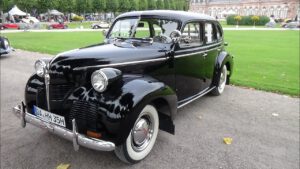
1911 Ford Model T – Oldtimer-Meeting Baden-Baden 2023
By 1911, the automobile had begun to move beyond novelty and into everyday use. The Ford Model T of this period captures that transition clearly, combining simple engineering with a production philosophy that would soon transform the industry. It was not a radical machine in isolation, but it changed how cars were built and who could afford them.
Technical Details
The 1911 Ford Model T was powered by a front-mounted inline four-cylinder gasoline engine with a displacement of approximately 2.9 liters. It produced around 20 horsepower, sufficient to reach a top speed of about 65–70 km/h depending on conditions. The engine was designed for durability and ease of maintenance, with a low compression ratio that allowed it to run on varying fuel qualities, including low-grade gasoline or even ethanol mixtures.
A defining technical feature was its planetary transmission system. Instead of a conventional gearbox, the Ford Model T used a two-speed epicyclic transmission operated by pedals, which controlled forward gears, reverse, and braking. Power was transmitted to the rear wheels via a driveshaft. The chassis was built on a simple but robust steel frame with rigid axles and transverse leaf springs, providing flexibility on uneven roads.
The car did without several components that would later become standard, such as a fuel pump or water pump. Fuel was gravity-fed from a tank located beneath the front seat, and cooling relied on thermosiphon circulation. These choices reduced mechanical complexity and made the car easier to maintain, especially in rural environments with limited infrastructure.
- Manufacturer: Ford Motor Company
- Model name: Ford Model T
- Year of manufacturing: 1911
Design
The design of the 1911 Ford Model T reflected its utilitarian purpose. It was offered in several body styles, including touring car, runabout, and town car, allowing it to serve a wide range of customers. The proportions were upright and narrow, with large wheels and high ground clearance suited to rough roads.
Unlike later years when black became dominant, the 1911 Ford Model T was available in multiple colors, including red, green, blue, and gray. This variety reflected the fact that Ford had not yet fully standardized production around a single fast-drying paint. The body used a combination of steel panels and wood framing, typical of the period.
The exterior was simple, with minimal ornamentation. Exposed headlights, a straightforward radiator grille, and curved fenders defined its appearance. Inside, the layout was equally restrained. Controls were functional rather than decorative, and the interior provided only basic comfort. The emphasis was on practicality and accessibility rather than style.
Historical Significance
The Ford Model T had been introduced in 1908, but by 1911 it was already gaining momentum as a practical vehicle for a growing number of users. This period predates the full implementation of the moving assembly line, which Ford would introduce in 1913, but the foundations of mass production were already in place.
Henry Ford’s central idea was to produce a car that ordinary people could afford and operate. The Ford Model T embodied this vision through its simplicity, durability, and relatively low cost. As production methods improved, prices would fall significantly, making car ownership accessible to a much broader population.
The Ford Model T also contributed to the development of infrastructure and new patterns of mobility. As more people acquired cars, roads improved, and the automobile became integrated into daily life. The 1911 version represents an early phase of this transformation, before production volumes reached their peak but after the concept had proven viable.
Quirks and Pop Culture
The Ford Model T would later become widely known as “Tin Lizzy,” a nickname that reflected both its simple construction and its familiarity. While this nickname became more common in the following years, the cultural foundations were already forming by 1911 as the car spread across different regions and social groups.
One of the most distinctive quirks of the Ford Model T is its control system. The use of pedals for gear selection, combined with hand controls for throttle and ignition timing, required a specific driving technique that differs significantly from modern cars. This system, while initially unfamiliar, was part of Ford’s effort to simplify operation for new drivers.
The Ford Model T’s adaptability also became part of its legacy. Owners frequently modified their cars for different uses, from farming equipment to delivery vehicles. This versatility helped embed the Ford Model T in everyday life and contributed to its lasting cultural presence.
Display and preservation
This car was displayed at the Oldtimer-Meeting Baden-Baden 2023, held from 7 to 9 July. The show brought together more than 20,000 visitors in the elegant spa town at the foot of the Black Forest. Over 350 classic vehicles from across Europe created a refined yet lively atmosphere. At the heart of the event stood the prestigious Concours d’Élégance, awarding around 120 prizes for quality, originality, and design. A special highlight was the celebration of 75 years of Porsche, complemented by a vibrant program including a grand auto corso, art exhibitions, and even a hot air balloon display.
Conclusion
The 1911 Ford Model T represents an early but decisive stage in the evolution of mass mobility. Technically simple yet thoughtfully engineered, it combined a durable four-cylinder engine with an unconventional but effective transmission system. Its design emphasized practicality and adaptability, while its historical role laid the groundwork for large-scale automobile production. As part of the broader Ford Model T story, the 1911 version illustrates how the car began to shift from a specialized machine to a widely accessible means of transport, shaping the future of the automotive industry.