1935 – 1942 – Peugeot 402 Legere – Retro Classics Stuttgart 2016
Introduced in the mid-1930s, the Peugeot 402 Légère represented a more compact and accessible interpretation of Peugeot’s aerodynamic ambitions. While retaining the visual identity of the larger Peugeot 402, it adapted the concept to a lighter and more economical format suited to a broader audience.
Technical Details
The 1935–1942 Peugeot 402 Légère was powered by a front-mounted inline four-cylinder engine with a displacement of approximately 1,991 cc. This engine produced around 55 horsepower, delivering adequate performance for a mid-size car of the late 1930s. The engine followed a conventional side-valve design, emphasizing reliability and smooth operation rather than high output.
Power was transmitted to the rear wheels via a manual gearbox, typically with three forward gears. The drivetrain adhered to the standard front-engine, rear-wheel-drive layout of the era. The chassis used a traditional body-on-frame construction, allowing Peugeot to offer multiple body styles while maintaining structural robustness.
Suspension consisted of independent front wheels—an advanced feature for the time—paired with a rigid rear axle supported by leaf springs. This combination provided improved ride comfort compared to fully rigid setups. Braking was handled by hydraulic drum brakes on all four wheels, a notable step forward in safety compared to earlier mechanical systems.
- Manufacturer: Peugeot
- Model name: Peugeot 402 Légère
- Year of manufacturing: 1935–1942
Design
The design of the Peugeot 402 Légère was strongly influenced by aerodynamic principles that were gaining prominence in the 1930s. Like the standard Peugeot 402, it featured a streamlined body with flowing lines and integrated elements.
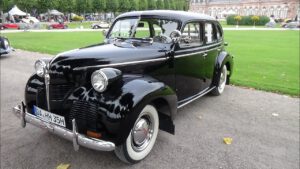
The most distinctive visual feature was the front grille with headlights positioned behind it, creating a smooth and uninterrupted front surface. This design reduced visual clutter and aligned with contemporary ideas about airflow and efficiency. The fenders were fully integrated into the body, contributing to a cohesive silhouette that differed markedly from earlier, more segmented designs.
Compared to the standard Peugeot 402, the Légère variant had slightly more compact proportions and a lighter overall appearance. The body was offered in several configurations, including saloon and cabriolet versions. Inside, the cabin reflected the same balance of practicality and modernity, with a straightforward layout and improved space utilization.
Historical Significance
The Peugeot 402 range was introduced in 1935 as part of Peugeot’s effort to modernize its lineup during a period of rapid technological and stylistic change. The Légère version played a key role in making these innovations accessible to a wider customer base by offering a lighter and more economical alternative.
This period also marked Peugeot’s engagement with aerodynamic design trends influenced by developments in aviation and industrial design. The Peugeot 402, including the Légère, stands as one of the clearest examples of this approach in pre-war European automotive design.
Production was interrupted by the outbreak of the Second World War, with manufacturing largely ceasing in the early 1940s. As a result, surviving examples of the Peugeot 402 Légère are relatively rare, particularly in original configurations. The model helped bridge the gap between traditional pre-war construction and the more integrated designs that would dominate the post-war era.
Quirks and Pop Culture
One of the defining quirks of the Peugeot 402 Légère was its hidden headlight arrangement. By placing the headlights behind the grille, Peugeot created a distinctive visual identity that set the car apart from most contemporaries. This feature became closely associated with the Peugeot 402 range and remains one of its most recognizable characteristics.
The model is also notable for its association with early experiments in automatic transmission. Some versions of the Peugeot 402 were equipped with the “Cotal” electromagnetic gearbox, an advanced and unusual system for the time, although it was not universally fitted.
While the Peugeot 402 Légère did not achieve widespread representation in film or popular media, it is frequently referenced in discussions of aerodynamic pre-war cars. Its design places it alongside other European efforts to rethink automotive form in response to new technological influences.
Display and preservation
This car was displayed at the Retro Classics Stuttgart 2016. It was held from 17 to 20 March 2016, spread across 125,000 square meters and featured 1,555 exhibitors. The fully booked event attracted over 90,000 visitors. Across fully occupied halls, rare originals, such as those from the Louwman Museum and a striking lineup of Veritas sports and racing cars, were displayed with an emphasis on authenticity and historical context. With around 2,000 vehicles on show, the exhibition balanced high-profile brands with lesser-known treasures. The thoughtful staging and diversity of exhibits ensured not only visual impact but also a meaningful preservation of automotive history for a wide audience. Beyond exhibition, the fair also functioned as a major marketplace, with numerous vehicles offered for sale.
Conclusion
The 1935–1942 Peugeot 402 Légère represents a thoughtful adaptation of aerodynamic design to a more compact and accessible format. Its conventional yet reliable engineering was complemented by advanced features such as independent front suspension and hydraulic brakes. Visually, it stood out through its streamlined body and concealed headlights, while historically it reflects Peugeot’s response to changing design and engineering trends in the late 1930s. As part of the broader Peugeot 402 family, the Légère remains an important example of pre-war innovation shaped by both ambition and constraint.