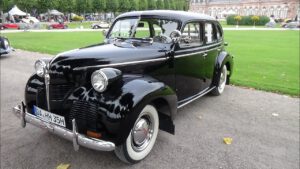
1952 Connaught A Type F2 – Exterior and Interior – Auto Zürich Classic Car Show 2022
In the early 1950s, British motor racing was still rebuilding after the disruption of the Second World War. Among the smaller teams that emerged during this period was Connaught Engineering, a company that quickly gained respect for building technically refined racing cars. The 1952 Connaught A Type F2 was one of its earliest and most important creations, designed specifically for Formula Two competition.
Technical Details
The Connaught A Type F2 was a single-seat racing car developed for the Formula Two regulations that were in force in the early 1950s. The car used a front-mounted inline four-cylinder engine derived from Lea-Francis units. In racing specification, the engine had a displacement of approximately 1,970 cc and was extensively modified by Connaught engineers to improve performance. The revised engine featured a high-compression cylinder head and twin carburetors, producing roughly 130 horsepower depending on the exact specification and tuning.
Power was delivered to the rear wheels through a four-speed manual gearbox. Like most racing cars of the era, the Connaught A Type used a lightweight tubular chassis designed to combine structural rigidity with minimal mass. Suspension followed conventional racing practice of the period, with independent front suspension and a live rear axle supported by leaf springs. Hydraulic drum brakes were fitted on all four wheels.
The overall engineering philosophy of the Connaught A Type emphasized precision and balance rather than brute power. With a relatively light chassis and a well-developed four-cylinder engine, the car offered competitive performance within the two-liter Formula Two class. Top speeds varied depending on gearing and circuit conditions but generally exceeded 200 km/h on faster tracks.
- Manufacturer: Connaught Engineering
- Model name: Connaught A Type F2
- Year of manufacturing: 1952
Design
The design of the Connaught A Type F2 reflected the functional priorities of early 1950s single-seat racing cars. The bodywork was narrow and streamlined, constructed from lightweight aluminum panels mounted over the tubular chassis. The car’s long, tapered nose housed the front-mounted engine, while the cockpit was positioned close to the rear axle to optimize weight distribution.
The front wheels were partially exposed, typical of Formula racing cars of the period. Small cycle-style fenders were sometimes fitted depending on the race regulations, but the essential layout remained that of a minimalist open-wheel racing machine. The narrow body gradually tapered toward the rear, ending in a short tail that helped reduce aerodynamic drag.
Inside the cockpit, the layout was extremely simple and focused entirely on driving. A small steering wheel faced a minimal set of gauges, typically including tachometer, oil pressure, and temperature indicators. The seating position was low and confined, surrounded by the structural elements of the tubular frame. Every aspect of the design reflected the priorities of competition rather than comfort or convenience.
Historical Significance
The Connaught A Type played a central role in the early history of Connaught Engineering. The company was founded in 1950 by Rodney Clarke and Mike Oliver in Send, Surrey, with the aim of producing competitive British racing cars. The A Type became the firm’s first major Formula Two design and marked its entry into international motorsport.
At the time, Formula Two had become particularly important because the FIA temporarily adopted Formula Two regulations for the World Championship between 1952 and 1953. This meant that cars such as the Connaught A Type could compete alongside major manufacturers in Grand Prix events. Although Connaught operated on a much smaller budget than factory teams like Ferrari or Maserati, the A Type often performed respectably in competition.
Several talented drivers raced Connaught cars during this period, including Stirling Moss, Roy Salvadori, and Tony Rolt. While the A Type did not achieve major championship victories, it established Connaught as a serious engineering effort within British motorsport. The experience gained with the A Type later contributed to the development of the Connaught B Type, which would achieve greater success later in the decade.
Quirks and Pop Culture
One of the notable aspects of the Connaught A Type was the company’s approach to engineering refinement. Despite limited financial resources, Connaught became known for meticulous preparation and mechanical precision. Mechanics and drivers often praised the cars for their balanced handling and reliability, qualities that allowed them to compete effectively against better-funded teams.
The Connaught team also reflected a broader trend in British motorsport during the 1950s, when small engineering companies began challenging established continental manufacturers. This environment would eventually give rise to many influential British racing constructors, including Lotus, Cooper, and BRM. In that sense, the Connaught A Type belongs to an early generation of British-built racing cars that helped shift the center of Grand Prix engineering toward the United Kingdom.
Today, surviving Connaught A Type cars occasionally appear in historic racing events and motorsport demonstrations. Their presence offers a glimpse into a formative period of Formula racing, when engineering ingenuity and small independent teams played an important role in shaping the sport.
Display and preservation
The vehicle was exhibited at the Auto Zürich Classic Car Show in 2022. The 35th edition of Auto Zürich is Switzerland’s leading automotive trade fairs, traditionally hosting numerous world and Swiss premieres. Since 2019, Hall 6 has been exclusively dedicated to classic automobiles, providing a distinguished setting for historic vehicles, while the majority of the exhibition space remained focused on modern mobility solutions. The classic cars presented at Auto Zürich were of remarkably high quality. With approximately 60,000 visitors, Auto Zürich Classic was first introduced in 2019. In 2022, a special exhibition celebrated Ferrari’s 75th anniversary, showcasing more than a dozen Ferrari models.
Conclusion
The 1952 Connaught A Type F2 stands as an important early example of British post-war racing engineering. Built around a lightweight tubular chassis and powered by a modified two-liter four-cylinder engine, it embodied the technical principles of Formula Two competition in the early 1950s. Its streamlined design, competitive performance, and participation in Grand Prix events helped establish Connaught Engineering as a respected name in motorsport. Although produced in small numbers and overshadowed by larger teams, the Connaught A Type contributed to the emergence of Britain as a major force in international racing.