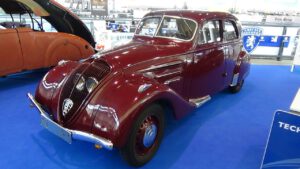
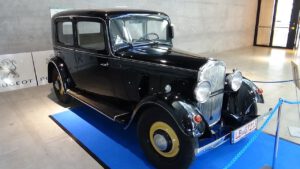
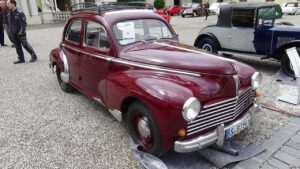
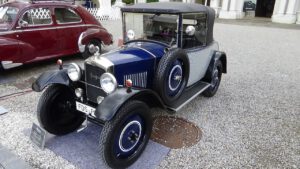
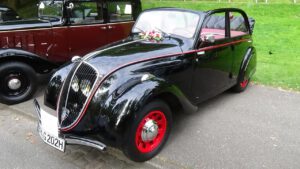
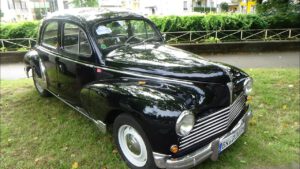
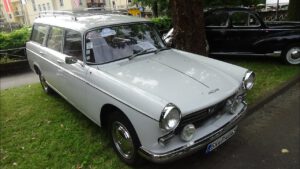
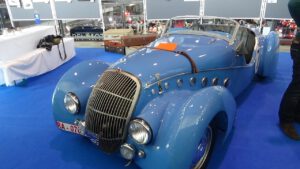
1932 – Peugeot 301 – Retro Classics Stuttgart 2016
Introduced at a time when European manufacturers were refining the transition from early automotive experimentation to more standardized production, the Peugeot 301 combined conventional engineering with a clear focus on reliability and everyday usability. It marked a step toward greater consistency in Peugeot’s model range during the early 1930s.
Technical Details
The 1932 Peugeot 301 was powered by a front-mounted inline four-cylinder engine with a displacement of approximately 1,465 cc. This engine produced around 35 horsepower, a figure that positioned the car comfortably within the mid-range segment of its time. The engine followed a conventional side-valve (flathead) design, prioritizing durability and ease of maintenance over high performance.
Power was transmitted to the rear wheels via a manual gearbox, typically with three forward gears. The drivetrain layout adhered to the standard front-engine, rear-wheel-drive configuration that defined most automobiles of the early 1930s. This arrangement ensured mechanical simplicity and reliability, particularly important in an era when road infrastructure varied widely.
The chassis was constructed using a traditional body-on-frame design, providing robustness and flexibility for different body styles. Suspension relied on rigid axles supported by leaf springs at both the front and rear, a setup that emphasized durability over ride refinement. Braking was handled by mechanical drum brakes on all four wheels, reflecting the transitional stage of braking technology before the widespread adoption of hydraulic systems.
- Manufacturer: Peugeot
- Model name: Peugeot 301
- Year of manufacturing: 1932
Design
The design of the Peugeot 301 reflects the formal and upright aesthetic typical of early 1930s automobiles. The body featured clearly defined, separate fenders, a tall and narrow radiator grille, and exposed headlamps mounted on either side of the front end. This arrangement gave the car a structured and somewhat vertical appearance, characteristic of the period.
The Peugeot 301 was offered in multiple body styles, including saloon, coupé, cabriolet, and commercial variants, allowing it to serve a wide range of uses. Regardless of configuration, the design remained restrained, with minimal ornamentation beyond essential chrome accents.
The passenger compartment was relatively spacious for its class, with a straightforward layout focused on practicality. Large windows provided good visibility, while the upright seating position reflected contemporary expectations of comfort and control. Interior materials were simple and durable, aligning with the car’s role as a reliable everyday vehicle.
Historical Significance
The Peugeot 301 was introduced as part of Peugeot’s “three-digit” naming system, which had begun with the Peugeot 201. This system, using a zero as the central digit, would become a defining characteristic of the brand and continues to influence Peugeot model names today.
Positioned above the smaller 201, the Peugeot 301 represented Peugeot’s move into a more substantial and versatile segment. It was designed to appeal to customers seeking a balance between affordability and increased space or capability. The model also demonstrated Peugeot’s commitment to structured product development, offering a clear hierarchy within its lineup.
Production of the Peugeot 301 continued until 1936, during which time it contributed to Peugeot’s growing reputation for building solid and dependable vehicles. It formed part of a broader family of models that helped stabilize the company during the economically challenging interwar period.
Quirks and Pop Culture
The Peugeot 301 is less associated with specific cultural references and more with its role as a representative example of early 1930s motoring. Its variety of body styles made it adaptable to different uses, from private transport to light commercial work.
One of its defining characteristics is its adherence to traditional automotive construction at a time when new technologies were beginning to emerge. This makes the Peugeot 301 a useful reference point for understanding the evolution of car design and engineering during the interwar years.
Today, surviving examples are appreciated for their authenticity and for illustrating a period when automobiles were still closely tied to carriage-building traditions in both form and construction.
Display and preservation
This car was displayed at the Retro Classics Stuttgart 2016. It was held from 17 to 20 March 2016, spread across 125,000 square meters and featured 1,555 exhibitors. The fully booked event attracted over 90,000 visitors. Across fully occupied halls, rare originals, such as those from the Louwman Museum and a striking lineup of Veritas sports and racing cars, were displayed with an emphasis on authenticity and historical context. With around 2,000 vehicles on show, the exhibition balanced high-profile brands with lesser-known treasures. The thoughtful staging and diversity of exhibits ensured not only visual impact but also a meaningful preservation of automotive history for a wide audience. Beyond exhibition, the fair also functioned as a major marketplace, with numerous vehicles offered for sale.
Conclusion
The 1932 Peugeot 301 reflects a stage in automotive history defined by consolidation rather than radical innovation. Its side-valve engine, body-on-frame construction, and leaf-spring suspension represent established engineering principles, while its design captures the formal aesthetic of the early 1930s. Historically, it played a role in structuring Peugeot’s model range and reinforcing the brand’s reputation for reliability. As such, the Peugeot 301 stands as a clear example of how manufacturers balanced tradition and gradual progress during the interwar period.