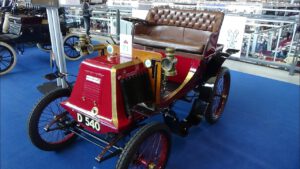
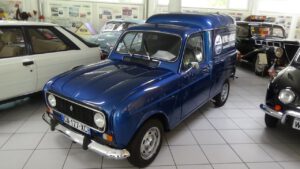
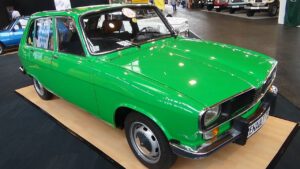
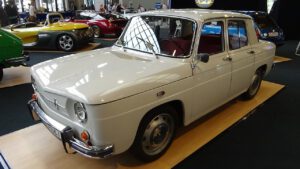
1901 – Renault Type D Phaeton – Exterior and Interior – Retro Classics Stuttgart 2016
At the beginning of the 20th century, the automobile was still an experimental machine rather than an established product. The 1901 Renault Type D Phaeton reflects this early phase, when engineering solutions were not yet standardized and manufacturers like Renault were actively shaping what a car could be. It represents a moment when design, mechanics, and usability were still being defined.
Technical Details
The Renault Type D Phaeton of 1901 was a lightweight automobile built around a front-mounted engine, a configuration that was not yet universally adopted at the time. It used a small displacement internal combustion engine, typically a single-cylinder or early twin-cylinder unit depending on specification, producing modest power suitable for low-speed travel. Output figures were limited, generally in the range of a few horsepower, reflecting the technological constraints of the era.
A defining technical feature of early Renault vehicles, including the Type D, was the use of a direct-drive shaft system instead of chains or belts. This innovation, associated with Louis Renault, improved reliability and efficiency compared to many contemporaries. Power was transmitted to the rear wheels, establishing a layout that would later become standard in automotive design.
The chassis was simple and lightweight, constructed to support the minimal bodywork of the phaeton style. Suspension relied on leaf springs, and braking systems were rudimentary, typically acting on the drivetrain rather than directly on all wheels. Steering mechanisms were basic but functional, suited to the low speeds at which these vehicles operated.
- Manufacturer: Renault
- Model name: Renault Type D Phaeton
- Year of manufacturing: 1901
Design
The Renault Type D Phaeton followed the open “phaeton” body style, characterized by minimal bodywork and the absence of a fixed roof. Its design was closely related to horse-drawn carriages, reflecting the transitional nature of early automobiles. The vehicle featured an open seating arrangement, often with space for two or four occupants, and little protection from weather conditions.
Visually, the car was defined by its exposed mechanical components and simple structural elements. The engine compartment was not fully enclosed, and the wheels were large and spoked, similar to carriage wheels. The seating position was upright, and the driver’s controls were straightforward, with levers and pedals arranged in a manner that varied between manufacturers.
There was little emphasis on decoration or comfort. Instead, the design focused on functionality and lightness, ensuring that the limited engine power could move the vehicle effectively. The overall appearance reflects a period when automotive design had not yet developed a distinct identity separate from earlier forms of transport.
Historical Significance
The Renault Type D belongs to the earliest generation of automobiles produced by Renault, a company founded in 1899. During this period, the automotive industry was still in its infancy, with manufacturers experimenting with different layouts, technologies, and production methods.
Louis Renault played a significant role in shaping early automotive engineering. His development of the driveshaft system marked a departure from chain-driven vehicles and influenced the technical direction of the industry. Models like the Type D helped establish Renault’s reputation as an innovator during these formative years.
The early 1900s were characterized by rapid technological progress and increasing public interest in motor vehicles. Cars like the Type D were not yet mass-produced; instead, they were built in small numbers and often tailored to individual customers. As such, they represent a stage when the automobile was transitioning from a novelty to a viable means of transport.
Quirks and Pop Culture
Vehicles such as the Renault Type D Phaeton are often remembered for their close resemblance to horse-drawn carriages. This similarity was not merely aesthetic but practical, as early buyers were already familiar with carriage design and operation. The transition to motorized vehicles therefore retained many familiar elements.
Driving a car like the Type D required a different set of skills compared to later automobiles. Controls were not standardized, and operating the vehicle often involved managing multiple levers and mechanical systems. This complexity contributed to the perception of early cars as machines for enthusiasts and pioneers rather than everyday users.
While the Type D itself is not widely represented in modern pop culture, early Renault vehicles frequently appear in historical exhibitions and collections, illustrating the origins of the automobile and the rapid evolution that followed.
Display and preservation
This car was displayed at the Retro Classics Stuttgart 2016. It was held from 17 to 20 March 2016, spread across 125,000 square meters and featured 1,555 exhibitors. The fully booked event attracted over 90,000 visitors. Across fully occupied halls, rare originals, such as those from the Louwman Museum and a striking lineup of Veritas sports and racing cars, were displayed with an emphasis on authenticity and historical context. With around 2,000 vehicles on show, the exhibition balanced high-profile brands with lesser-known treasures. The thoughtful staging and diversity of exhibits ensured not only visual impact but also a meaningful preservation of automotive history for a wide audience. Beyond exhibition, the fair also functioned as a major marketplace, with numerous vehicles offered for sale.
Conclusion
The 1901 Renault Type D Phaeton stands as an example of the automobile in its formative years. Technically simple yet innovative in key areas such as the driveshaft, it reflects a period of experimentation and rapid development. Its design, closely tied to carriage traditions, highlights the transitional nature of early automotive history.
As part of Renault’s earliest production, the Type D contributed to establishing fundamental principles that would shape the industry. It remains a reminder of how quickly the automobile evolved from a mechanical curiosity into a central element of modern mobility.