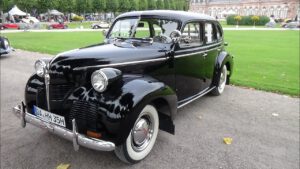
1965 Ford Mustang Coupé – NR Classic Cars Rudersberg 2020
The Ford Mustang Coupe was never intended to be an exotic sports car. Ford developed it as an affordable, compact, stylish car that could appeal to younger buyers without alienating families or everyday drivers. Yet within months of its launch, the Mustang became one of the most commercially successful new automobiles in American history. The 1965 Coupe in particular established the visual and mechanical formula that would define the “pony car” segment for decades: a long hood, short rear deck, sporty image, and a wide range of engines that allowed buyers to choose anything from economical transportation to serious V8 performance.
Technical Details
The 1965 Ford Mustang Coupe was based heavily on the Ford Falcon platform, a decision that allowed Ford to develop and produce the car quickly and economically. Its construction used a steel unibody chassis with a conventional front-engine, rear-wheel-drive layout. Suspension followed established American compact-car practice of the period, with independent front suspension using coil springs and upper and lower control arms, while the rear used a solid axle suspended by leaf springs.
Ford offered an unusually broad range of engines for the Mustang Coupe, which became one of the car’s key selling points. The entry-level engine was a 170 cubic inch (2.8-liter) inline-six producing around 101 horsepower. Buyers wanting more performance could choose several V8 options, most famously the 289 cubic inch (4.7-liter) Windsor V8. Depending on carburetion and specification, outputs ranged from approximately 200 horsepower to 271 horsepower in the high-performance “K-Code” version.
Transmission options included a three-speed manual gearbox, a four-speed manual, and automatic transmissions. The variety of drivetrains meant the Mustang Coupe could function as an economical commuter car, a comfortable cruiser, or a relatively quick performance machine depending on configuration.
Although technically straightforward, the Mustang’s engineering emphasized accessibility and ease of ownership rather than complexity. Parts sharing with existing Ford models helped reduce maintenance costs and simplified repairs. This practicality became central to the Mustang’s enormous popularity.
- Manufacturer: Ford Motor Company
- Model name: Ford Mustang Coupe
- Year of manufacturing: 1965
Design
The design of the 1965 Mustang Coupe played a major role in the car’s immediate success. Developed under the direction of Lee Iacocca and designed primarily by Joe Oros and Ford’s styling team, the Mustang combined compact dimensions with proportions normally associated with larger, more expensive sports cars.
The car’s silhouette was simple but carefully balanced. A long hood and relatively short rear section gave the Coupe a sporty appearance without sacrificing practicality. The front grille prominently featured the galloping Mustang emblem, immediately establishing a distinct identity separate from other Ford products. Vertical details inside the grille and triple-segment rear lamps became defining styling elements that would remain associated with the Mustang for decades.
Unlike many larger American cars of the mid-1960s, the Mustang Coupe avoided excessive chrome and oversized bodywork. The body sides were relatively clean, while subtle sculpting around the wheel arches added visual tension. The Coupe roofline gave the car a more formal and practical profile than the fastback version introduced later, helping broaden its appeal among mainstream buyers.
Inside, the dashboard design mixed sporty influences with familiar Ford ergonomics. Round gauges, optional center consoles, bucket seats, and sporty steering wheels created an atmosphere inspired by European GT cars, though adapted for American tastes and comfort expectations. Buyers could also personalize the car extensively through optional trim packages, radios, wheel designs, vinyl roofs, and interior color combinations.
Historical Significance
The 1965 Ford Mustang fundamentally changed the American automobile market. Introduced in April 1964 as an early 1965 model, the car exceeded Ford’s expectations almost immediately. Demand surged so rapidly that dealerships reportedly sold cars directly from showroom floors before they could even be fully displayed.
Ford’s strategy behind the Mustang was unusually calculated. Rather than building an expensive niche sports car, the company created a vehicle that looked sporty while remaining affordable and practical. This combination allowed the Mustang to attract young drivers, families, and performance enthusiasts simultaneously.
The Mustang also created an entirely new market category that soon became known as the “pony car.” Competitors rapidly responded with models such as the Chevrolet Camaro, Pontiac Firebird, Plymouth Barracuda, and Dodge Challenger. The Mustang therefore shaped not only Ford’s future but also the broader direction of American performance-car design during the late 1960s and early 1970s.
Production numbers reflected this impact. Ford sold hundreds of thousands of Mustangs within the first full production year, an extraordinary achievement for a newly introduced car. The Mustang became both a commercial success and a cultural phenomenon almost immediately.
Quirks and Pop Culture
Few American cars entered popular culture as quickly as the Mustang. By the mid-1960s, the car appeared regularly in television, films, music references, and advertising. The Mustang quickly became associated with youth culture, personal freedom, and the expanding American car lifestyle of the decade.
Interestingly, the Coupe body style was by far the most common version sold, even though later media attention often focused more heavily on fastback and convertible variants. For many buyers in 1965, the Coupe represented the ideal balance between sporty appearance and everyday usability.
The Mustang’s name itself became part of its mythology. Ford officially linked the car to the North American wild horse, reinforcing themes of movement and independence. The galloping horse emblem on the grille became one of the most recognizable automotive logos of the decade.
High-performance “K-Code” Mustangs equipped with the 271-horsepower V8 also developed an enthusiastic following among drag racers and street-performance enthusiasts. Meanwhile, less powerful inline-six cars became common first vehicles for younger American drivers, further broadening the Mustang’s cultural reach.
The Mustang’s role in motorsport and entertainment only expanded in later years, but the 1965 Coupe established the image from which all later Mustang mythology grew.
Display and preservation
This car was displayed at the NR Classic Car Collection in Rudersberg which reflects a deep passion for American automotive culture. Specialising in muscle and pony cars from the 1960s, 1970s and 1980s, the collection regularly features around 30 to 40 carefully selected classics. Many of the cars are equipped with powerful V8 engines exceeding six litres in displacement and producing well over 400 horsepower. Unlike static museum exhibits, these automobiles are actively maintained, driven and continuously renewed through new acquisitions, ensuring that the exhibition remains dynamic and authentic for enthusiasts and visitors alike.
Conclusion
The 1965 Ford Mustang Coupe succeeded because it combined accessibility, style, and performance in a way few cars had previously managed. Technically, it relied on proven Ford engineering rather than radical innovation, but this simplicity helped make the car affordable and adaptable. Its design introduced a new visual language for compact American performance cars, while its commercial success reshaped the automotive market and created the pony-car segment. More than simply a successful new Ford model, the 1965 Mustang Coupe became one of the defining American automobiles of the 1960s and a lasting symbol of the era’s automotive optimism.