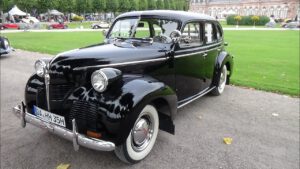
1911 Ford Model T – Klassikwelt Bodensee 2016
In 1911, the Ford Model T was already a common sight, but what made it remarkable was how little it tried to impress. It did not rely on advanced engineering or striking design. Instead, it succeeded by removing complexity—mechanical, visual, and economic—until what remained was a car that could function almost anywhere.
Technical Details
The 1911 Ford Model T was engineered around durability and mechanical clarity. Its 2.9-liter inline four-cylinder engine delivered approximately 20 horsepower, a figure that reflected its purpose as a utility vehicle rather than a performance machine. The engine was tuned for flexibility and reliability, allowing it to operate under varying fuel qualities and road conditions.
A key technical feature was the planetary transmission, controlled via pedals. This system eliminated the need for a conventional gear lever and reduced the learning curve for new drivers. The drivetrain followed a front-engine, rear-wheel-drive layout, transmitting power through a driveshaft rather than chains, which were still used by some earlier automobiles.
The chassis was built on a simple but resilient frame, supported by transverse leaf springs. This configuration allowed the car to cope with uneven surfaces, which were common at the time. The Ford Model T also relied on mechanical brakes, typically acting on the rear wheels. The absence of components such as a fuel pump or water pump was intentional, reducing mechanical complexity and making the vehicle easier to maintain. This approach reflected a broader engineering philosophy: reliability through simplicity.
- Manufacturer: Ford Motor Company
- Model name: Ford Model T
- Year of manufacturing: 1911
Design
The 1911 Ford Model T was not designed to stand out visually, but to be easily produced and widely usable. Its appearance was shaped by necessity rather than stylistic ambition. The upright radiator, separate fenders, and exposed lamps reflected early automotive construction methods, where individual components remained visually distinct.
By this stage, Ford was moving toward greater uniformity in production, and darker paint finishes—especially black—became increasingly common due to faster drying times. However, earlier color variations still existed, reflecting a transitional moment before full standardization.
Inside, the design remained minimal. The seating arrangement was straightforward, and the control layout required familiarity, particularly due to the pedal-operated transmission system. Materials were chosen for durability, and the interior avoided unnecessary detail. The overall impression was one of practicality, where every element served a clear purpose.
Historical Significance
The importance of the 1911 Ford Model T lies in how it redefined the relationship between people and machines. Before its introduction, automobiles were often complex, expensive, and limited to a small segment of society. The Ford Model T changed this by offering a vehicle that could be produced in large numbers and maintained by its owners.
This shift was closely linked to Ford’s production philosophy. Although the fully developed moving assembly line would be introduced shortly afterward, the principles of standardization and efficiency were already shaping the Ford Model T’s development. These methods allowed Ford to reduce costs over time, making the car increasingly accessible. Ultimately, more than 15 million units would be produced, establishing a new scale for industrial manufacturing .
By 1911, the Ford Model T was already influencing patterns of mobility. It enabled travel beyond local areas, connected rural communities, and supported economic activity by making transportation more reliable and affordable.
Quirks and Pop Culture
The Ford Model T developed a reputation not just as a machine, but as a companion to everyday life. Its nickname, “Tin Lizzy,” captured both its simplicity and its familiarity. Owners often adapted their cars for specific tasks, using them in ways that went beyond their original design. This included converting them into farm equipment or modifying them for commercial use.
One of the more unusual aspects of the Ford Model T was the level of involvement required from its driver. Operating and maintaining the car demanded a degree of mechanical understanding, making ownership an active experience. This hands-on relationship contributed to its cultural identity, where the car was seen as something to be worked with rather than simply used.
The Ford Model T also appeared frequently in early media, symbolizing progress and modernity. Its widespread presence meant that it became a shared cultural reference, recognized across different regions and social groups.
Display and preservation
This car was filmed at the Klassikwelt Bodensee 2016. Held from June 3 to 5, the event created a uniquely immersive setting for historic mobility in all its forms. Around 38,700 enthusiasts explored displays of vintage cars, boats, and aircraft presented by roughly 800 exhibitors and clubs. Beyond the exhibition halls, live demonstrations brought motorcycles and racing cars into motion, while daily vintage racing, a classic parade, and an airshow enriched the experience. Special showcases such as “100 Years of BMW” and “Vive la France” celebrated automotive heritage, blending preservation with vibrant, living history.
Conclusion
The 1911 Ford Model T stands out not because of advanced technology or distinctive design, but because of its deliberate simplicity. Its engineering reduced complexity to a minimum, its design focused on function, and its production methods aimed at scale. Together, these elements created a vehicle that could be used, maintained, and adapted by a wide range of people. In doing so, the Ford Model T helped establish the foundations of modern car ownership and industrial manufacturing, leaving an impact that extended far beyond its technical specifications.