1954 Peugeot 203 C – Retro Classics meets Barock Ludwigsburg 2016
In 1954, Peugeot refined rather than reinvented its post-war success story. The Peugeot 203 C represents the mature phase of a model that had already proven its durability across Europe and beyond, combining careful engineering updates with a design that had become instantly recognizable.
Technical Details
The 1954 Peugeot 203 C retained the established mechanical layout of the Peugeot 203 series, centered around a front-mounted inline four-cylinder engine with a displacement of 1,290 cc. This overhead-valve (OHV) unit produced approximately 42 horsepower at around 4,500 rpm, offering steady and reliable performance rather than outright speed.
Power was transmitted to the rear wheels through a four-speed manual gearbox. A notable feature was the fourth gear functioning as an overdrive, allowing lower engine speeds during cruising and improving long-distance efficiency. The drivetrain followed a conventional front-engine, rear-wheel-drive configuration, contributing to the model’s reputation for robustness and ease of maintenance.
The Peugeot 203 C continued to use a monocoque body structure, a significant engineering choice that improved rigidity and reduced weight compared to earlier body-on-frame designs. Suspension consisted of independent front wheels with coil springs and a rigid rear axle, also supported by coil springs. This setup prioritized ride comfort and predictable handling. Braking was handled by hydraulic drum brakes on all four wheels, consistent with mid-1950s standards.
- Manufacturer: Peugeot
- Model name: Peugeot 203 C
- Year of manufacturing: 1954
Design
The design of the Peugeot 203 C reflects a transitional moment in automotive styling, where post-war practicality met emerging modern forms. The car adopted a fully integrated ponton body, eliminating separate fenders and creating a smooth, unified silhouette. This gave the Peugeot 203 a more contemporary appearance compared to pre-war designs.
At the front, a narrow and upright grille was framed by rounded headlights that blended into the bodywork. Chrome detailing was restrained, used primarily to accentuate the grille and trim rather than dominate the design. The proportions remained compact but well balanced, with a gently sloping rear that softened the overall profile.
Inside, the cabin emphasized clarity and function. The dashboard layout was simple, with centrally positioned instruments and logically arranged controls. The use of a steering-column-mounted gear lever freed up space in the front seating area, allowing for a more flexible bench-seat configuration. Materials were durable and practical, reflecting the car’s role as reliable everyday transport rather than a luxury product.
Historical Significance
The Peugeot 203 C belongs to the later phase of the Peugeot 203’s production, which began in 1948 as Peugeot’s first entirely new post-war model. During the early 1950s, the Peugeot 203 was the backbone of Peugeot’s lineup, playing a central role in the company’s recovery and growth.
By 1954, the model had been progressively refined, with incremental improvements in reliability, comfort, and production quality. The introduction of variants such as the 203 C reflected Peugeot’s effort to keep the model competitive without fundamentally altering its successful formula.
Production of the Peugeot 203 continued until 1960, reaching more than 680,000 units. This success established Peugeot as a manufacturer known for durability and engineering consistency. The experience gained with the Peugeot 203 directly influenced subsequent models, including the 403 and later the 404, helping to define Peugeot’s identity in the mid-20th century.
Quirks and Pop Culture
The Peugeot 203 C is remembered less for high-profile appearances and more for its widespread everyday use. It became a familiar sight in both urban and rural environments, valued for its ability to handle long distances and variable road conditions.
One characteristic feature was the column-mounted gear shift, which, while common at the time, contributed to a distinctive driving experience compared to later floor-mounted systems. The car’s relatively soft suspension and robust construction made it particularly well suited to export markets, where road infrastructure could be less developed.
The Peugeot 203 also gained a reputation for longevity, with many examples remaining in service for decades. This durability became part of its identity and contributed to its lasting presence in classic car communities.
Display and preservation
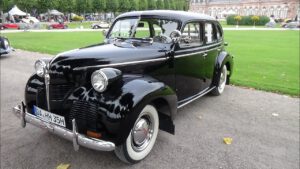
This car was filmed in Ludwigsburg. “Retro Classics meets Barock” 2016 offered a refined interpretation of classic car display, set against the grand courtyard of the Royal Palace. Limited to vehicles built between 1886 and 1968, the Concours d’Élégance emphasized authenticity, craftsmanship, and historical relevance. The baroque backdrop, enhanced by evening illuminations and artistic performances, elevated the presentation into a cultural experience. Highlights such as the rare Facel Vega gathering underscored the exclusivity of the event. Rather than sheer quantity, the focus lay on careful selection and elegant staging—demonstrating how preservation can merge seamlessly with heritage and atmosphere.
Conclusion
The 1954 Peugeot 203 C represents a mature and carefully refined iteration of Peugeot’s first post-war success. Its overhead-valve engine, monocoque construction, and practical drivetrain reflect a focus on reliability and efficiency. The design balances early post-war simplicity with emerging modern forms, while its historical role underscores its importance in Peugeot’s recovery and growth. Rather than relying on dramatic innovation, the Peugeot 203 C demonstrates how incremental development can produce a durable and enduring automobile.