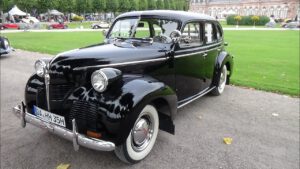
1929 Peugeot 201 – Retro Classics Stuttgart 2019
At the end of the 1920s, Peugeot introduced a model that would quietly redefine its product strategy and naming system. The Peugeot 201, launched during a period of economic uncertainty, combined affordability with technical modernization in a way that proved highly effective. The 1929 version represents the beginning of this shift, marking the introduction of a car that would influence Peugeot’s identity for decades.
Technical Details
The 1929 Peugeot 201 was powered by a front-mounted inline four-cylinder engine with a displacement of 1,122 cc. Early versions produced approximately 23 horsepower, which was sufficient for the vehicle’s relatively low weight and intended use as an economical family car. The engine used a conventional side-valve configuration, prioritizing simplicity and ease of maintenance over performance.
Power was transmitted to the rear wheels via a manual gearbox, typically with three forward speeds. The car followed a traditional front-engine, rear-wheel-drive layout, consistent with most vehicles of the period. The chassis was of ladder-frame construction, supporting a steel body and providing durability on varied road surfaces.
Suspension relied on rigid axles with semi-elliptic leaf springs at both the front and rear. Braking was mechanical, with drum brakes operated via cables or rods. Later developments within the Peugeot 201 range would introduce independent front suspension, but this innovation came after the initial versions. Overall, the technical concept focused on robustness, cost efficiency, and straightforward engineering.
- Manufacturer: Peugeot
- Model name: Peugeot 201
- Year of manufacturing: 1929
Design
The design of the Peugeot 201 reflects late-1920s automotive conventions, with a clear separation between structural and decorative elements. The body was upright and relatively narrow, with a distinct radiator grille at the front, often finished with vertical slats. Headlamps were mounted separately on either side, and the fenders were clearly defined and detached from the main body.
The car’s proportions emphasized practicality rather than visual integration. Running boards connected the front and rear fenders, while the cabin was positioned relatively high, offering good visibility. Body styles included saloon, coupé, and convertible variants, allowing the Peugeot 201 to appeal to a range of customers.
Inside, the layout was minimal and functional. Instrumentation was limited to essential gauges, and materials were chosen for durability. The overall design conveyed a sense of straightforward usability, aligning with the car’s role as an accessible entry into automobile ownership.
Historical Significance
The Peugeot 201 was introduced in 1929 and became the company’s first model to use the now-famous three-digit naming system with a zero in the middle. This naming convention would later become a defining feature of the brand and remains in use today.
The timing of its introduction coincided with the onset of the global economic crisis following the stock market crash of 1929. In this context, the Peugeot 201’s affordability and efficiency made it particularly relevant. Peugeot focused on producing a car that could be manufactured in large numbers while remaining accessible to a broader audience.
The model proved to be a commercial success, with production continuing throughout the early 1930s. It also served as a platform for technical development, with later versions introducing innovations such as independent front suspension, which was relatively advanced for its class at the time. The Peugeot 201 thus played a key role in stabilizing Peugeot during a challenging economic period.
Quirks and Pop Culture
One of the most enduring legacies of the Peugeot 201 is its naming structure. The use of three digits with a central zero became so closely associated with Peugeot that the company later protected this format legally, influencing how other manufacturers named their models.
The Peugeot 201 is also notable for its role as an early mass-produced Peugeot. It was not designed to be a luxury or performance car, but rather a practical vehicle for everyday use. This positioning contributed to its widespread adoption and visibility on European roads during the 1930s.
Although it does not feature prominently in film or popular media, the Peugeot 201 is often referenced in historical discussions as a symbol of accessible mobility during a period of economic hardship. Its understated presence reflects its purpose: to serve as a reliable means of transportation rather than a statement piece.
Display and preservation
The vehicle was exhibited at Retro Classics Stuttgart in 2019. Spread across nine exhibition halls as well as the outdoor and entrance areas, the 19th edition welcomed more than 90,000 visitors and presented around 4,000 vehicles. Unlike earlier years, the organizers did not focus on a central special exhibition, placing even greater emphasis on the market itself. Around 1,700 of the cars on display were offered for private or trade sale, underlining the event’s strong reputation as a meeting point not only for enthusiasts, but also for collectors and buyers.
Conclusion
The 1929 Peugeot 201 represents a foundational moment in the company’s history. With its simple yet effective engineering, practical design, and innovative naming convention, it established principles that would guide Peugeot for decades. Its success during a difficult economic period highlights the importance of affordability and reliability in automotive design. Today, the Peugeot 201 is best understood as a modest but influential model that helped shape both the brand’s identity and its long-term strategy.