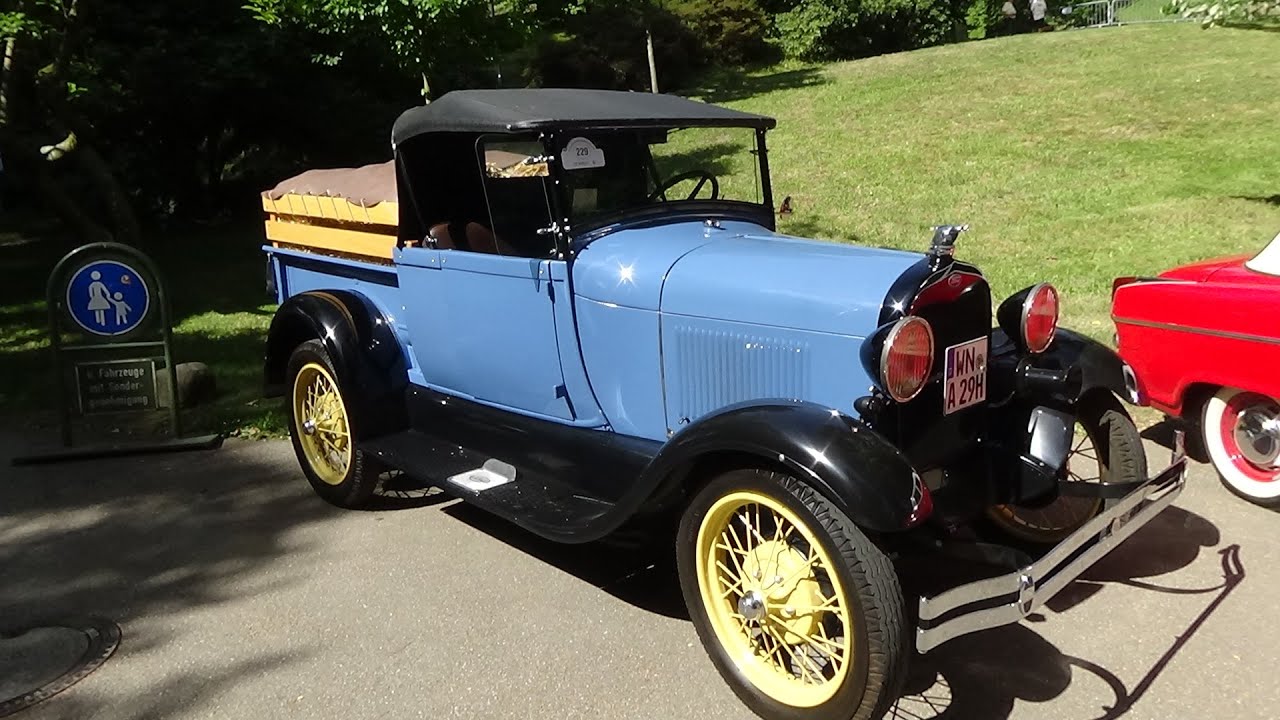
1928 Ford Model A Pickup – Exterior and Interior – Oldtimer-Meeting Baden-Baden 2022
The Ford Model A balanced practicality with a more refined appearance than earlier Ford vehicles. The pickup variant of 1928, such as the model displayed in the video, emphasized utility, yet it still carried the visual identity of the broader Model A family.
Technical Details:
The Ford Model A marked a clear technical step forward for Ford, and the 1928 pickup version shared the same mechanical foundation as the passenger cars. Under the hood sat a front-mounted inline four-cylinder engine with standing valves, displacing 3,285 cc (3.3 liters). Output was rated at 40 horsepower (around 30 kW), a meaningful increase over its predecessor and enough to push the vehicle to a top speed of around 100–104 km/h. Power was delivered to the rear wheels, following the classic front-engine, rear-wheel-drive layout.
Fuel was supplied by a simple Zenith updraft carburetor, a robust and easily serviceable solution suited to the era. Typical fuel consumption ranged between 12 and 19 liters per 100 kilometers, depending on load and driving conditions—an important consideration for a working pickup. The Ford Model A used a three-speed sliding-gear manual transmission with reverse, paired with a rear axle ratio of 3.77:1.
Chassis construction relied on steel body panels mounted to a frame with rigid beam axles front and rear, suspended by transverse leaf springs. Braking was handled by mechanically actuated drum brakes on all four wheels, a notable improvement over earlier Ford designs. Significantly, the Ford Model A was the first Ford to adopt a modern control layout, with separate accelerator, brake, and clutch pedals and a centrally mounted gear lever—features that would become industry standards.
- Manufacturer: Ford
- Model Name: Ford Model A Pickup
- Year of Manufacturing: 1928
Design:
From a design perspective, the Ford Model A balanced practicality with a more refined appearance than earlier Ford vehicles. The pickup variant of 1928, such as the model displayed in the video, emphasized utility, yet it still carried the visual identity of the broader Model A family. The body was constructed from steel sheet metal, giving it a sturdier and more contemporary feel compared to the wood-reinforced bodies of earlier years.
Ford offered the Model A in four standard body colors, though black was notably absent for the main body panels. For manufacturing efficiency, the fenders were always painted black, creating a visual contrast that became characteristic of the model. The 1928 and 1929 vehicles rode on 21-inch wheels, lending them a tall, upright stance that suited both passenger and commercial applications.
Inside, the cabin was functional and uncluttered. Controls were clearly laid out, reinforcing Ford’s move toward standardized ergonomics. Large windows provided good outward visibility, an advantage for a working pickup, while the overall form conveyed durability rather than ornamentation. Even so, the Ford Model A managed to feel approachable, reflecting a growing expectation that vehicles should be both useful and visually coherent.
Historical Significance:
The Ford Model A succeeded the Model T, often called the “Tin Lizzy,” which had dominated the automotive landscape for nearly two decades. By the mid-1920s, competition had intensified, and simply continuing the old formula was no longer viable. Ford halted Model T production in 1927 and spent nearly half a year retooling its factories before launching the Ford Model A.
The new model was more powerful, better equipped, and technically more advanced, signaling Ford’s response to a changing market. Although American mass-produced cars already featured larger engines than their European counterparts, the Ford Model A was still offered internationally. To avoid high import duties, vehicles for the German market were assembled in Berlin, a step that later led Ford to establish a full production facility in Cologne.
Production of the Ford Model A ended in 1931 after an impressive 4,320,446 units had been built. While its lifespan was far shorter than that of the Model T, its role was crucial: it modernized Ford’s lineup and helped the company remain competitive in a rapidly evolving automotive industry.
Quirks and Pop Culture:
When the Ford Model A was introduced, observers famously remarked, “Henry has turned the Lizzy into a Lady,” highlighting how much more refined the new car appeared compared to its predecessor. This phrase captured public sentiment and helped frame the Ford Model A as a symbol of progress rather than mere replacement.
The sheer variety of body styles—18 in total over its production run—also contributed to its cultural footprint. From elegant sedans to hardworking pickups like the 1928 example shown in the video, the Ford Model A became a familiar sight in cities, farms, and small businesses alike. Its adaptability made it part of everyday life, embedding it deeply in the visual memory of the late 1920s.
Display and preservation:
The vehicle was exhibited at the Oldtimer-Meeting Baden-Baden in 2022. Set in the elegant spa gardens of Baden-Baden, this open-air event is one of Germany’s most atmospheric classic car gatherings. The 2022 edition marked the 46th year of the meeting and featured over 350 carefully selected vintage vehicles from across Europe. With its picturesque backdrop and festive ambiance, the event draws thousands of visitors who stroll among historic automobiles, enjoy live music, and take in themed displays. In 2022, American classics and convertibles were especially well represented, reflecting the event’s continued celebration of both international and domestic automotive heritage.
Conclusion:
Combining a more powerful four-cylinder engine, standardized controls, and sturdy steel construction, the Ford Model A embodied Ford’s shift toward modern car design and engineering. Its design balanced function with restraint, while its historical role bridged the gap between the era of the Model T and a more competitive, technologically ambitious automotive market. As part of the wider Ford Model A family—and as a practical pickup—the 1928 version stands as a clear reflection of how Ford adapted to new demands while remaining focused on mass production and accessibility.