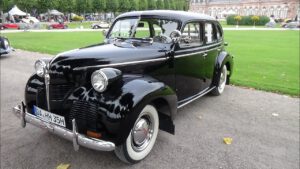
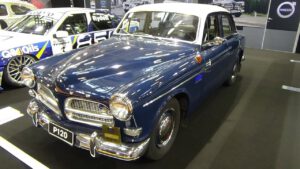
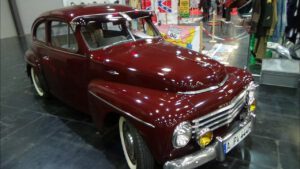
1938 -1939 Morris Eight Series II – Exterior and Interior – Oldtimer-Meeting Baden-Baden 2021
By the late 1930s, Britain’s small-car market had become intensely competitive, leaving little room for experimental thinking. The Morris Eight Series II was shaped by this environment: not as a reinvention, but as a careful update intended to keep a proven formula relevant. Introduced in 1938, it reflected how incremental engineering and design changes could sustain mass appeal in a mature segment.
Technical Details:
The Morris Eight Series II retained the familiar mechanical foundation of its predecessor but introduced refinements aimed at improved usability and comfort. Power came from a front-mounted inline four-cylinder side-valve petrol engine with a displacement of 918 cc. Output was approximately 23.5 bhp, delivered to the rear wheels through a three-speed manual gearbox with synchromesh on the upper ratios. The drivetrain followed a conventional front-engine, rear-wheel-drive layout.
The chassis used a separate steel frame with rigid axles front and rear, suspended by semi-elliptic leaf springs. Hydraulic drum brakes were fitted on all four wheels, a feature that remained noteworthy in the British small-car class. Electrical equipment operated on a 6-volt system. Performance figures were modest but adequate for contemporary traffic, with top speeds around 60 mph and fuel economy that made the Eight attractive to cost-conscious buyers. The Series II emphasized refinement and reliability rather than technical novelty.
- Manufacturer: Morris Motors
- Model Name: Morris Eight Series II
- Year of Manufacturing: 1938–1939
Design:
Visually, the Morris Eight Series II introduced subtle but important changes over the earlier Series I. The most noticeable update was the revised front end, featuring a more integrated and modern-looking grille that aligned with late-1930s styling trends. The body proportions remained compact and upright, with clearly defined fenders, running boards, and a separate luggage compartment.
Body styles included two- and four-door saloons as well as tourer variants, allowing the Eight to serve a wide range of everyday needs. The interior was functional but improved in detail quality, with clearer instrumentation and slightly enhanced seating comfort. Materials were selected for durability rather than decoration, reinforcing the car’s role as a dependable household vehicle. Overall, the Series II design conveyed quiet modernization without challenging customer expectations.
Historical Significance:
The Morris Eight Series II appeared during the final phase of civilian car development in Britain before the Second World War. By this time, the original Morris Eight had already established itself as one of the country’s best-selling small cars, helping Morris Motors regain market leadership in the mid-1930s. The Series II was intended to extend this success by keeping the model competitive against rivals such as the Austin Eight and Ford Model Y.
Production of the Series II was relatively short-lived. Introduced in 1938, it remained in production until 1939, when the onset of war redirected British industry toward military needs. As a result, the Series II represents the last pre-war evolution of the original Morris Eight concept. Its incremental updates illustrate how manufacturers prioritized continuity and reliability during a period of growing political and economic uncertainty.
Quirks and Pop Culture:
The Morris Eight Series II did not generate distinctive nicknames or cinematic fame, but it became deeply embedded in everyday British life. Its familiarity was one of its defining characteristics: the Eight was a car people recognized instantly, whether parked on a residential street or used for weekend travel.
A minor quirk often noted by enthusiasts is how subtle the differences between Series I and Series II can appear at first glance, despite the latter’s design and trim revisions. This understated evolution contributes to the Series II’s appeal among collectors today, who value it as a snapshot of late-1930s British motoring just before wartime disruption.
Display and preservation:
The vehicle was exhibited at the Oldtimer-Meeting Baden-Baden in 2021. This event, held annually in the spa town’s Kurpark and along the Kaiserallee, is one of Germany’s most picturesque classic car gatherings. In 2021, the 44th edition featured 300 vintage vehicles from 80 different brands, including rare models. The event embraced a 1970s theme, showcasing over 40 vehicles from that era. An innovative highlight was the “automobile fashion show,” where models presented current fashion trends while riding in open-top classic cars through the park. The event concluded with the traditional Concours d’élégance, awarding 120 prizes across 15 categories.
Conclusion:
The 1938–1939 Morris Eight Series II represents continuity rather than transformation. Mechanically conservative, visually updated, and carefully positioned within a crowded market, it fulfilled its purpose as an affordable and dependable small car. Its brief production run places it firmly in the final chapter of Britain’s pre-war civilian automotive industry. Today, the Series II stands as a reminder of how incremental engineering and design choices sustained everyday motoring on the eve of profound historical change.