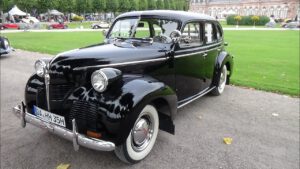
1930 DeSoto Six Series K – Exterior and Interior – Classic Expo Salzburg 2021
When Chrysler introduced the DeSoto brand at the end of the 1920s, it was intended to occupy a carefully defined middle ground in the American market. The 1930 DeSoto Six Series K illustrates this positioning clearly: a car engineered to offer six-cylinder smoothness, modern features, and solid construction at a price below Chrysler’s senior models. It was aimed at buyers moving up from basic transportation without entering the luxury segment.
Technical Details:
The DeSoto Six Series K was powered by a front-mounted inline six-cylinder petrol engine with a displacement of approximately 221 cubic inches (3.6 liters). This L-head engine produced around 55 horsepower, delivering smooth and flexible torque suitable for everyday driving and highway travel. Power was transmitted to the rear wheels through a three-speed manual gearbox, following the conventional front-engine, rear-wheel-drive layout.
The chassis was built around a sturdy ladder-frame construction. Suspension consisted of rigid axles front and rear, suspended by semi-elliptic leaf springs, prioritizing durability and predictable handling over ride softness. Braking was handled by four-wheel hydraulic drum brakes, a significant feature for the time and a key selling point within DeSoto’s market segment. The Series K emphasized mechanical robustness, ease of maintenance, and consistent performance rather than innovation for its own sake.
- Manufacturer: Chrysler Corporation
- Model Name: DeSoto Six Series K
- Year of Manufacturing: 1930
Design:
The design of the DeSoto Six Series K followed late-1920s American styling conventions, with upright proportions and a strong visual emphasis on solidity. The tall radiator grille and separate headlamps conveyed presence without ornament excess, while flowing fenders softened the overall form. The body sat relatively high on the chassis, reflecting contemporary expectations of ground clearance and road conditions.
DeSoto offered the Series K in several body styles, including two- and four-door sedans, coupes, and open variants. Interiors were spacious and functional, with generous seating and clear instrumentation. Materials emphasized durability and comfort rather than luxury embellishment. Chrome trim was applied selectively to highlight key elements such as the grille, headlamp housings, and bumpers, reinforcing the car’s image as a well-equipped but sensible purchase.
Historical Significance:
The DeSoto brand was launched in 1928 as part of Walter P. Chrysler’s strategy to create a tiered automotive empire. Positioned between Plymouth and Chrysler, DeSoto played a crucial role in expanding Chrysler Corporation’s reach during a period of intense competition. By 1930, the DeSoto Six Series K represented a mature expression of this strategy.
The Series K arrived just as the economic effects of the Great Depression began to reshape the American car market. Despite these challenges, DeSoto achieved strong early sales, aided by its combination of hydraulic brakes, six-cylinder power, and competitive pricing. The brand’s success in these years helped establish Chrysler Corporation as one of the dominant forces in the U.S. automotive industry. The Series K thus stands as an example of how thoughtful market positioning and engineering pragmatism could succeed even in uncertain times.
Quirks and Pop Culture:
The DeSoto Six Series K did not generate iconic nicknames or major cultural references, but it benefited from DeSoto’s reputation for reliability and value. One notable quirk is how advanced some of its features appeared relative to its conservative styling. Hydraulic brakes, in particular, set it apart from rivals still relying on mechanical systems.
Today, surviving Series K models are uncommon but appreciated by collectors who focus on early Chrysler Corporation vehicles. At classic car events, they are often recognized as understated representatives of early-Depression-era American motoring rather than as headline-grabbing showpieces.
Display and preservation:
The vehicle was exhibited at the Classic Expo Salzburg in 2021. As one of Austria’s premier classic car events, the show has established itself as a central meeting point for collectors, restorers, and enthusiasts from across Central Europe. The 2021 edition took place at Messezentrum Salzburg and featured more than 250 exhibitors, along with a strong turnout of over 20,000 visitors. Attendees could explore a broad range of offerings—from historical vehicles and motorcycles to automobilia, spare parts, and literature.
Conclusion:
The 1930 DeSoto Six Series K represents a carefully judged balance between affordability, performance, and modern engineering. With its smooth inline six-cylinder engine, hydraulic brakes, and solid construction, it delivered dependable motoring for buyers seeking to move beyond entry-level cars. Its design favored clarity and durability over excess, while its historical context places it at the beginning of DeSoto’s rise within Chrysler’s expanding brand structure. Today, the Series K stands as a clear illustration of how American manufacturers approached the middle market at the dawn of the 1930s.