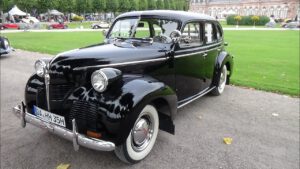
1936 BMW 326 Autenrieth – Exterior and Interior – Classic Expo Salzburg 2021
With the BMW 326, the brand entered the upper middle-class segment for the first time. The approach proved successful: by 1941, nearly 16,000 examples had been delivered, making it BMW’s most commercially successful model of the period.
Technical Details:
The BMW 326 marked a clear technical step forward for the brand and was positioned as a refined car for the upper middle class. Power came from a front-mounted inline six-cylinder engine that BMW had originally developed for the earlier BMW 319. In the 326, this engine was further refined and enlarged to a displacement of 1,971 cc. Equipped with two 26 mm Solex carburetors, it produced 50 horsepower at 3,750 rpm. Contemporary reports praised its smooth running and strong torque delivery, qualities that aligned well with BMW’s goal of emphasizing comfort over outright sportiness.
Power was transmitted to the rear wheels via a partially synchronized four-speed manual gearbox. The first two gears featured a freewheel function, reducing driveline shock and contributing to relaxed cruising. Depending on source and configuration, the BMW 326 reached top speeds between 115 and 120 km/h, a respectable figure for a four-door sedan and cabriolet in the mid-1930s. The streamlined body shape played a role in achieving this performance despite modest power output by later standards.
One of the most significant technical innovations was the braking system. For the first time in a BMW production car, a hydraulic braking system was used, replacing mechanical setups common in earlier models. The newly developed chassis also underlined BMW’s engineering ambitions. It featured hydraulic lever shock absorbers on both axles and a rear suspension with two longitudinal torsion bars, inspired by the Citroën Traction Avant. This configuration improved ride comfort and road holding, reinforcing the BMW 326’s positioning as a technically modern and comfortable touring car.
- Manufacturer: BMW
- Model Name: BMW 326
- Year of Manufacturing: 1936 (vehicle shown in the video; production period 1936–1941)
Design:
The design of the BMW 326 reflected a shift toward a more mature and representative appearance. The four-door sedan bodies were supplied by Ambi-Budd from its Berlin-Johannisthal pressing plant, while BMW manufactured fenders, running boards, hoods, and body panels in Eisenach. The overall shape was clean and flowing, with proportions that emphasized length and stability rather than compact sportiness.
In addition to the sedan, BMW offered the 326 as a two-door and four-door cabriolet, as well as a coupé. These open versions were built entirely by Autenrieth in Darmstadt, making the coachbuilder an important part of the model’s story. The vehicle shown in the video is a BMW 326 Autenrieth produced in 1936, a particularly rare configuration today. Autenrieth bodies are now known to survive only in very small numbers.
Interior design followed the same philosophy as the exterior: functional, comfortable, and well-finished for its class. In 1939, BMW updated the appearance of its entire model range, including the 326. The distinctive split bumpers at the front and rear were replaced by single-piece bumpers, subtly modernizing the car’s look without altering its fundamental character.
Autenrieth was founded in 1918 by Georg Autenrieth in Weinsberg, Germany. As early as 1922, the young entrepreneur relocated his small company to Darmstadt. There, Autenrieth became a preferred coachbuilder for BMW: more than 1,000 two- and four-door cabriolets of the pre-war BMW 326 were produced in Darmstadt. These vehicles were listed by BMW as official models, priced at 6,650 Reichsmarks for the two-door version and 7,300 Reichsmarks for the four-door version. Autenrieth even offered a BMW 326 with sliding doors—an unusual feature for the time.
Historical Significance:
When BMW presented the 326 at the Berlin Motor Show in February 1936, it marked a strategic turning point for the company. Until then, BMW had been perceived mainly as a manufacturer of high-quality, sporty small cars. With the BMW 326, the brand entered the upper middle-class segment for the first time. It was also BMW’s first model offered with four doors, signaling a deliberate move toward comfort, space, and equipment rather than pure driving performance.
As a complete new development, the BMW 326 was more grown-up and representative than any previous BMW. The concept proved successful: by 1941, nearly 16,000 examples had been delivered, making it BMW’s most commercially successful model of the period. The six-cylinder engine used in the 326 would go on to have a long life, remaining in production in various forms well into the 1950s.
Production ended in 1941 after 15,936 units due to the war. After 1945, Eisenach fell within the Soviet occupation zone. From the remains of the heavily damaged factory, a small number of vehicles were completed for the military authorities. The BMW 326 later experienced an unusual revival: initially built again under its original name, it was produced from 1949 to 1955 as the EMW 340, illustrating the lasting relevance of its basic design.
Quirks and Pop Culture:
The BMW 326 achieved a notable commercial success despite its high price. The four-door cabriolet was the most expensive variant at 7,300 Reichsmark, followed by the two-door cabriolet at 6,050 Reichsmark and the sedan at 5,500 Reichsmark, or 5,810 Reichsmark with a sliding roof. Even so, the model became BMW’s top seller, outperforming all other BMW models combined during those years.
Production numbers highlight its variety: 10,142 sedans were built, alongside 4,060 two-door cabriolets and just 1,093 four-door cabriolets. Autenrieth even offered a BMW 326 with sliding doors, an unusual feature that added to the model’s distinctive reputation. The combination of technical modernity, body style diversity, and strong sales helped cement the BMW 326’s place in the brand’s pre-war history.
Display and preservation:
The vehicle was exhibited at the Classic Expo Salzburg in 2021. As one of Austria’s premier classic car events, the show has established itself as a central meeting point for collectors, restorers, and enthusiasts from across Central Europe. The 2021 edition took place at Messezentrum Salzburg and featured more than 250 exhibitors, along with a strong turnout of over 20,000 visitors. Attendees could explore a broad range of offerings—from historical vehicles and motorcycles to automobilia, spare parts, and literature.
Conclusion:
The BMW 326 stands as a defining model in BMW’s evolution before the Second World War. Technically advanced with hydraulic brakes, a modern suspension layout, and a smooth inline six-cylinder engine, it marked a shift toward comfort and refinement. Its design, particularly in rare Autenrieth-bodied versions like the 1936 BMW 326 Autenrieth shown in the video, underlines the importance of coachbuilders in this era. Historically, the BMW 326 reshaped BMW’s market position and laid the groundwork for future models, while its post-war continuation as the EMW 340 confirms the durability and relevance of its original concept.